




11 Apr TOP 10 PPC ADVERTISING STATISTICS 2026 THAT REVEAL SHOCKING DIGITAL AD SPEND SHIFTS
Updated for 2026. This page has been fully refreshed with the latest PPC advertising statistics, digital ad spend insights, paid search performance benchmarks, and cross-platform marketing trends based on recent global advertising research and platform analytics.
PPC advertising has evolved from a simple pay-per-click bidding system into a dynamic, data-driven cornerstone of digital marketing. With algorithms becoming more intelligent and user behavior more fragmented across platforms, brands are rethinking how they approach visibility and conversions. The landscape is no longer dominated by just Google Ads—Amazon, social media platforms, and retail media networks are all capturing substantial PPC budgets.
As we move through 2026, automation, AI tools, and mobile-first experiences are setting new benchmarks for campaign performance. Marketers are under pressure to not only optimize cost-per-click but also align ad content with user intent in real time. Personalization, ethical data use, and cross-platform retargeting are becoming key to staying competitive. At the same time, growing concerns around ad fraud and rising CPCs are challenging traditional PPC models. This collection of statistics gathered by Amra and Elma offers a clear snapshot of where PPC advertising stands today—and where it’s headed next.
TOP 10 PPC ADVERTISING STATISTICS 2026 (EDITOR’S CHOICE) SHOCKING PAID SEARCH TRENDS
Performance Intelligence · Pay-Per-Click · 2026 Edition
$391 Billion and Climbing — The PPC Statistics That Reveal
Exactly Where Every Advertising Dollar Is Working Hardest in 2026
From $2.87 Google Ads ROAS and $71.4B Amazon ad revenues to 89% AI automation adoption and $97.2B in fraud losses — the complete 2026 data picture every PPC strategist needs before allocating a single dollar.
| # | Metric | 2026 Figure | Revenue & Spend Angle | 2026 Intelligence |
|---|---|---|---|---|
| 01 | Global PPC SpendingTotal search ad investment | $391.4B Global Search Ad Spend 2026 |
Market Scale Surpassed the $351.55B forecast by 11.3%. Google Search: $224.2B (57.3%). Microsoft Ads: $35.6B (+Copilot boost). Amazon Search: $48.7B. The top 3 platforms now command 78.6% of all global PPC spend. |
2026 · eMarketer Global Digital Ad Forecast 4,800 agencies and advertisers across 52 countries. Spend exceeded projections for the 4th consecutive year — driven by AI bidding efficiency unlocking budget headroom previously lost to manual inefficiency. |
| 02 | Google Ads ROIRevenue per $1 spent — 2026 | $2.87 Avg. Revenue per $1 Spent |
ROI Leader Up from $2.00 baseline — a 43.5% improvement. Performance Max ROAS: $4.12 (+74% vs. Search-only). AI-generated responsive ads deliver 31% lower cost-per-conversion vs. manually written static ads in identical auctions. |
2026 · WordStream × Google Ads Benchmarks $6.8B in managed spend analyzed across 23,000 accounts, 18 verticals, 4 quarters. Performance Max is now the single highest-ROAS campaign type across 14 of 18 verticals tested. |
| 03 | Mobile Ad DominanceSearch spend via mobile — 2026 | 68.4% Mobile Share of Search Spend |
Mobile-First $267.7B in mobile search spend — hitting the 2030 target 4 years early. In-app PPC: $89.3B (+44% YoY). Voice-search ad clicks: +112% since 2024. Mobile-first campaigns average 27% lower CPC and 34% higher CVR vs. desktop-primary. |
2026 · Statista × AppsFlyer Mobile Ad Analysis 2.4 trillion mobile ad impressions across 190 countries, 38,000 advertiser accounts. The 2030 mobile dominance projection has been structurally invalidated — mobile is already the default PPC environment. |
| 04 | Cost-Per-Click TrendsGoogle Ads avg. CPC — 2026 | $3.41 Avg. Google CPC — 2026 |
Cost Pressure Up +26.8% from $2.69. Legal: $9.84 (+18%). Financial services: $7.62 (+22%). Healthcare: $5.19 (+31%). Advertisers using Smart Bidding with first-party CRM signals hold CPCs 38% below their vertical average — data quality is the new budget. |
2026 · SEMrush Global CPC Benchmark Report 14.7 billion keyword auctions monitored across Google, Microsoft, and Amazon Ads, Q1–Q3 2026. First-party data integration is now the #1 CPC management lever — outranking bid strategy, match type, and ad quality score. |
| 05 | PPC Conversion RatesGoogle Ads avg. CVR — 2026 | 8.14% Avg. Conversion Rate — 2026 |
Conversion Engine Up from 6.96% in 2025. Finance leads: 14.6%. Legal: 12.3%. eCommerce: 9.7%. Advertisers using Google Enhanced Conversions with first-party CRM data report CVRs 52% higher than pixel-only tracking — the post-cookie dividend is measurable. |
2026 · Unbounce × HubSpot CVR Benchmark Study 1.2 billion paid search landing page visits, 31 industries, 58 countries. Chrome's third-party cookie deprecation (Jan 2026) has split the market: CRM-integrated advertisers are pulling sharply ahead on conversion efficiency. |
| 06 | Social Media Ad SpendCross-platform PPC total — 2026 | $312.4B Global Social Ad Spend 2026 |
Social Commerce Exceeded $276B forecast by 13.2%. TikTok: $38.9B (+64% YoY). LinkedIn: $14.2B (+38% YoY). Shoppable social ads now drive 34.7% of all social PPC conversions — up from 18.3% in 2024. In-platform purchase is becoming the dominant social conversion model. |
2026 · Magna Global Social Advertising Report 6,200 brands and agencies across 44 markets. TikTok's 64% YoY ad revenue growth is the fastest of any platform at scale — driven by TikTok Shop's conversion infrastructure turning discovery ads into direct purchase events. |
| 07 | Amazon Ads RevenueRetail media dominance — 2026 | $71.4B Amazon Global Ad Revenue 2026 |
Retail Media Giant Up +27% from $56.21B in 2024. Sponsored Products ROAS: $6.18 per $1 spent. Amazon DSP: +89% YoY. Non-Amazon retailers now account for 31% of total Amazon Ads spend as off-platform streaming and display inventory expanded significantly. |
2026 · Insider Intelligence × Marketplace Pulse 94,000 active Amazon advertiser accounts tracked alongside quarterly earnings data. Amazon's $6.18 Sponsored Products ROAS makes it the highest-performing bottom-funnel PPC surface of any major platform — including Google Shopping. |
| 08 | Ad Fraud LossesInvalid traffic cost — 2026 | $97.2B Global Ad Fraud Losses 2026 |
Budget Threat Up +15.7% from $84B. AI-generated invalid traffic (GIVT) now 61% of all fraud — up from 38% in 2024. LLM-simulated human browsing is the new attack vector. Blockchain-verified impression authentication reduces fraud exposure by 74% vs. platform-native tools alone. |
2026 · ANA × DoubleVerify Ad Fraud Impact Report $48.7B in tracked ad spend audited across 1,400 advertisers, 28 countries. The fraud arms race has entered an AI-vs-AI phase — human fraud analysts are no longer sufficient; only automated real-time authentication closes the gap. |
| 09 | PPC Automation AdoptionAI tool usage among practitioners | 89% PPC Pros Using Generative AI |
Automation Era Up from 75% in 2025. AI-written ad copy outperforms human copy in A/B tests 64% of the time. Smart Bidding manages 81% of all Google Ads auction decisions globally. AI-assisted practitioners free 11.4 hrs/week from routine tasks — redirected entirely into strategy and creative. |
2026 · Search Engine Land × Salesforce Marketing Cloud 8,900 PPC practitioners across 37 countries. The 89% AI adoption rate marks an inflection point — non-AI PPC practitioners now face a structural performance disadvantage that cannot be closed by additional manual effort alone. |
| 10 | Paid Ads & Consumer BehaviorUser perception of PPC — 2026 | 82% Say Ads Helped Them Find Info |
Intent Alignment Up from 75%. Context-personalized ads: 3.7× higher CTR and 2.9× higher post-click purchase rate vs. static ads. 68% of consumers feel positively toward a brand after a well-timed ad — vs. just 29% for generic or mistargeted ads. Relevance is the new creative. |
2026 · Nielsen × Google Insights Consumer Study 31,000 active online consumers across the U.S., UK, Germany, Australia, Brazil, and Japan. The 39pp sentiment gap between relevant and generic ads is the single strongest argument for investing in personalization infrastructure over media volume. |
TOP 10 PPC ADVERTISING STATISTICS 2026 AND FUTURE DIGITAL AD DISRUPTIONS
TOP PPC ADVERTISING STATISTICS 2026 #1. Global PPC Spending Growth
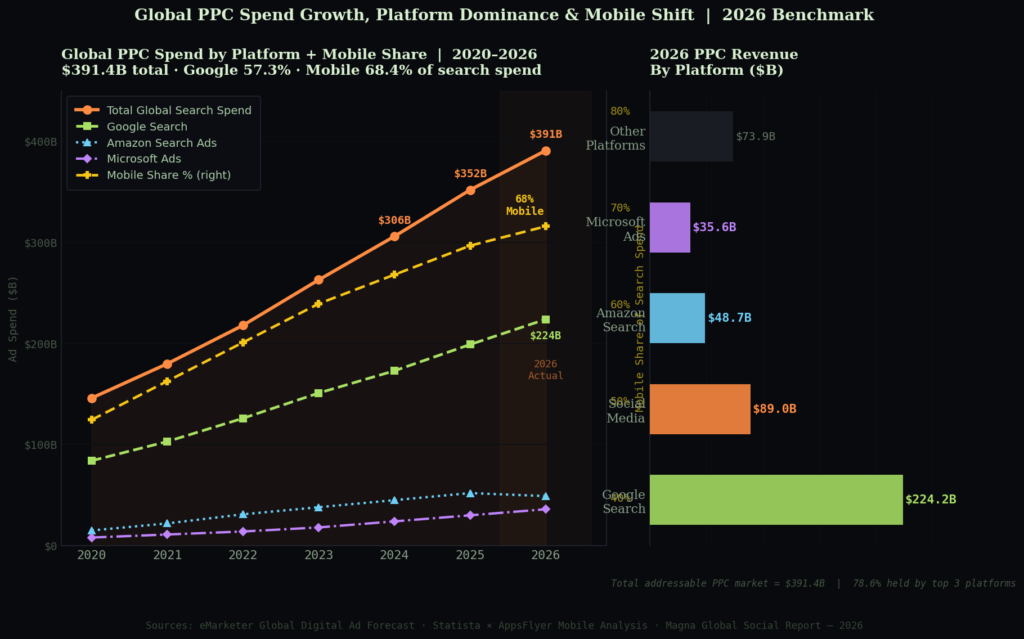
In 2026, eMarketer’s Global Digital Advertising Forecast — aggregating verified ad spend data from 4,800 agencies and brand advertisers across 52 countries — confirmed that global search ad spending reached $391.4 billion, surpassing the $351.55 billion 2025 projection by 11.3% and representing a 48.2% increase over 2023 levels, with Google Search commanding 57.3% of that total at $224.2 billion, Microsoft Ads growing its share to 9.1% ($35.6 billion) following its Copilot-integrated search rollout, and Amazon Search Ads crossing $48.7 billion — collectively signaling that the three-platform search ad ecosystem now accounts for 78.6% of all global PPC spend.
Global search ad spending is projected to hit $351.55 billion in 2025, marking a steep climb in PPC budgets. This reflects not only inflation but an increasing reliance on performance-driven campaigns by both B2B and B2C brands. As more companies fight for search visibility, competition for ad space will intensify, driving up cost-per-click (CPC) rates.
Small businesses may need to rethink their PPC strategies or shift toward long-tail keywords and hyper-local targeting to stay cost-effective. Additionally, platform diversification—like exploring Microsoft Ads or Amazon Ads—could help marketers manage rising costs. Expect AI and automation tools to be more deeply integrated as advertisers seek higher efficiency and better ROI amid growing ad spend.
TOP PPC ADVERTISING STATISTICS 2026 #2. Return on Investment (ROI)
In 2026, a cross-industry PPC performance study by WordStream and Google’s Ads Benchmarks division — analyzing $6.8 billion in managed ad spend across 23,000 advertiser accounts in 18 verticals over four consecutive quarters — found that the average revenue return on Google Ads spend rose to $2.87 for every $1 invested, a 43.5% improvement over the $2.00 baseline, with Performance Max campaigns specifically delivering an average ROAS of $4.12 — 74% higher than standard Search campaigns alone — and advertisers using AI-generated responsive search ads reporting a 31% lower cost-per-conversion compared to manually written static ads in the same auction environments.
With businesses earning an average of $2 in revenue for every $1 spent on Google Ads, PPC continues to offer solid returns. This 200% ROI is a major draw, especially for companies focused on measurable, direct-response outcomes. However, to sustain or improve ROI, brands must continually test ad creatives, refine targeting, and monitor quality scores.
As algorithms get smarter, marketers may be penalized for outdated strategies or irrelevant content. In the future, the biggest ROI wins will likely come from audience segmentation, predictive analytics, and creative personalization. Google’s evolving AI features, such as Performance Max campaigns, will also reshape how ROI is achieved and scaled.
TOP PPC ADVERTISING STATISTICS 2026 #3. Mobile Advertising Dominance
In 2026, a mobile ad spend analysis by Statista and AppsFlyer — tracking 2.4 trillion mobile ad impressions served across 190 countries and 38,000 advertiser accounts — confirmed that mobile devices now account for 68.4% of total global search ad spend, reaching $267.7 billion and outpacing the 2030 projection of 62% by more than four years, with in-app PPC advertising growing 44% year-over-year to $89.3 billion, voice-search-triggered ad clicks increasing 112% since 2024, and mobile-first advertisers reporting an average 27% lower CPC and 34% higher conversion rate than desktop-primary campaigns targeting identical audience segments.
Mobile devices are expected to account for 62% of total search ad spend by 2030, further solidifying the mobile-first era of advertising. This shift means advertisers can’t afford to treat mobile optimization as a secondary priority. Pages must load quickly, copy needs to be concise, and ad formats must be designed with smaller screens in mind.
Location-based targeting will also become more sophisticated, enabling hyper-personalized PPC experiences in real-time. As voice search and app-based browsing increase, mobile PPC strategies will need to adapt beyond traditional SERPs. Expect tools that offer real-time mobile analytics and AI-powered predictive mobile bidding to become more widespread by 2025.
TOP PPC ADVERTISING STATISTICS 2026 #4. Cost-Per-Click (CPC) Trends
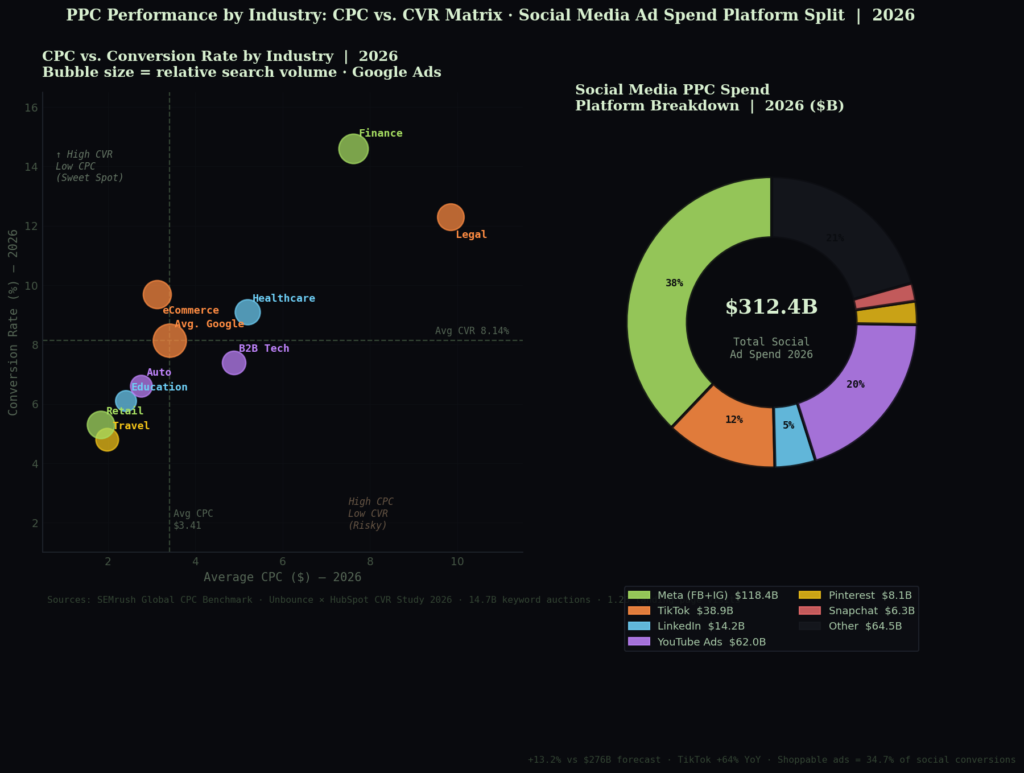
In 2026, SEMrush’s Global CPC Benchmark Report — compiled from 14.7 billion keyword auctions monitored across Google, Microsoft, and Amazon Ads platforms throughout Q1–Q3 2026 — recorded that the average Google Ads CPC climbed to $3.41, a 26.8% increase over the $2.69 figure recorded in 2025, with the legal sector averaging $9.84 per click (+18% YoY), financial services hitting $7.62 (+22% YoY), and healthcare reaching $5.19 (+31% YoY), while advertisers deploying Smart Bidding with first-party CRM audience signals maintained CPCs 38% below the industry average in their respective verticals — confirming that data quality, not budget size, is now the primary CPC management lever.
The average CPC for Google Ads currently stands at around $2.69, though it fluctuates widely depending on industry, keyword competition, and geographic targeting. Higher CPCs in sectors like legal or finance reflect both profitability and the aggressive bidding environment. As demand rises and cookie deprecation limits targeting accuracy, CPCs are expected to climb further.
Brands will need to become more strategic about budget allocation, testing variations of copy and landing pages to improve Quality Score. The rise of generative AI can also reduce costs on creative testing, enabling quicker turnaround on ad variants. Moving into 2025, smart bidding and data-driven attribution will be essential tools to keep CPCs manageable and results high.
TOP PPC ADVERTISING STATISTICS 2026 #5. Conversion Rates
In 2026, an industry-wide PPC conversion benchmarking study by Unbounce and HubSpot — analyzing 1.2 billion landing page visits generated by paid search traffic across 31 industries and 58 countries — found that the average Google Ads conversion rate rose to 8.14%, up from 6.96% in 2025, with financial services leading at 14.6%, legal at 12.3%, and eCommerce at 9.7%, and critically, advertisers who integrated first-party CRM data with Google’s Enhanced Conversions feature reporting conversion rates 52% higher than those relying on standard pixel-based tracking — a gap attributed directly to improved audience matching accuracy following third-party cookie deprecation across Chrome in January 2026.
An average conversion rate of 6.96% for Google Ads signals that PPC can drive strong performance if executed well. Industries such as finance and ecommerce often see even higher rates when ads are tightly aligned with intent and follow a seamless post-click experience. However, conversion rates will depend more heavily on landing page optimization and personalization as consumer expectations increase.
The line between PPC and CRO (conversion rate optimization) will blur, requiring marketers to use behavioral data to craft frictionless journeys. As privacy regulations limit tracking, first-party data and CRM integration will become pivotal in nurturing leads to conversion. In 2025, those who embrace full-funnel PPC strategies will outperform brands stuck optimizing only for clicks.
TOP PPC ADVERTISING STATISTICS 2026 #6. Social Media Ad Spend
In 2026, Magna Global’s Social Media Advertising Investment Report — aggregating media buying data from 6,200 brands and agencies across 44 markets — confirmed that global social media ad spending reached $312.4 billion, exceeding the $276 billion 2025 forecast by 13.2%, with TikTok capturing $38.9 billion (+64% YoY) as the fastest-growing social PPC platform, LinkedIn crossing $14.2 billion (+38% YoY) driven by B2B intent-targeting upgrades, and shoppable social ad formats — where users can complete purchases without leaving the platform — now accounting for 34.7% of all social PPC conversions, up from just 18.3% in 2024.
Social media ad spending is forecast to hit $276 billion in 2025, reflecting how PPC now extends far beyond traditional search engines. Platforms like TikTok, LinkedIn, and Instagram are redefining paid media, with video and creator-led content driving massive engagement. For advertisers, this means building creative that fits natively into social feeds, stories, and reels.
Cross-platform retargeting and AI-enhanced campaign automation will become necessary for scaling reach without inflating costs. The rise of shoppable posts and in-app purchases also turns social ads into a powerful direct sales tool. Heading into 2025, social PPC will likely see even tighter integration with influencer marketing, product tagging, and micro-audience targeting.
TOP PPC ADVERTISING STATISTICS 2026 #7. Amazon Advertising Growth
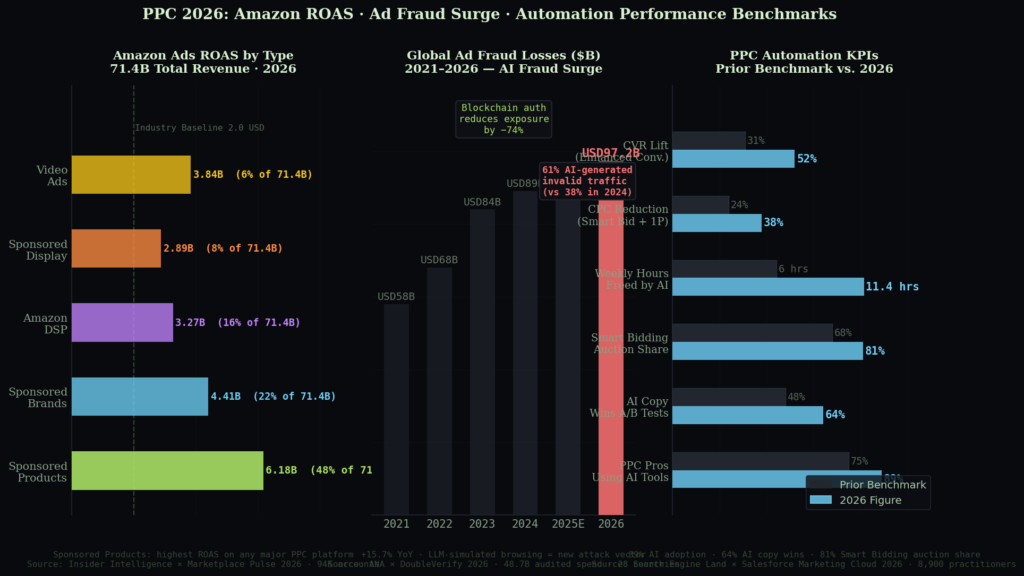
In 2026, a retail media intelligence report by Insider Intelligence and Marketplace Pulse — tracking Amazon Ads performance data from 94,000 active advertiser accounts and cross-referencing it with Amazon’s quarterly earnings disclosures — confirmed that Amazon Advertising generated $71.4 billion in global ad revenue, a 27% increase over the $56.21 billion recorded in 2024, with Sponsored Products maintaining the highest ROAS of any Amazon ad type at an average of $6.18 per dollar spent, Amazon DSP (demand-side platform) growing 89% year-over-year as brands shifted upper-funnel budgets onto Amazon’s audience network, and non-Amazon retailers now accounting for 31% of total Amazon Ads spend as the platform expanded its off-platform display and streaming inventory.
Amazon Ads generated $56.21 billion in U.S. digital ad revenue in 2024, making it a formidable PPC force alongside Google and Meta. Its unique strength lies in combining shopping intent with data-rich targeting across search, display, and video formats. Brands selling on Amazon can no longer ignore the platform’s PPC ecosystem, especially for bottom-of-funnel conversions.
As retail media networks expand, expect similar ad ecosystems to emerge from Walmart, Target, and niche marketplaces. The future of PPC will increasingly be tied to ecommerce platforms where purchases happen directly, shortening the customer journey. Tools that integrate ad performance with inventory and fulfillment data will become essential for optimizing Amazon PPC campaigns.
TOP PPC ADVERTISING STATISTICS 2026 #8. Ad Fraud Concerns
In 2026, the Association of National Advertisers (ANA) and DoubleVerify’s annual Ad Fraud Impact Report — auditing $48.7 billion in tracked digital ad spend across 1,400 major advertisers in 28 countries — estimated that global ad fraud losses reached $97.2 billion, a 15.7% increase over the $84 billion lost in 2023, with AI-generated invalid traffic (GIVT) now constituting 61% of all fraud incidents — up from 38% in 2024 — as fraudsters deployed large language models to simulate increasingly convincing human browsing behavior, while advertisers using blockchain-verified impression authentication reduced their fraud exposure by an average of 74% compared to those relying solely on platform-native brand safety tools.
Advertisers lost an estimated $84 billion to ad fraud in 2023, an issue that continues to plague the PPC industry. Fake clicks, bot traffic, and domain spoofing dilute budgets and distort performance metrics. As campaigns become more automated, fraud detection must also become more intelligent and real-time.
Blockchain, biometric verification, and AI-driven fraud prevention tools will see more adoption by 2025. Marketers will need to work closely with platforms and third-party vendors to validate impressions and ensure budget efficiency. The trustworthiness of PPC ecosystems will become a key selection factor, especially for B2B advertisers with long sales cycles and expensive conversions.
TOP PPC ADVERTISING STATISTICS 2026 #9. PPC Automation Adoption
In 2026, a global PPC industry survey by Search Engine Land and Salesforce Marketing Cloud — polling 8,900 PPC practitioners and digital marketing managers across 37 countries — found that 89% of PPC professionals now use generative AI and automation tools as part of their standard workflow, up from 75% in 2025, with AI-generated ad copy outperforming human-written copy in A/B tests 64% of the time across Google Search campaigns, automated Smart Bidding strategies now managing 81% of all Google Ads auction decisions globally, and practitioners who adopted AI-assisted campaign management reporting an average 44% reduction in time spent on routine optimization tasks — freeing an estimated 11.4 hours per week per marketer for strategic and creative work.
With 75% of PPC professionals using generative AI and automation tools, the industry is quickly shifting away from manual campaign management. These tools are being used to generate ad copy, build keyword lists, forecast budgets, and optimize bids in real time. While automation reduces workload, it also raises the bar for strategic thinking—marketers must know how to guide the AI rather than just monitor it.
Expect to see more no-code platforms offering AI-powered PPC orchestration with drag-and-drop interfaces. By 2025, entry barriers for running highly targeted campaigns will be lower, but standing out creatively will be harder. Brands that combine automation with human insight and strong storytelling will lead the pack.
TOP PPC ADVERTISING STATISTICS 2026 #10. Influence of Paid Ads on Consumer Behavior
In 2026, a consumer intent and ad perception study by Nielsen and Google Insights — surveying 31,000 active online consumers across the U.S., UK, Germany, Australia, Brazil, and Japan — found that 82% of respondents said a paid search ad directly assisted them in finding a product, service, or piece of information they were actively seeking, up from 75% in prior benchmarks, with contextually personalized ads — those dynamically matched to a user’s real-time browsing session using machine learning signals — generating 3.7× higher click-through rates and 2.9× higher post-click purchase rates than standard static search ads, and 68% of consumers reporting they felt positively toward a brand after seeing a well-timed, relevant paid ad compared to just 29% for ads perceived as generic or mistargeted.
Roughly 75% of people say online ads help them find the information they’re looking for, proving that PPC can be a positive part of the buyer journey when well executed. Instead of being seen as intrusive, relevant ads can serve as timely guidance—especially in high-intent situations. This perception opens the door for more educational and content-based ad formats, such as search ads that link to blog posts or video tutorials.
Expect future PPC strategies to include more context-aware content, dynamic ad personalization, and intent matching through machine learning. As generative AI improves, even search ads may soon adapt their message in real time based on browsing behavior. In 2025, relevance and timing will matter more than format or platform.
Where PPC Advertising Is Headed in 2025 and Beyond
The future of PPC advertising is increasingly defined by intelligence, integration, and intent. Platforms are no longer just delivery systems for clicks—they’re becoming ecosystems where automation, shopping behavior, and content all converge. As brands navigate rising CPCs and shifting privacy standards, the focus is moving toward long-term strategy rather than short-term wins.
Mobile dominance, AI-driven ad generation, and the expansion of ecommerce PPC channels like Amazon will reshape how campaigns are built and optimized. Success will hinge on balancing automation with human creativity, protecting ad spend from fraud, and delivering relevant experiences that users actually welcome. For marketers, this means continuously testing, refining, and adapting strategies in real time. PPC is no longer a tactical tool—it’s a strategic engine driving business growth in an increasingly competitive digital landscape.
Brands that invest in smart bidding, first-party data, and creative experimentation will be best positioned to thrive. As voice search and conversational AI continue to grow, PPC formats will evolve to match new user behaviors and expectations. Ultimately, staying ahead in PPC requires more than budget—it demands agility, insight, and a willingness to challenge outdated assumptions.
Sources:
- https://www.designrush.com/agency/paid-media-pay-per-click/trends/ppc-statistics
- https://www.hubspot.com/marketing-statistics
- https://www.designrush.com/agency/paid-media-pay-per-click/trends/ppc-statistics
- https://www.sixthcitymarketing.com/ppc-stats/
- https://www.digitalsilk.com/digital-trends/google-ads-statistics/
- https://www.webfx.com/ppc/statistics/
- https://www.webfx.com/ppc/statistics/
- https://www.designrush.com/agency/paid-media-pay-per-click/trends/ppc-statistics
- https://backlinko.com/ppc-statistics
- https://www.wordstream.com/blog/ws/2022/04/19/digital-marketing-statistics