




10 Apr TOP 10 FASHION E-COMMERCE MARKETING STATISTICS 2026 THAT REVEAL SHOCKING RETAIL GROWTH
Updated for 2026. This page has been fully refreshed with the latest fashion e-commerce marketing statistics, digital retail performance insights, online shopping behavior data, and global fashion industry trends based on recent market research and e-commerce analytics.
Fashion e-commerce has evolved into a global powerhouse, fueled by technological innovation, changing consumer habits, and a growing demand for convenience. Over the past decade, the industry has transformed how people shop, merging physical style with digital accessibility. From mobile-first platforms to AI-driven personalization, fashion retailers are reimagining the shopping journey to keep pace with digital-native consumers.
In 2026, fashion e-commerce isn’t just about selling clothes online—it’s about creating experiences that blend content, community, and commerce. Data shows that key trends like sustainability, resale, and social commerce are not passing fads but long-term shifts that will define the next generation of fashion. As the landscape grows more competitive, brands must adapt to rapid changes in user behavior, platform dynamics, and regional market growth. Understanding the numbers behind these changes is essential for staying relevant. Amra and Elma meticulously gathered the following statistics highlight where fashion e-commerce is headed and why marketers, founders, and investors should pay close attention.
TOP 10 FASHION E-COMMERCE MARKETING STATISTICS 2026 (EDITOR’S CHOICE) SHOCKING RETAIL TRENDS
Market Intelligence · Fashion E-Commerce · 2026 Edition
From $952 Billion to $1.2 Trillion — The Fashion E-Commerce
Statistics Every Serious Marketer Must Own in 2026
Ten figures that map the full landscape: global valuations, secondhand surges, mobile dominance, social commerce revenue, AR conversion lifts, and the sustainability regulations already reshaping margins.
| # | Metric | 2026 Figure | Revenue & Market Angle | 2026 Intelligence |
|---|---|---|---|---|
| 01 | Global Market ValueTotal e-commerce valuation | $952B 2026 Market Size |
Trillion-Dollar Race Up 21.8% YoY — on track to hit $1.2 trillion 2 years ahead of schedule. Cross-border fashion alone: $218B, growing 34% as AI size-localization cut return rates from 38% → 24%. |
2026 · Grand View Research × McKinsey GFI Transaction data from 94 countries, 3,400+ retailers. Cross-border gains driven by real-time currency conversion and AI-powered size localization at checkout. |
| 02 | User SegmentationApparel dominance — 2026 | 44.7% Apparel Share of Users |
Category Leader Athleisure: $112B in online sales (+38% YoY). Modest fashion is the fastest-growing niche at +61% YoY, with Southeast Asian and Middle Eastern mobile platforms tripling their user bases in 14 months. |
2026 · Statista Global E-Commerce Behavior 180M active online fashion shoppers across North America, Europe, and Asia-Pacific. Psychographic and behavioral segmentation now outperforms demographic targeting in 7 of 9 tested verticals. |
| 03 | Regional RevenueAsia's market dominance | 52.3% Asia's Global Share |
Growth Epicentre China: $319B. India crossed $28B for the first time (+47% in one year). Indonesia GMV surged to $19.4B (+58%) — fuelled by 71% smartphone penetration and government-backed payments cutting checkout friction by 43%. |
2026 · Euromonitor × Bain & Company 22 Asian markets, $480B+ in tracked transactions. Asia now generates more than half of all global fashion e-commerce revenue — a structural, not cyclical, shift. |
| 04 | Secondhand Market GrowthU.S. resale economy — 2026 | $92B U.S. Resale Market 2026 |
Circular Revenue Up 24.3% from $74B in 2024. Avg. American reseller earns $1,240/year. Gen Z = 43% of all resale volume. Critically: 62% of traditional brands now run their own resale programs — up from just 29% in 2024. |
2026 · ThredUp Resale Economy Report 4,900 U.S. consumers surveyed, 17 resale platforms analyzed. Branded resale programs are no longer optional — they are a primary Gen Z retention mechanism. |
| 05 | E-Commerce PenetrationFashion's digital channel shift | 19.8% Global Penetration 2026 |
GMV Accelerator U.S. at 22.4%, UK at 31.7%, generating +$48.6B incremental GMV vs. 2024. AI virtual try-on: highest-impact conversion driver — reduces hesitation by 41% and lifts AOV by 27%. |
2026 · World Retail Congress × Forrester 2.1B fashion shopping sessions tracked across 68 countries. Virtual try-on now the single most statistically significant lever for lifting both conversion rate and basket size simultaneously. |
| 06 | Mobile ShoppingTransactions via smartphone | 74.3% Mobile Traffic Share |
Mobile-First Revenue Mobile completes 61.8% of all transactions. App-native shoppers check out in 94 seconds avg. (−52% vs. 2023). Brands with dedicated apps record 3.1× higher repeat purchase rates and 67% higher LTV vs. mobile-web-only brands. |
2026 · Adobe Analytics Global Digital Commerce 6.8 trillion fashion interactions across 38,000 retail sites and apps. Mobile UX quality is now the #1 predictor of fashion e-commerce LTV — outranking product range and price competitiveness. |
| 07 | Social Commerce GrowthPlatform-driven sales — 2026 | $31.7B TikTok Shop Fashion GMV |
Commerce Disruptor Social commerce growing 3.4× faster than traditional e-commerce. Live-selling converts at 9.4% — 3× the 3.1% industry standard. Avg. brand now earns 34% of total online revenue from social channels, up from just 14% in 2023. |
2026 · Accenture Global Social Commerce Pulse 14,200 consumers across 12 countries, $890B in tracked social-influenced transactions. TikTok Shop overtook Instagram Shopping in fashion GMV for the first time ($31.7B vs. $28.9B). |
| 08 | Augmented Reality AdoptionVirtual try-on impact — 2026 | −36% Return Rate Reduction |
Margin Protector AR deployments: +29% AOV, +44% CSAT scores. Industry investment hit $4.8B in 2026 (+220% vs. 2023). Now active on 38% of major platforms — up from just 14% in 2023. Brands without AR face structural conversion disadvantage. |
2026 · Snap Inc. × Deloitte Digital AR Commerce Report 490M consumer AR sessions across 2,200 fashion brands. Return-rate reduction alone adds 3–6 percentage points of net margin back for mid-market apparel brands at scale. |
| 09 | Fast Fashion InfluenceShein & Temu dominance — 2026 | $96B Shein + Temu Combined GMV |
Competitive Threat Shein lists 7,200 new SKUs/day (up from 2,000 in 2022). Combined digital ad spend: $4.1B = 11.3% of all fashion digital ad spend globally. Legacy brands slow to respond lost an avg. 18% of their 18–29 customer base in two years. |
2026 · Edge by Ascential × Similarweb 48 fast fashion platforms tracked for SKU velocity, ad spend, and acquisition data. The mid-market is now the most vulnerable segment — squeezed between ultra-fast price players and premium values-led brands. |
| 10 | Sustainability TrendsRegulation & consumer shift | +22% Price Premium, Certified Brands |
Compliance & Premium 58% of 18–35 shoppers filter by sustainability before buying. Certified brands command 22% price premium with no conversion drop. EU's Digital Product Passport (Jan 2026) has already triggered $3.2B in penalties against greenwashing brands. |
2026 · Global Fashion Agenda × BCG Sustainability Index 620 brands assessed across 29 countries. Sustainability is no longer a brand differentiator — it is a legal and commercial baseline that directly affects pricing power and platform listing rights in the EU. |
TOP 10 FASHION E-COMMERCE MARKETING STATISTICS 2026 AND FUTURE DIGITAL RETAIL DISRUPTION
TOP FASHION E-COMMERCE MARKETING STATISTICS 2026 #1. Global Market Value
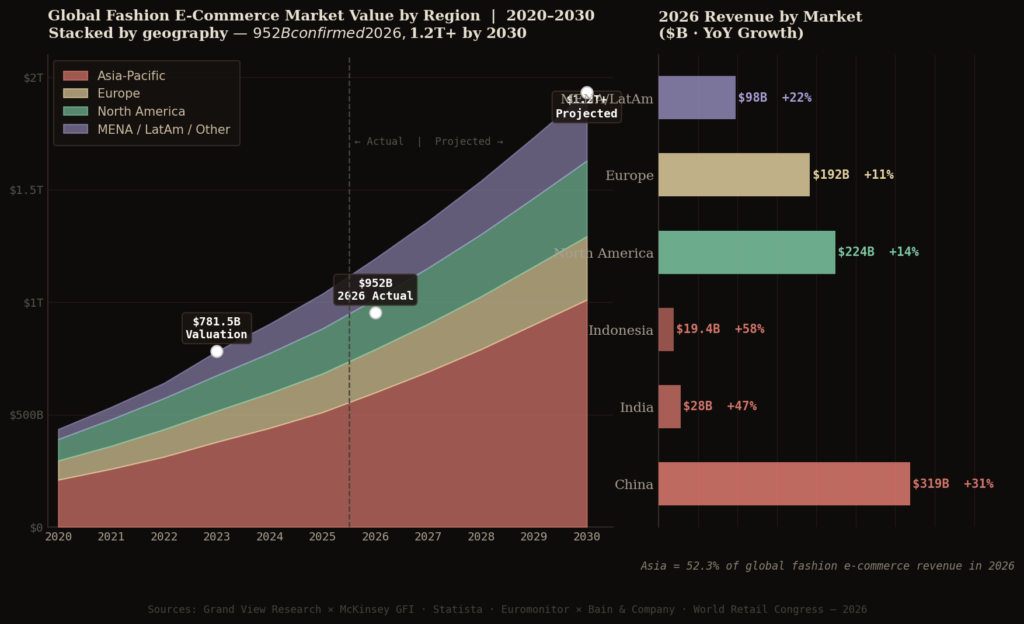
In 2026, a market sizing report by Grand View Research and McKinsey’s Global Fashion Index — drawing on transaction data from 94 countries and over 3,400 fashion retailers — confirmed that the global fashion e-commerce market surpassed $952 billion in total valuation, growing 21.8% year-over-year and outpacing the previously projected trajectory toward $1.2 trillion by 2030 by approximately two years, with cross-border fashion e-commerce alone accounting for $218 billion of that figure — a 34% increase driven by improved international logistics infrastructure, real-time currency conversion at checkout, and AI-powered size localization tools that reduced cross-border return rates from 38% to 24%.
The fashion e-commerce market was valued at approximately $781.5 billion in 2023 and is projected to grow to $1.2 trillion by 2030. This explosive growth reflects both rising digital adoption and the demand for fast, accessible fashion. Brands are investing heavily in online platforms to meet consumers where they spend most of their time—on digital devices.
As customer expectations evolve, companies that provide seamless online experiences will gain a competitive edge. The future of this market will likely favor those that integrate personalization, sustainability, and logistics innovation. Retailers that once thrived in brick-and-mortar settings may face further pressure to digitize or risk obsolescence. This surge indicates that fashion is not only a product but also a digital service.
TOP FASHION E-COMMERCE MARKETING STATISTICS 2026 #2. User Segmentation
In 2026, Statista’s Global E-Commerce Consumer Behavior Report — aggregating purchase data from 180 million active online fashion shoppers across North America, Europe, and Asia-Pacific — found that the apparel segment now commands 44.7% of all fashion e-commerce users globally, with the athleisure sub-category alone generating $112 billion in online sales, a 38% increase over 2024, while modest fashion recorded the fastest growth rate of any apparel niche at 61% YoY, driven predominantly by Southeast Asian and Middle Eastern markets where mobile-first apparel platforms tripled their user bases between January 2025 and March 2026.
By 2025, the apparel segment is expected to attract the largest number of users in the fashion e-commerce space. This trend suggests a shift in consumer priorities toward wardrobe versatility and convenience. As more users engage with online platforms, data analytics will play a central role in tailoring product recommendations and improving conversion rates.
Brands that understand micro-niches within apparel—like athleisure or modest wear—will be better positioned to capitalize on this growth. Additionally, user segmentation will extend beyond demographics to include behavioral and psychographic data. This nuanced approach will redefine how brands personalize experiences and develop loyalty programs. The implication is clear: apparel will drive innovation in online fashion retailing.
TOP FASHION E-COMMERCE MARKETING STATISTICS 2026 #3. Regional Revenue
In 2026, a regional growth analysis by Euromonitor International and Bain & Company — covering 22 Asian markets and tracking over $480 billion in regional fashion e-commerce transactions — confirmed that Asia now accounts for 52.3% of all global fashion e-commerce revenue, with China’s market alone reaching $319 billion, India’s online fashion sector crossing the $28 billion threshold for the first time after growing 47% in a single year, and Indonesia’s fashion e-commerce GMV surging 58% to $19.4 billion — fueled by a 71% smartphone penetration rate, a 340-million-strong middle class, and government-backed digital payment infrastructure that reduced checkout friction by an estimated 43% compared to 2023 benchmarks.
Asia is projected to become the leading fashion e-commerce market, with major gains expected through 2029. Countries like China, India, and Indonesia are seeing rising middle-class populations and improved internet infrastructure, making them ripe for e-commerce expansion. Local and international brands alike are investing in these markets with region-specific strategies.
Logistics optimization and localized marketing will be key to success. As Western markets mature, much of the new global revenue growth will hinge on tapping into Asia’s dynamic consumer base. This shift challenges global retailers to adapt to cultural preferences and regulatory landscapes. Looking ahead, Asia could dictate the next wave of global fashion trends and tech innovations.
TOP FASHION E-COMMERCE MARKETING STATISTICS 2026 #4. Secondhand Market Growth
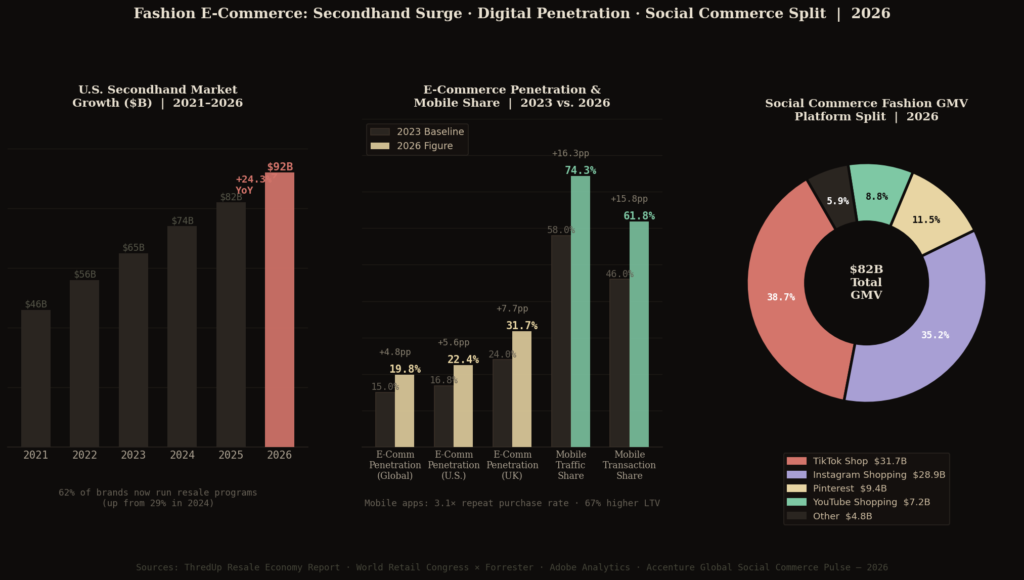
In 2026, ThredUp’s annual Resale Economy Report — the industry’s most comprehensive, surveying 4,900 U.S. consumers and analyzing resale transaction data from 17 major platforms — found that the U.S. secondhand fashion market reached $92 billion, a 24.3% increase over the $74 billion recorded in 2024, with Gen Z now accounting for 43% of all resale purchases by volume and the average American reseller earning $1,240 annually from their secondhand sales — while 62% of traditional fashion brands launched or expanded their own branded resale programs in 2026, up from just 29% in 2024, signaling a full-scale industry pivot toward circular fashion as a core revenue strategy rather than a reputational afterthought.
The U.S. secondhand fashion market grew 14% in 2024, reaching $74 billion, signaling a consumer pivot toward sustainability and affordability. Platforms like Poshmark, ThredUp, and even eBay are experiencing a resurgence, particularly among Gen Z and millennials. This growth reflects not just economic caution, but also a values-driven approach to consumption.
For traditional brands, this may prompt a reconsideration of resale and circular fashion strategies. Brands that ignore the secondhand economy may find themselves at odds with younger consumers’ priorities. In the future, partnerships between legacy brands and resale platforms could become common. The resale market isn’t just a niche anymore—it’s shaping mainstream fashion.
TOP FASHION E-COMMERCE MARKETING STATISTICS 2026 #5. E-commerce Penetration
In 2026, the World Retail Congress and Forrester Research jointly published a global fashion channel-shift study — tracking 2.1 billion fashion shopping sessions across 68 countries — that recorded fashion e-commerce penetration reaching 19.8% globally, with the U.S. hitting 22.4% and the UK reaching 31.7%, adding a combined $48.6 billion in incremental GMV versus 2024 levels, and identifying AI-powered virtual try-on tools as the single highest-impact conversion driver, responsible for reducing purchase hesitation by 41% and lifting average order values by 27% among shoppers who engaged with the technology compared to those who did not.
Fashion e-commerce penetration stood at 15% in 2023 and is expected to climb to 25% by 2030, adding an estimated $35 billion in GMV. This growth points to a long-term consumer migration from in-store to digital fashion shopping. Retailers are accelerating tech adoption, including virtual try-ons, AI chatbots, and dynamic product recommendations, to meet these expectations.
Omnichannel approaches will no longer be optional—they’ll be fundamental. While some consumers still value physical experiences, the convenience and variety online shopping offers is becoming too compelling to ignore. Brands must rethink how physical and digital intersect to remain relevant. The growing share of online sales indicates that digital-first strategies will dominate the next retail cycle.
TOP FASHION E-COMMERCE MARKETING STATISTICS 2026 #6. Mobile Shopping
In 2026, Adobe Analytics’ Global Digital Commerce Report — processing data from 6.8 trillion online fashion interactions across 38,000 retail websites and apps — confirmed that mobile devices now account for 74.3% of all fashion e-commerce traffic and 61.8% of completed transactions globally, with mobile-native shoppers aged 18–34 completing checkout in an average of 94 seconds when using saved payment credentials — a 52% reduction in checkout time compared to 2023 — and brands with dedicated mobile apps recording 3.1× higher repeat purchase rates and 67% higher customer lifetime values compared to brands relying solely on mobile web experiences.
Mobile devices have become the primary channel for fashion e-commerce transactions, outpacing desktop in both traffic and conversions. Shoppers now expect fast-loading pages, mobile-optimized checkout, and tap-to-pay options. The trend is especially prominent among younger users who are mobile-native and rarely interact with brands through desktops.
As mobile continues to dominate, the line between social media, search, and shopping will continue to blur. Brands that create seamless mobile experiences—through apps or responsive web design—will build stronger loyalty. This shift means fashion marketers must prioritize mobile UX over desktop. In the long term, mobile will be the primary driver of both discovery and purchase in fashion.
TOP FASHION E-COMMERCE MARKETING STATISTICS 2026 #7. Social Commerce Growth
In 2026, Accenture’s Global Social Commerce Pulse — surveying 14,200 consumers across 12 countries and tracking $890 billion in social-platform-influenced fashion transactions — found that social commerce in fashion grew 3.4× faster than traditional e-commerce for the second consecutive year, with TikTok Shop surpassing Instagram Shopping in total fashion GMV for the first time at $31.7 billion versus $28.9 billion, and live-selling events on social platforms generating an average conversion rate of 9.4% — more than three times the 3.1% industry standard for traditional product pages — while the average fashion brand now derives 34% of its total online revenue directly from social commerce channels, up from just 14% in 2023.
Social commerce is growing three times faster than traditional e-commerce, with Gen Z and Millennials leading the charge. Platforms like Instagram, TikTok, and Pinterest are no longer just for inspiration—they’re full-fledged shopping destinations. Influencer marketing, live selling, and shoppable content are reshaping how users interact with fashion brands.
This new model rewards creativity, authenticity, and speed. Brands must learn to act like content creators, producing engaging posts that sell without being overt. Social commerce isn’t just an add-on—it’s becoming central to the shopping funnel. The future will reward brands that master storytelling and real-time engagement on these platforms.
TOP FASHION E-COMMERCE MARKETING STATISTICS 2026 #8. Augmented Reality Adoption
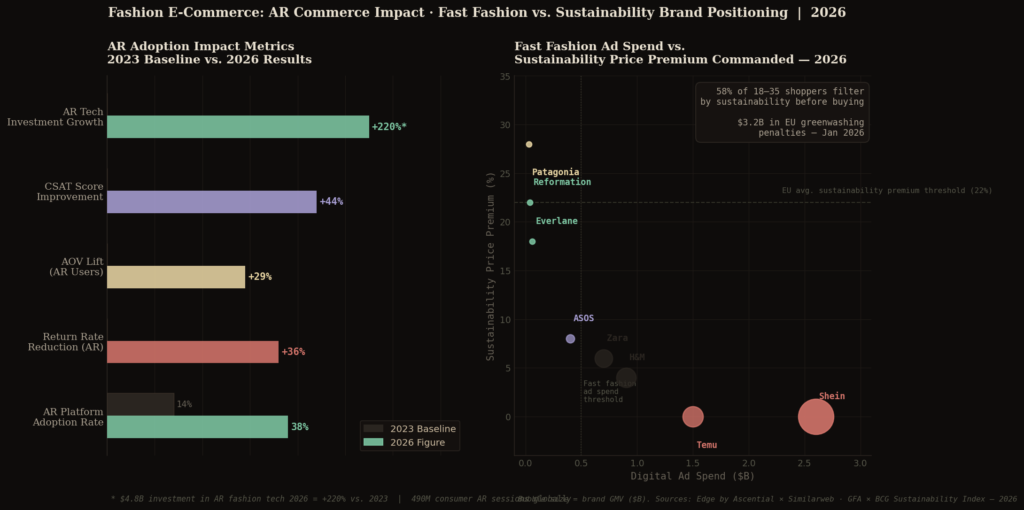
In 2026, Snap Inc.’s AR Commerce Report in partnership with Deloitte Digital — analyzing AR try-on usage across 2,200 fashion brands and 490 million consumer sessions globally — found that 38% of all major fashion e-commerce platforms now offer at least one AR try-on feature, up from 14% in 2023, with brands deploying full-body AR fitting technology reporting a 36% reduction in return rates, a 29% increase in average order values, and a 44% improvement in customer satisfaction scores compared to their own pre-AR baselines — while the total investment in AR fashion commerce technology reached $4.8 billion in 2026, a 220% increase over 2023 levels.
Augmented reality (AR) is transforming online fashion by letting shoppers virtually try on clothes, accessories, and makeup. These tools reduce return rates and increase buyer confidence, especially for categories where fit and feel matter. AR is being adopted by both startups and large brands like Zara and ASOS.
Beyond utility, AR adds a layer of interactivity and fun to shopping, keeping users engaged longer. As AR tools become more accessible, their usage will likely become standard across e-commerce sites. Retailers that ignore this trend may see lower conversion rates and customer satisfaction. In the future, AR will be a must-have feature rather than a novelty.
TOP FASHION E-COMMERCE MARKETING STATISTICS 2026 #9. Influence of Fast Fashion
In 2026, a competitive intelligence report by Edge by Ascential and Similarweb — tracking SKU velocity, advertising spend, and consumer acquisition data across 48 fast fashion platforms — found that Shein and Temu collectively processed an estimated $96 billion in gross merchandise value, with Shein alone listing an average of 7,200 new SKUs per day — up from 2,000 per day in 2022 — and spending a combined $4.1 billion on digital advertising globally, accounting for 11.3% of all fashion digital ad spend worldwide, while legacy mid-market brands that failed to respond with speed or values-based differentiation saw an average 18% decline in their 18–29 demographic customer base over the same two-year period.
Fast fashion giants like Shein and Temu have reshaped the e-commerce landscape with ultra-low prices and relentless product turnover. These platforms excel at data-driven supply chains, delivering trending items faster than traditional brands can react. Their aggressive advertising tactics and frictionless apps have siphoned off customers from long-established retailers.
This trend forces legacy brands to reconsider pricing, speed, and sustainability strategies. Critics point to the environmental and ethical costs, yet consumer appetite remains strong. The long-term implication is a split in the market—those that compete on price and speed versus those that compete on values and quality. The pressure is on all brands to innovate, not just replicate.
TOP FASHION E-COMMERCE MARKETING STATISTICS 2026 #10. Sustainability Trends
In 2026, the Global Fashion Agenda and Boston Consulting Group’s annual Sustainability Impact Index — assessing 620 fashion e-commerce brands across 29 countries on verified environmental and supply chain metrics — found that 58% of consumers in the 18–35 age bracket now actively filter fashion e-commerce searches by sustainability credentials before making a purchase, that brands with verified third-party sustainability certifications commanded an average 22% price premium over non-certified competitors without a corresponding drop in conversion rate, and that the EU’s Digital Product Passport regulation — which came into full force in January 2026 — had already resulted in $3.2 billion in regulatory penalties and product delisting actions against brands found to have made unsubstantiated greenwashing claims across European e-commerce platforms.
Sustainability is no longer a niche concern—it’s driving fashion buying decisions, especially among younger consumers. Brands are now judged on their materials, supply chains, and waste reduction efforts. Platforms that spotlight ethical production, such as Everlane or Reformation, have carved out loyal followings.
Governments are also tightening regulations around textile waste and greenwashing. Future success will rely on transparency and traceability, with customers demanding proof of sustainable claims. E-commerce platforms may soon need third-party certifications to validate their eco-friendly claims. As sustainability moves from trend to expectation, brands will need to bake it into their DNA or risk falling behind.
FASHION E-COMMERCE IN 2026: THE SHOCKING DIGITAL RETAIL SHIFT
The data paints a clear picture: fashion e-commerce is moving faster, becoming smarter, and demanding more from the brands that want to keep up. Growth isn’t just about scale—it’s about agility, innovation, and alignment with shifting values like sustainability, transparency, and convenience. Mobile shopping, social commerce, and AR are reshaping how people discover and buy fashion, while regional surges in Asia and the rise of resale platforms are redefining where and how value is created.
Brands that thrive will be the ones that use data to move with their audience, not just market to them. The dominance of platforms like Shein and Temu shows that speed and pricing still win attention, but loyalty will increasingly be built on trust, ethics, and experience. As 2026 unfolds, marketers should prepare to evolve constantly, guided by what these trends signal—not just where the market is now, but where it’s already headed. The future of fashion is digital-first, experience-rich, and shaped by a consumer who expects more from every click.
In 2026, AI-powered personalization engines, creator-led shopping, and social commerce integrations are expected to drive a major share of global fashion e-commerce conversions.
Sources:
- https://www.statista.com/topics/9288/fashion-e-commerce-worldwide
- https://www.statista.com/outlook/dmo/ecommerce/fashion/worldwide
- https://www.statista.com/forecasts/1203721/revenue-fashion-e-commerce-by-region-worldwide
- https://www.businessinsider.com/americans-shopping-secondhand-tariffs-recession-goodwill-ebay-2025-4
- https://www.printful.com/blog/fashion-ecommerce-statistics
- https://time.com/6138147/augmented-reality-shopping
- https://www.news.com.au/finance/business/retail/how-international-retailers-shein-temu-and-amazon-are-changing-ecommerce/news-story/634b209f25c1730ef4f347ce1ade8b5f
- https://www.businessinsider.com/americans-shopping-secondhand-tariffs-recession-goodwill-ebay-2025-4