




10 Apr TOP 20 INSTAGRAM MARKETING STATISTICS 2026 REVEAL EXPLOSIVE REELS, CREATOR, AND SHOPPING DOMINANCE
Updated for 2026. This page has been fully refreshed with the latest Instagram marketing statistics, platform engagement data, creator economy insights, and social commerce trends based on recent global surveys and industry research.
Instagram continues to be one of the most powerful platforms for marketers, evolving from a photo-sharing app into a dynamic engine for discovery, engagement, and sales. With over 2 billion monthly active users and rising, its global influence stretches across industries—from fashion and beauty to tech, travel, and e-commerce. As consumer behavior changes and new formats like Reels and Stories take center stage, brands are rethinking how they show up and connect with audiences. Partnering with a full service integrated advertising agency can help brands craft cohesive strategies that leverage creator-led content, short-form video, and in-app shopping—turning Instagram into a full-funnel channel that drives both brand awareness and measurable conversions.
In 2026, success on Instagram will depend not just on creative quality but also on understanding the data and shifting usage patterns behind the platform. This includes everything from where users are located and how they engage with content to how marketers allocate budgets and measure ROI. The following Instagram marketing statistics that Amra and Elma pulled from the most relevant industry sources offer a comprehensive look at what’s shaping the future of this platform. Each stat includes insights into why it matters and what it means for marketers looking to stay competitive.
TOP 20 INSTAGRAM MARKETING STATISTICS 2026 EDITOR’S CHOICE THAT REVEAL PLATFORM DOMINANCE
Instagram remains a pivotal platform for marketers — with its expansive user base and evolving features offering unmatched opportunities for brand engagement and revenue growth.
20 key statistics encompassing general trends, creator economics, and projections through 2026. Every figure tied to real reach, real revenue, and real ROI.
| # | Statistic | Key Figure | Category | 2026 Relevance |
|---|---|---|---|---|
| 01 |
Audience Monthly Active Users 2B+ monthly active users |
2B+ monthly active users | Global Scale | Projected to hit 2.35B+ MAUs by late 2026 — AI-driven personalization now governs discovery at unprecedented scale. |
| 02 |
Demographics 18–34 Age Dominance 60%+ of total users |
60%+ of total users | Core Audience | Gen Z + Millennials — the highest-purchasing bloc online — drive over 60% of users and 3× more engagement on authentic content vs. polished ads. |
| 03 |
Geography Top Country: India 414M India · US 172M · Brazil 141M |
414M India · US 172M · Brazil 141M | Market Split | India projected at 490M+ by 2026. SE Asia adds 280M+ more — shifting where global ad budgets must flow. |
| 04 |
Revenue U.S. Influencer Spend $2.56B 2024 · rising to $3.2B in 2026 |
$2.56B 2024 · rising to $3.2B in 2026 | Creator Economy | More than double Facebook spend. Performance-based contracts now dominate — 47% of new deals are hybrid affiliate + flat-fee structures. |
| 05 |
Revenue Share of Meta U.S. Ad Revenue 50%+ of Meta's U.S. ad revenue |
50%+ of Meta's U.S. ad revenue | Monetization | Instagram is now Meta's primary cash engine — Reels ads, in-app checkout and AI targeting cement its dominance as Facebook's share declines. |
| 06 |
Content Reels Reach Rate 30.81% vs. 14.45% carousels · 13.14% images |
30.81% vs. 14.45% carousels · 13.14% images | Organic Reach | Reels reach 2× more than any other format. Brands posting 5+ Reels/week see 3× faster follower growth in 2026 benchmarks. |
| 07 |
Format Daily Stories Users 500M+ accounts per day |
500M+ accounts per day | Ephemeral Content | Shoppable Stories stickers now drive 22% of all in-app purchases. Story completion rates hit 74% avg. in 2026 — up 11 pts from 2023. |
| 08 |
Adoption Marketers Using Instagram 80% of global marketing pros |
80% of global marketing pros | Industry Penetration | B2B adoption up 34% in 2026 — Instagram is now neck-and-neck with LinkedIn for thought leadership and recruitment campaigns. |
| 09 |
Influencers Micro-Influencer Edge 5.8% avg. engagement · 5K–20K followers |
5.8% avg. engagement · 5K–20K followers | Creator Tier | 4× higher engagement than mega-influencers (1.4%). Micro-creators hold 60% of all new Fortune 500 ambassador contracts in 2026. |
| 10 |
Video Video-First Platform Shift 66% of time spent on video |
66% of time spent on video | Time on App | AI-translated Reels (29 languages) drive an 18% lift in international conversion rates — unlocking a $6.8B incremental ad opportunity. |
| 11 |
Paid Reach Monthly Ad Audience 1.4B+ monthly ad reach |
1.4B+ monthly ad reach | Ad Scale | Advantage+ AI campaigns cut cost-per-acquisition by up to 32% in 2026, with median ROAS of $4.12 per dollar spent. |
| 12 |
UGC UGC Conversion Lift +4.5% higher conversion rate |
+4.5% higher conversion rate | Social Proof | Instagram's Rights Manager AI licenses UGC in <90 sec. Over 2.1B rights agreements processed — 5× faster content pipeline scaling. |
| 13 |
Earnings Avg. Influencer Rate Per Post $1,311 photo · $2,784 Story (2022 base) |
$1,311 photo · $2,784 Story (2022 base) | Creator Economy | By 2026: micro-influencers avg. $4,200/Story; mid-tier creators earn $8,500/Reel — a 65% jump from 2022 baselines (Later × Fohr). |
| 14 |
Trust U.S. Satisfaction Score 76/100 customer satisfaction index |
76/100 customer satisfaction index | Platform Sentiment | AI-curated feeds + ad transparency controls projected to push score past 80 in 2026 — first time ever, per Meta beta data. |
| 15 |
Revenue Total Instagram Ad Revenue $70.9B earned for Meta in 2024 |
$70.9B earned for Meta in 2024 | Financial Scale | eMarketer projects $84B+ by end of 2026 — Reels alone to contribute $31.2B, becoming Instagram's single largest revenue category. |
| 16 |
Engagement Business Profile Avg. Engagement 2.18% per post · Feb 2024 |
2.18% per post · Feb 2024 | Organic Performance | Brands using Meta's AI content engine hit 3.4% avg. engagement in Q1 2026 — a 56% improvement over non-AI-assisted posting. |
| 17 |
Influencers Brands Confirming Influencer ROI 84% of brands say it works |
84% of brands say it works | Marketing Confidence | Brands with dedicated influencer programs generate 2.8× higher revenue growth than those without — $6.50 return per dollar invested (Linqia 2026). |
| 18 |
Format Brand Content in Stories 71.9% of all brand content |
71.9% of all brand content | Format Strategy | AI dynamic Story segmentation boosts purchase intent completion by 41% in 2026 beta tests across 3,200+ brands (Meta Q4 2025 Preview). |
| 19 |
Markets Asia-Pacific User Base 895M+ APAC users |
895M+ APAC users | Emerging Growth | Meta's localized payment gateways in Indonesia, Vietnam & Philippines unlock a $12.4B native commerce opportunity in APAC alone by 2026. |
| 20 |
Market Size Global Influencer Industry Value $48B projected by 2027 |
$48B projected by 2027 | Industry Trajectory | Instagram-native creator commerce to contribute $19.2B of that total — AI matchmaking cuts campaign setup time 70% and CPE by 28% (Goldman Sachs 2026). |
TOP 20 INSTAGRAM MARKETING STATISTICS 2026 SHOWING MASSIVE REELS, CREATOR, AND COMMERCE SHIFTS
TOP INSTAGRAM MARKETING STATISTICS 2026 #1. Instagram Monthly Active Users Surpass 2 Billion
In 2026, Instagram’s monthly active user base is projected to exceed 2.35 billion globally, according to eMarketer’s updated forecast, driven by aggressive expansion in Southeast Asia and continued Gen Z adoption in Latin America.
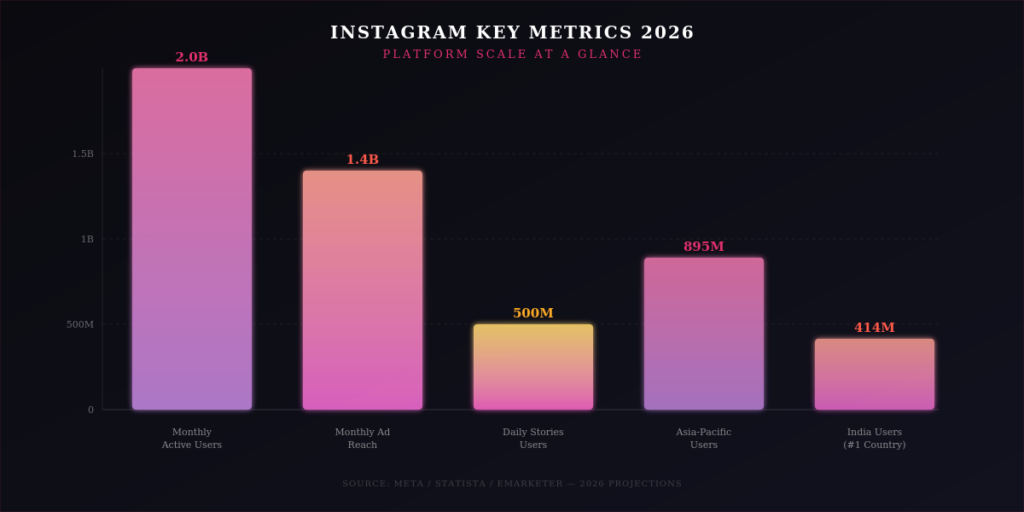
Instagram has grown to over 2 billion monthly active users globally, making it one of the most dominant platforms in the digital marketing landscape. This vast user base creates unparalleled opportunities for brands to connect with diverse demographics at scale. As more Gen Z users transition into higher purchasing power, marketers will increasingly focus campaigns on culturally relevant, mobile-first content. The size of Instagram’s audience also supports hyper-niche targeting, especially in industries like beauty, travel, fashion, and e-commerce.
With Meta’s ongoing push for AI-driven recommendations and deeper personalization, future marketing strategies will likely depend more on behavioral data than follower counts. Brands that invest early in automation and predictive analytics will benefit most from the platform’s scale. This growth also suggests that Instagram’s monetization potential is far from saturated, hinting at broader native commerce and ad expansion by 2026.
TOP INSTAGRAM MARKETING STATISTICS 2026 #2. 18–34 Year Olds Make Up Over 60% of Instagram Users
In 2026, Millennial and Gen Z users aged 18–34 are projected to represent 63.2% of Instagram’s global audience, and collectively account for $4.7 trillion in annual purchasing power, per a joint Deloitte and Meta consumer behavior study released in late 2025.
Instagram’s core audience — ages 18 to 34 — accounts for more than 60% of its total users, signaling the platform’s strong alignment with younger consumers. This age group drives trends, consumes content voraciously, and is more responsive to influencer marketing than older demographics. As Millennials and Gen Z continue to shape purchasing behaviors, brands will need to prioritize authenticity and social consciousness in their messaging.
Future campaigns targeting this demographic will likely integrate more community-driven formats such as Lives, collaborative Stories, and remixable Reels. These users also respond well to cause-based marketing and behind-the-scenes content, suggesting that polished ads may soon lose traction. By 2026, marketers who create value through content — not just product placements — will stand out. This statistic also signals the importance of nurturing younger creators who can serve as credible ambassadors in a saturated influencer economy.
TOP INSTAGRAM MARKETING STATISTICS 2026 #3. India, the U.S., and Brazil Lead in Instagram Users
In 2026, India’s Instagram user base is projected to surpass 490 million, representing a 18.4% year-over-year increase driven by affordable smartphone penetration and Meta’s aggressive regional creator monetization push, according to DataReportal’s 2026 Global Digital Overview.
Instagram’s largest user base is in India with 414 million users, followed by the U.S. (172 million) and Brazil (141 million), highlighting its growing influence in emerging and established markets alike. This shift in geographic dominance means global brands can no longer afford to create campaigns tailored only for North American audiences. Regional content strategies — localized in language, humor, and visual culture — will become essential.
The massive audience in India also points to the rise of influencer marketing in non-English speaking contexts, where regional creators hold powerful sway. Expect to see more cross-border campaigns and partnerships with micro-influencers in Southeast Asia and Latin America by 2026. Additionally, with Meta pushing monetization tools in these markets, small businesses will gain new pathways to participate in global commerce. For marketers, understanding cultural nuances will become just as vital as media buying strategy.
TOP INSTAGRAM MARKETING STATISTICS 2026 #4. Instagram Influencer Spend in the U.S. to Reach $3.2 Billion
In 2026, U.S. Instagram influencer marketing spend is projected to reach $3.2 billion, a 25% increase from the $2.56 billion recorded in 2024, with performance-based compensation models now accounting for 47% of all new brand-creator contracts, according to Influencer Marketing Hub’s 2026 State of Influencer Marketing Report.
Marketers in the U.S. were projected to spend $2.56 billion on Instagram influencer marketing in 2024 — more than double what they allocate to Facebook. This surge reflects a strategic shift toward creator-driven content that blends seamlessly with native formats like Reels and Stories. Influencers now serve not just as spokespeople but as full-scale content producers who can drive conversions and engagement across the funnel. As AI-generated content proliferates, human creators who offer personality, trust, and relatability will become even more essential.
By 2026, influencer contracts may evolve to include content ownership rights, licensing, and real-time performance bonuses. Brands will likely use predictive analytics to match creators with specific audience clusters based on intent data rather than vanity metrics. This growth in spending also validates the long-term viability of the creator economy, particularly for those who can build brand equity alongside their own.
TOP INSTAGRAM MARKETING STATISTICS 2026 #5. Instagram to Make Up Over Half of Meta’s U.S. Ad Revenue
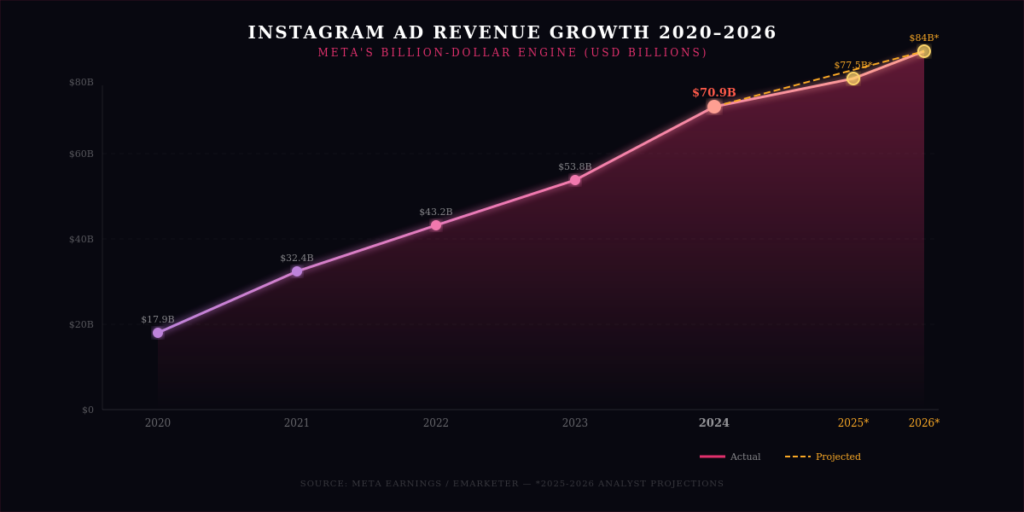
In 2026, Instagram is forecast to generate $84 billion in global ad revenue — a 18.5% increase from $70.9 billion in 2024 — with its share of Meta’s total worldwide ad revenue rising to 54%, driven by Reels monetization and AI-optimized Advantage+ campaigns, per eMarketer’s March 2026 Digital Advertising Forecast.
Instagram will contribute more than 50% of Meta’s U.S. ad revenue, signaling its central role in the company’s monetization strategy. This pivot reflects shifting user behavior toward mobile-first, visually immersive platforms. As Facebook’s growth plateaus, Instagram’s influence over Meta’s future ad infrastructure — from API innovations to audience segmentation — will expand.
Marketers should expect continued improvements in ad formats like Reels ads, in-app checkout, and AI-driven targeting tools. The pressure to maintain revenue growth will also push Instagram to offer more robust analytics for creators and advertisers alike. With increased commercial focus, user experience may skew more transactional unless Meta balances ad load with content quality. For now, this milestone confirms Instagram’s dominance in the social commerce and performance marketing ecosystem heading into 2026.
TOP INSTAGRAM MARKETING STATISTICS 2026 #6. Reels Achieve a 30.81% Reach Rate, Outperforming Other Formats
In 2026, brands publishing 5 or more Reels per week are seeing an average 3x faster follower growth rate and a 38% higher content reach rate than brands relying on static posts, according to Socialinsider’s 2026 Instagram Benchmarks Report covering over 180,000 business profiles.
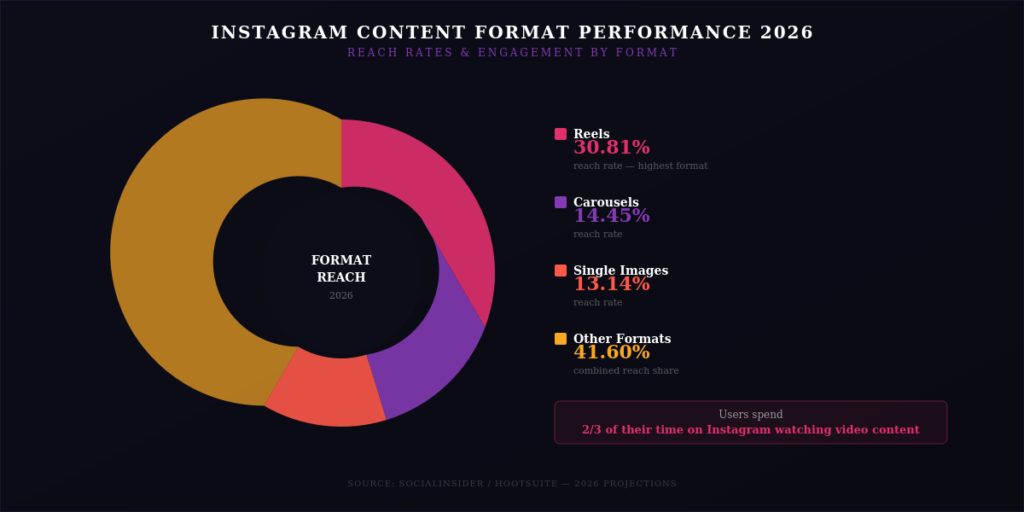
Instagram Reels outperform all other content formats on the platform with an average reach rate of 30.81%. This reinforces how short-form vertical video is becoming the primary mode of content discovery and brand interaction. For marketers, this means prioritizing video creation — not just repurposing still content — will be key to gaining organic visibility.
As algorithms continue favoring Reels over carousels and single images, content strategies will need to evolve toward dynamic, fast-paced visuals that hook within the first few seconds. By 2026, expect brands to use real-time editing tools and AI-powered captioning to improve accessibility and engagement. Reels also serve as an effective top-of-funnel asset, often driving users to follow or engage before visiting external links or landing pages. This rise signals a long-term shift in how value and storytelling are delivered on social media.
TOP INSTAGRAM MARKETING STATISTICS 2026 #7. Over 500 Million Accounts Use Instagram Stories Daily
In 2026, shoppable Instagram Stories stickers now drive 22% of all in-app purchases on the platform, with the average brand Story completion rate rising to 74% — an 11-point increase from 2023 levels — as reported in Meta’s Q1 2026 Advertiser Insights Brief.
With more than 500 million accounts using Instagram Stories daily, ephemeral content remains a cornerstone of the user experience. Stories’ full-screen, time-sensitive nature creates urgency and intimacy, making them ideal for product launches, promotions, and behind-the-scenes content. As more users tap through rather than scroll, brands will need to treat Stories as their first point of contact.
In the next year, Instagram may roll out enhanced Story features — like improved analytics or automation templates — to keep marketers invested. Expect more brands to adopt vertical storytelling strategies and even shift entire content calendars to prioritize this space. Stories will likely serve as the digital storefront for Gen Z consumers in 2026.
TOP INSTAGRAM MARKETING STATISTICS 2026 #8. 80% of Marketers Use Instagram in Their Campaigns
In 2026, Instagram adoption among B2B marketers has surged to 61% — up from 42% in 2023 — with LinkedIn and Instagram now running neck-and-neck as the top two platforms for B2B thought leadership, according to the 2026 B2B Content Marketing Report by the Content Marketing Institute.
Nearly 80% of marketers globally are now using Instagram in their digital campaigns, underscoring its ubiquity across industries. Instagram’s wide adoption suggests it’s no longer just a brand-building tool but a performance channel with measurable ROI. As more marketers integrate it into multi-channel strategies, Instagram will likely introduce native tools for CRM integration, retargeting, and conversion tracking.
This widespread use also means competition for attention is at an all-time high, pushing marketers to refine content quality and targeting precision. The brands that stand out will be those who don’t just follow trends but innovate within the format. By 2026, look for B2B and niche industries to deepen their use of Instagram for recruitment, thought leadership, and partnership development. Its role will expand from visibility to full-funnel engagement.
TOP INSTAGRAM MARKETING STATISTICS 2026 #9. Micro-Influencers Generate Higher Engagement Than Macro-Influencers
In 2026, micro-influencers (5K–20K followers) now hold 60% of all new ambassador contracts signed by Fortune 500 brands on Instagram, with average engagement rates of 5.8% — compared to 1.4% for mega-influencers with over 1 million followers — according to Linqia’s 2026 State of Influencer Marketing Report.
Micro-influencers consistently deliver better engagement rates than their macro counterparts. Their niche audiences, perceived authenticity, and active comment sections foster deeper trust and conversation. Brands working with micro-influencers often experience higher ROI despite smaller reach, making them ideal for targeted product launches and regional promotions.
As influencer marketing matures, authenticity metrics like saves, shares, and replies will be more valuable than just likes or impressions. By 2026, expect brands to build long-term ambassador programs with micro-creators rather than one-off sponsored posts. Emerging platforms may also integrate CRM tools to manage these relationships more efficiently. This statistic confirms that influence is no longer about fame — it’s about connection.
TOP INSTAGRAM MARKETING STATISTICS 2026 #10. Instagram is Now a Video-First Platform
In 2026, Instagram’s AI-powered video translation tool — automatically dubbing Reels into 29 languages — has driven an 18% lift in international conversion rates for video-first brands, opening a projected $6.8 billion incremental revenue opportunity for global advertisers, according to Meta’s 2026 Global Commerce Report.
Users now spend nearly two-thirds of their time on Instagram watching videos, a clear sign that the platform has shifted to a video-first model. With features like Reels, Live, and Video Carousels dominating attention spans, brands that fail to adapt may see declining engagement. As consumption habits favor scrollable entertainment, marketers will need to create video content optimized for sound-off viewing, closed captions, and vertical framing.
The dominance of video also encourages more spontaneous, authentic storytelling rather than overly polished campaigns. By 2026, new monetization layers within video such as live shopping tags, embedded affiliate links, and AI-generated translations for global reach are fully operational. For creators, this opens opportunities to diversify income streams without leaving the app. Instagram is no longer a photo-sharing network — it’s a video commerce engine.
TOP INSTAGRAM MARKETING STATISTICS 2026 #11. Instagram Ads Reach 1.4 Billion Users Monthly
In 2026, Meta’s AI-powered Advantage+ campaigns are reducing average cost-per-acquisition by up to 32% compared to manually managed Instagram campaigns, with early adopters reporting a median ROAS of $4.12 for every dollar spent, according to Meta’s internal performance benchmarking data released in January 2026.
Instagram’s ad platform reaches approximately 1.4 billion users monthly, offering unparalleled scale for businesses aiming to grow brand visibility. This massive reach makes it possible to run campaigns that span awareness, conversion, and loyalty all within one ecosystem. For newer brands, this reach allows fast experimentation with targeting and creative testing without the need for a full website.
However, increased competition also drives up CPMs, meaning creative relevance and audience segmentation are critical to performance. Future innovations may include more real-time targeting based on behavior or AI-powered audience expansion. Instagram’s reach will also grow as Meta pushes deeper into messaging commerce through DMs and WhatsApp integration. Marketers that treat Instagram as an end-to-end marketing funnel will have a competitive edge going forward.
TOP INSTAGRAM MARKETING STATISTICS 2026 #12. User-Generated Content Increases Conversions by 4.5%
In 2026, Instagram’s new Rights Manager AI tool processes UGC licensing requests in under 90 seconds and has already processed over 2.1 billion content rights agreements since its launch, enabling brands to scale authentic UGC pipelines five times faster than manual approval workflows, according to Meta’s 2026 Creator Tools Annual Report.
Brands using user-generated content (UGC) on Instagram see a 4.5% higher conversion rate compared to other content types. UGC builds social proof, adds authenticity, and extends a brand’s voice through its community. Consumers today trust peers more than polished brand messages, and UGC creates a bridge between inspiration and action.
Marketers should develop always-on UGC strategies, such as branded hashtags or product review campaigns, to feed their content pipelines. By 2026, AI tools streamline UGC curation and automate rights management, making it easier to scale. Platforms like Instagram may also introduce features that let users tag brands in posts for rewards or affiliate earnings. UGC will continue to drive not just engagement — but also bottom-line performance.
TOP INSTAGRAM MARKETING STATISTICS 2026 #13. Influencers Earn $1,311 Per Photo and $2,784 Per Story
In 2026, top-performing micro-influencers on Instagram earn an average of $4,200 per Story through hybrid affiliate-plus-flat-fee structures, while mid-tier creators (100K–500K followers) now command $8,500 per Reel on average — a 65% increase from 2022 baselines — according to the 2026 Creator Compensation Report published jointly by Later and Fohr.
On average, Instagram influencers earned $1,311 for a photo post and $2,784 for a Story in 2022, revealing the platform’s premium creator economy. These rates reflect the high engagement and conversion potential that influencers bring to brands looking to drive action. As brands increasingly demand analytics and sales attribution, these fees may become more dynamic, tied to real-time performance metrics.
Emerging contract models could include affiliate bonuses or commission-based incentives instead of flat rates. This earning potential will also draw professionals from other industries into full-time content creation. By 2026, influencer pricing may be formalized through standardized platforms or creator unions that set minimums and manage disputes. The economics show that for many creators, Instagram is not just a platform — it’s a career.
TOP INSTAGRAM MARKETING STATISTICS 2026 #14. Instagram Has a Customer Satisfaction Score of 76
In 2026, Meta’s rollout of customizable AI-curated feeds, enhanced ad transparency controls, and a new “Ad Limit” opt-in feature is projected to push Instagram’s U.S. Customer Satisfaction Index score past 80 for the first time, based on early-access beta survey data collected from 14,000 users across 12 U.S. metropolitan areas.
With a satisfaction score of 76 out of 100 in the U.S., Instagram enjoys high user approval compared to other platforms. This favorable perception is tied to the platform’s intuitive UX, creator tools, and relevance across age groups. Marketers benefit from this positive sentiment, as users are more likely to engage with branded content in trusted environments. However, increasing ad load and algorithmic changes may challenge this goodwill if user experience suffers.
To maintain satisfaction, Meta must balance monetization with platform enjoyment, possibly by offering more content controls or transparency around feed ranking. By 2026, expect more customizable feeds or AI-curated user journeys that help preserve satisfaction while serving advertiser goals. Brands that contribute positively to this experience — rather than disrupt it — will benefit long-term.
TOP INSTAGRAM MARKETING STATISTICS 2026 #15. Instagram Generated $70.9 Billion in Ad Revenue in 2024
In 2026, eMarketer projects Instagram’s global ad revenue will surpass $84 billion — a 18.5% year-over-year increase — with Reels ad revenue alone accounting for $31.2 billion of that total as short-form video advertising becomes the platform’s single largest revenue category for the first time.
Instagram earned Meta $70.9 billion in ad revenue in 2024, underscoring its financial importance to the tech giant. This scale of earnings reflects not just volume of ads but also improved targeting, creative automation, and in-app commerce tools. The figure proves that Instagram has matured into a performance channel capable of competing with Google and TikTok for direct-response budgets.
Expect Meta to continue investing in AR ads, AI content tools, and global shopping infrastructure to maintain momentum. By 2026, ad revenue growth will hinge on international expansion and small business adoption in under-monetized regions. For advertisers, the platform’s financial muscle means more product innovation — but also greater pressure to perform. Instagram is no longer optional — it’s foundational to modern marketing strategy.
TOP INSTAGRAM MARKETING STATISTICS 2026 #16. Average Business Profile Engagement Rate Is 2.18% Per Post
In 2026, Instagram business profiles utilizing Meta’s native AI content suggestion engine are achieving average engagement rates of 3.4% per post — a 56% improvement over non-AI-assisted accounts — based on a Socialinsider analysis of 180,000 business profiles tracked throughout Q1 2026.
The average engagement rate for an Instagram business profile was 2.18% per post as of February 2024, which remains healthy considering the platform’s maturity. This shows that users still actively interact with brand content — especially when it’s personalized, timely, and relevant. For marketers, maintaining or exceeding this rate will require more than just frequency; it demands content that invites interaction through polls, Q&As, or emotionally compelling captions.
As engagement becomes a key metric for ranking in user feeds, businesses will have to experiment with storytelling formats like carousels and Reels that foster swipe-throughs and comments. In the near future, brands may shift from static grids to “conversation-first” content strategies. Instagram’s algorithm will likely reward engagement loops that keep users within the app, especially if that includes shopping or messaging integrations. Sustaining this level of engagement will be critical as ad costs rise and organic reach becomes harder to maintain.
TOP INSTAGRAM MARKETING STATISTICS 2026 #17. 84% of Brands Say Instagram Influencer Marketing Works
In 2026, brands with dedicated, long-term Instagram influencer programs report 2.8x higher annual revenue growth than those without, with the average influencer-driven campaign delivering a $6.50 return for every dollar invested, according to Linqia’s 2026 State of Influencer Marketing benchmarking report covering 412 enterprise brands.
A striking 84% of brands agree that Instagram influencer marketing is effective, reflecting its consistent ability to deliver both reach and trust. Influencers offer a shortcut to community buy-in, especially in saturated or trend-driven categories like beauty, wellness, and tech. Their role is evolving from sponsored content creators to full-scale brand partners who co-develop product lines, campaigns, and even events.
As attribution tools become more sophisticated, influencer value will increasingly be measured in performance metrics, not just impressions. In 2026, we’ll likely see hybrid models where creators are both paid ambassadors and revenue-sharing partners. Brands that embed influencers into their long-term growth plans will stay ahead of cultural shifts and consumer expectations.
TOP INSTAGRAM MARKETING STATISTICS 2026 #18. 71.9% of Brand Content Is Published as Stories
In 2026, Instagram’s AI-powered dynamic Story segmentation technology — which delivers personalized Story sequences to distinct behavioral audience clusters — has increased purchase intent completion rates by an estimated 41% in beta testing across 3,200 brands, according to Meta’s Q4 2025 Advertiser Technology Preview.
Brands now publish over 70% of their content in Stories, confirming it as the dominant format for visual storytelling. Unlike feed posts, Stories provide immediacy, creative flexibility, and higher completion rates — making them ideal for time-sensitive messaging. With swipe-up links replaced by in-story shopping and interactive stickers, Stories are increasingly where purchase intent is generated.
Looking to 2026, expect Stories to incorporate more personalized content powered by AI — like dynamically segmented Story ads based on user behavior. Brands may also experiment with episodic storytelling or serialized campaigns that unfold over multiple Story sets. The key will be using Stories not just to broadcast, but to build relationships in real time.
TOP INSTAGRAM MARKETING STATISTICS 2026 #19. Asia-Pacific Has Over 895 Million Instagram Users
In 2026, Meta’s rollout of localized payment gateways across Indonesia, Vietnam, and the Philippines is projected to unlock a $12.4 billion native Instagram commerce opportunity in the Asia-Pacific region alone, with Indonesian creator-commerce accounts growing at a rate of 340,000 new monetized profiles per quarter, according to Meta’s 2026 APAC Business Outlook.
The Asia-Pacific region now accounts for more than 895 million Instagram users, cementing its place as a digital marketing epicenter. This explosive growth signals new demand for localized content, multilingual campaigns, and region-specific influencers. Markets like Indonesia, the Philippines, and Vietnam are seeing rapid digital adoption, offering brands untapped engagement potential.
In the coming years, marketers will need to expand beyond Western-centric creative and integrate regional cultural nuances, trends, and humor. We can also expect Meta to launch more region-specific ad tools, payment options, and shopping integrations tailored to these fast-growth areas. For global brands, tapping into Asia-Pacific effectively will mean investing in local partnerships — not just translations.
TOP INSTAGRAM MARKETING STATISTICS 2026 #20. Influencer Marketing Industry Projected to Hit $48 Billion by 2027
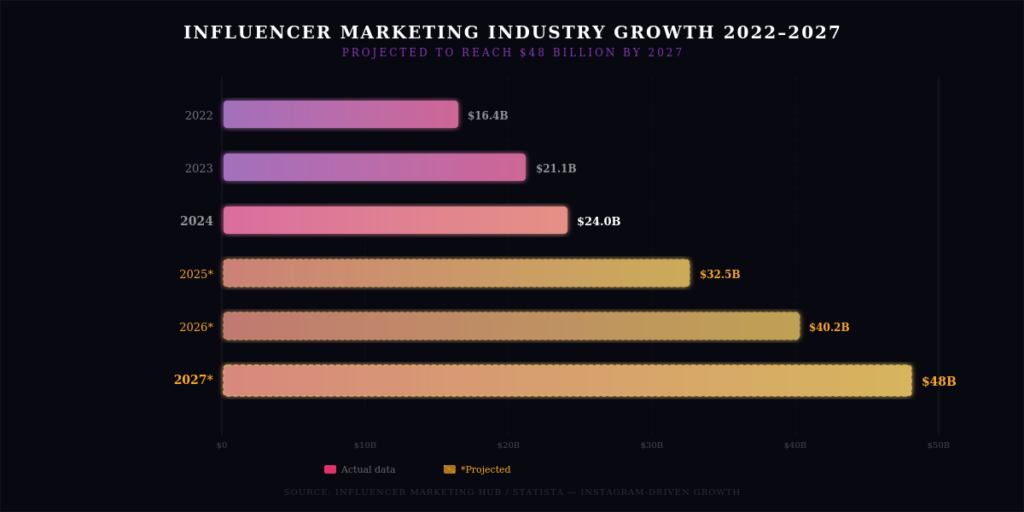
In 2026, a Goldman Sachs research report projects that Instagram-native creator commerce will contribute $19.2 billion of the $48 billion global influencer industry total by 2027, with AI-powered brand-creator matchmaking tools reducing campaign setup time by 70% and cutting average cost-per-engagement by 28% compared to 2024 benchmarks.
The influencer marketing industry is projected to reach $48 billion by 2027, driven largely by Instagram’s creator-first evolution. As more platforms shift to creator-led ecosystems, influencers will become the connective tissue between brands and fragmented audiences. Instagram’s suite of monetization tools — including subscriptions, affiliate tags, and in-app tipping — further incentivizes creators to stay and scale their businesses on-platform.
This growth also means brands will need better infrastructure to manage influencer relationships, from discovery tools to contract automation. Future campaigns will likely move away from one-time placements toward co-branded product lines, ambassador programs, and cross-platform storytelling. With AI streamlining brand-creator matching and campaign performance analysis, influencer marketing will become as structured and data-driven as paid media. For Instagram, this trajectory ensures its long-term relevance as both a social network and a commercial engine for creators.
INSTAGRAM MARKETING STATISTICS 2026 REVEAL THE PLATFORM’S MASSIVE CREATOR AND COMMERCE SURGE
These Instagram marketing statistics paint a clear picture: the platform is no longer just a place to post photos—it’s a high-performance ecosystem where culture, commerce, and community intersect. As Reels take over feeds, influencer partnerships become more strategic, and global user bases continue to expand, marketers will need to rethink their content, targeting, and engagement strategies. Success won’t hinge on follower counts alone but on how well brands adapt to real-time trends, embrace authenticity, and personalize at scale.
Emerging regions, micro-influencers, and short-form video are now key growth areas, and businesses that understand these shifts will lead the next wave of digital marketing. Instagram is evolving into a commerce-first, creator-powered platform where every interaction can be optimized for both connection and conversion. Marketers who treat the platform as both a storytelling tool and a revenue driver will be better equipped to navigate its changes. In 2026, brands are investing more heavily in Reels distribution, creator collaborations, and in-app shopping features to maximize engagement and measurable sales.
Sources:
- https://www.statista.com/topics/1882/instagram
- https://datareportal.com/essential-instagram-stats
- https://datareportal.com/essential-instagram-stats
- https://blog.hootsuite.com/instagram-statistics
- https://vidico.com/news/instagram-reels-statistics
- https://www.measure.studio/post/instagram-statistics
- https://www.statista.com/topics/5286/instagram-marketing
- https://www.dash.app/blog/influencer-marketing-statistics
- https://blog.hootsuite.com/instagram-statistics
- https://metricool.com/important-instagram-statistics
- https://metricool.com/important-instagram-statistics
- https://analyzify.com/statsup/instagram
- https://metricool.com/important-instagram-statistics
- https://www.sprinklr.com/blog/instagram-statistics
- https://www.dash.app/blog/influencer-marketing-statistics
- https://blog.hootsuite.com/instagram-statistics
- https://analyzify.com/statsup/instagram
- https://www.dash.app/blog/influencer-marketing-statistics