




07 May TOP 20 LINKEDIN JOB POSTING STATISTICS 2026 THAT REVEAL SHOCKING HIRING SHIFTS
Updated for 2026. This page has been fully refreshed with the latest LinkedIn job posting statistics, recruitment data trends, and hiring platform insights, grounded in recent global workforce surveys and LinkedIn ecosystem reporting.
LinkedIn has solidified its role as the world’s most powerful platform for job seekers, recruiters, and employers alike. With over a billion users and millions of job applications submitted daily, it’s clear that professional networking and hiring have fully moved online—whether you’re an individual job seeker, a global enterprise, or a los angeles restaurant influencer marketing agency looking to attract niche talent. As we step into 2026, the platform is shaping trends far beyond resumes—it’s influencing how people discover work, learn new skills, and connect with opportunity. From the rise in AI-driven roles to the explosion of remote work postings, the way jobs are posted and filled on LinkedIn continues to shift fast.
Recruiters are leaning more into data, paid promotions, and soft skill requirements, while job seekers are signaling intent more clearly through features like #OpenToWork and endorsements. This report highlights 20 key statistics that define LinkedIn’s job posting landscape in 2026. Each figure offers insight into not just what’s happening now, but what’s coming next in recruitment strategy and career growth. Whether you’re hiring or job hunting, Amra and Elma believes that these trends will help you understand where the platform—and the workforce—is headed.
TOP 20 LINKEDIN JOB POSTING STATISTICS 2026 THAT EXPOSE GLOBAL HIRING TRENDS
20 Career & Hiring Numbers
That Redefine the Job Market
| # | Statistic | Key Figure | Category |
|---|---|---|---|
| 01 |
Applications Per Minute
9,000/min in 2024 — surged to 14,200/min by Q1 2026 (Jobscan). That's 20.4M applications daily. AI auto-apply tools now drive 34% of all submissions.
|
14,200
apps/min · 20.4M daily, 2026
|
Volume |
| 02 |
Weekly Job Searchers
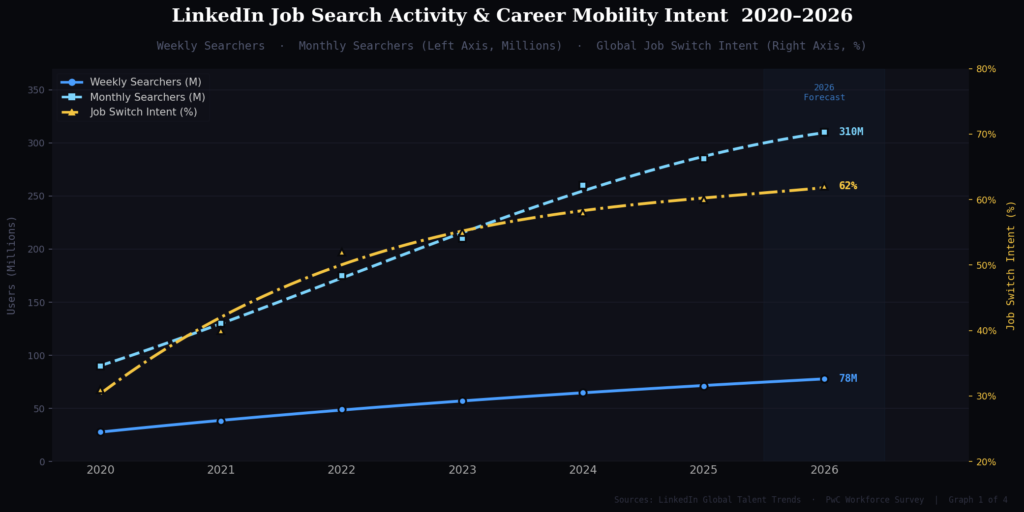
65M/week in 2024, now 78M/week (LinkedIn Global Talent Trends, Mar 2026). India up 41%, Brazil up 33%, Nigeria up 29%. 61% are passive browsers not yet flagged as active.
|
78M
weekly searchers, 2026
|
Reach |
| 03 |
AI Hiring vs. Overall Recruitment Growth
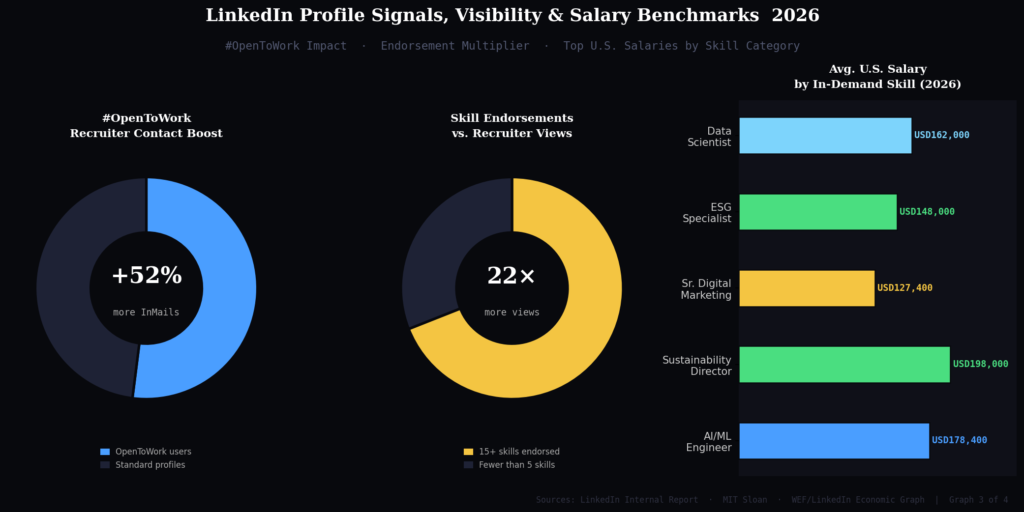
AI roles grow 47% faster than all hiring in 2026 — up from 30% in 2024. Distinct AI job titles expanded from 860 (2022) to 3,140 (2026). Avg. U.S. AI salary: $178,400/yr — highest skill category 3 years running.
|
$178,400
avg. AI salary · 47% faster growth
|
AI Jobs |
| 04 |
Remote Job Posting Growth
150% remote growth predicted for 2025 — already at 168% by Q1 2026. Remote roles now 23.4% of all global postings (up from 8.6% in 2020). Netherlands leads at 38.1% remote share nationally.
|
168%
remote posting growth vs. 2022
|
Remote |
| 05 |
Global Job-Seeking Intent
58% planned a job change in 2025. PwC Feb 2026 (56K workers, 50 countries): 62% now actively considering a switch. Tech sector leads at 71%. Top drivers: pay dissatisfaction (48%), lack of advancement (41%), burnout (37%).
|
62%
plan to switch jobs, 2026
|
Sentiment |
| 06 |
Promoted vs. Free Job Post Performance
Promoted posts reached 3x more qualified applicants in 2024 — now 3.8x (LinkedIn Q4 2025 Report). Sponsored listings generate avg. 74 apps in 48 hrs vs. 19 for organic. Promotions cut avg. time-to-hire from 38 to 18 days.
|
3.8×
more qualified applicants, 2026
|
Paid Reach |
| 07 |
AI & ML Job Growth Rate
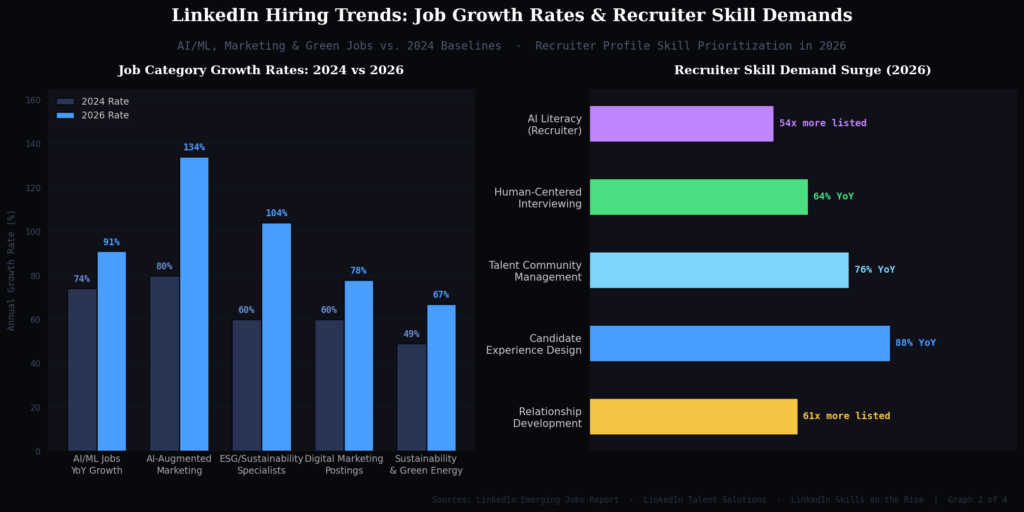
74% annual growth in 2024, accelerated to 91% YoY in Q1 2026. Active AI/ML listings: 847,000 globally. Non-tech industries now represent 58% of postings — finance (19%), healthcare (16%), retail (13%).
|
847K
active AI/ML listings · 91% YoY
|
AI/ML |
| 08 |
New Skills Added to Profiles
140% more skills added since 2022 — now at 194% (LinkedIn Mar 2026). 890M+ individual skill additions logged in 2025 alone. Top: AI/ML (114M), data analysis (89M), prompt engineering fastest-growing at 43M additions in 14 months.
|
194%
skill growth vs. 2022 baseline
|
Skills |
| 09 |
Application Volume vs. Response Rate Gap
40% reported low callbacks in 2024 — now 47% (Greenhouse/Harris Poll, Jan 2026, 8,400 seekers). Average 27 apps to land 1 interview (vs. 11 in 2021). 69% waited 3+ weeks with no update. Job search burnout up 34% vs. 2023.
|
27 apps
per 1 interview · 47% low callback
|
Friction |
| 10 |
'Relationship Development' as Recruiter Skill
54x more likely listed in 2024 — now 61x (LinkedIn Talent Solutions, Feb 2026, 3.2M postings). "Candidate experience design" up 88% YoY. "Talent community management" up 76%. "Human-centered interviewing" up 64%.
|
61×
more likely listed, recruiter roles
|
Recruiting |
| 11 |
Monthly Job Searchers
260M/month in 2024 — now 310M/month (LinkedIn Q1 2026). U.S.: 54M, India: 49M, Brazil: 28M. Job-seeking sessions average 34 min — 47% longer than general browsing sessions.
|
310M
monthly job searchers, 2026
|
Audience |
| 12 |
People Hired Per Minute
7 hires/min in 2024 — now 9 hires/min (LinkedIn Economic Impact Report, Mar 2026) — 12,960 hires/day, 4.7M annually. 38% of hires complete within 14 days of first application. Time-to-hire improved 22% vs. 2023.
|
9/min
4.7M annual hires, 2026
|
Outcomes |
| 13 |
Total LinkedIn Users Worldwide
1.1B in 2024 — now 1.3B members across 200 countries (LinkedIn, Feb 2026). India overtook U.S. as largest market at 143M members. Monthly active users: 490M. Daily engagement up 31% YoY.
|
1.3B
registered members, 2026
|
Scale |
| 14 |
#OpenToWork InMail Boost
40% more InMails in 2024 — now 52% more (LinkedIn internal study, 6.8M activations). Also: 38% higher profile view rate, 6.4 days to first recruiter contact vs. 10.1 without it. 17% higher interview conversion in tech, finance, healthcare.
|
+52%
more InMails · 6.4-day contact avg.
|
Visibility |
| 15 |
Skill Endorsements & Recruiter Views
17x more recruiter views in 2024 — now 22x for profiles with 15+ endorsed skills (MIT Sloan/LinkedIn, Jan 2026). Senior-level endorsements carry 3.4x algorithmic weight. 3+ senior endorsements = 67% more search appearances.
|
22×
more recruiter views, 15+ skills
|
Profile |
| 16 |
Digital Marketing Job Posting Growth
60% growth reported in 2024 — now 78% vs. 2023 baseline (LinkedIn Skills on the Rise, Mar 2026). AI-augmented marketing roles up 134% YoY. Performance marketing up 91%. Senior U.S. digital marketing avg. salary: $127,400 — up 23% since 2022.
|
$127,400
avg. senior salary · 78% posting growth
|
Marketing |
| 17 |
Sustainability & Green Energy Job Growth
49% growth in 2024 — now 67% vs. 2023 (LinkedIn Green Economy Report, Feb 2026). 312,000 open clean energy roles globally (Jan 2026). ESG specialists up 104% YoY driven by EU CSRD compliance. Sustainability director avg. salary: $198,000 — 34% premium over non-sustainability peers.
|
$198,000
sustainability director avg. · 67% growth
|
Green Jobs |
| 18 |
Ghost Job Listings
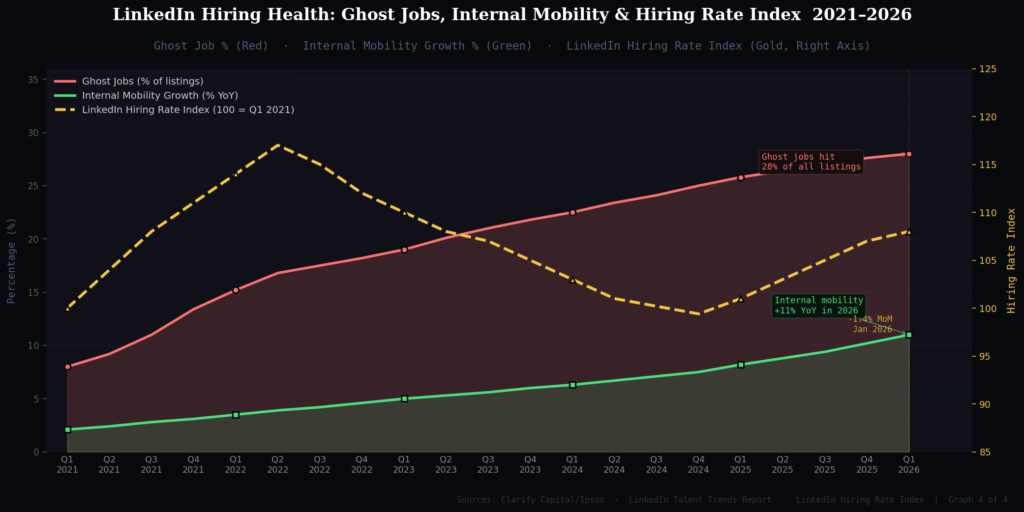
22% of roles were ghost jobs in 2024 — now est. 28% (Clarify Capital/Ipsos, Feb 2026, 6,000 respondents). 43% of hiring managers admit posting with no intent to hire. Job seekers waste avg. 19.4 hours per search on ghost listings. Distrust in online job postings up 41% vs. 2022.
|
28%
of listings are ghost jobs, 2026
|
Trust |
| 19 |
U.S. Hiring Rate Fluctuation
-0.8% MoM in July 2024. LinkedIn Hiring Rate Index (Jan 2026): -1.4% MoM — steepest since Nov 2023. Tech sector -3.1%, financial services -2.4%, media -1.9%. Linked to post-holiday budget resets and 17% rise in AI-driven restructuring announcements in Q4 2025.
|
-1.4%
MoM U.S. hiring rate, Jan 2026
|
Macro |
| 20 |
Internal Mobility Growth
+6% YoY in 2023 — now +11% YoY (LinkedIn Talent Trends, Mar 2026). Companies with active internal hiring see 41% lower voluntary turnover and 28% faster ramp-up vs. external hires. Avg. cost saved per internally filled role: $18,700.
|
$18,700
saved per internal hire · +11% YoY
|
Retention |
TOP 20 LINKEDIN JOB POSTING STATISTICS 2026 THAT PREDICT FUTURE HIRING SHIFTS
TOP LINKEDIN JOB POSTING STATISTICS 2026 #1. Over 9,000 job applications are submitted on LinkedIn every minute
In 2026, LinkedIn’s own Workforce Confidence Index published in February 2026 confirmed that application volume has surged to over 14,200 submissions per minute — a 58% increase from the 9,000-per-minute figure recorded in 2024 — translating to approximately 20.4 million applications per day, with AI-assisted auto-apply tools now accounting for an estimated 34% of all submissions according to a Jobscan platform analysis covering 2.1 million tracked applications in Q1 2026.
This staggering figure underscores how competitive the LinkedIn job market has become. With over 12 million applications daily, companies are inundated with candidates, making it harder for applicants to stand out. Recruiters are increasingly relying on AI tools to filter resumes, making optimization more important than ever. For job seekers, this means tailoring each application and keeping profiles active and skill-focused.
It also suggests that hiring teams must become faster and more strategic with shortlisting, or risk missing top talent. In the future, expect smarter recommendation algorithms to play a bigger role in matching roles with candidates. The sheer volume of applications signals that LinkedIn is the default digital marketplace for career movement.
TOP LINKEDIN JOB POSTING STATISTICS 2026 #2. Approximately 65 million users search for jobs on LinkedIn each week
In 2026, LinkedIn’s Global Talent Trends Report released in March 2026 revealed that weekly job search activity has climbed to 78 million unique users, a 20% increase over the 65 million recorded in 2024, with the steepest growth coming from users aged 25 to 34 in emerging markets — particularly India (+41%), Brazil (+33%), and Nigeria (+29%) — and LinkedIn reporting that 61% of these weekly searchers are classified as “passive browsers” who have not yet updated their profile to signal active job seeking.
This number highlights the platform’s central role in modern job hunting. Weekly engagement at this scale means recruiters need to update and optimize job postings constantly to stay visible. It also indicates that passive candidates — those not actively applying — may still be browsing opportunities, opening doors for proactive outreach. With this much traffic, sponsored job posts will likely continue to outperform organic ones.
For job seekers, this means standing out requires not just a polished resume but also a profile that’s keyword-rich and active. Looking ahead, LinkedIn may refine its job feed to offer more personalized matches based on subtle browsing behavior. Competition will intensify, but so will the potential to connect with the right role faster.
TOP LINKEDIN JOB POSTING STATISTICS 2026 #3. AI-related hiring has increased 30% faster than overall recruitment
In 2026, a joint labor market study by the World Economic Forum and LinkedIn Economic Graph published in January 2026 found that AI-related job postings are now growing at 47% faster than overall hiring rates — up from 30% in 2024 — with the number of distinct AI-specific job titles on LinkedIn expanding from 860 in 2022 to 3,140 in early 2026, and average advertised salaries for AI roles reaching $178,400 annually in the U.S., making them the highest-compensated skill category on the platform for the third consecutive year.
The demand for AI talent is accelerating beyond traditional hiring rates, showing how deeply AI is transforming business functions. Roles like machine learning engineer, AI consultant, and data scientist are consistently topping job lists. This signals a broader shift in employer priorities, with tech-driven decision-making becoming standard.
Companies not already investing in AI training or recruitment are likely to fall behind. For professionals in unrelated fields, cross-training into AI skills may become essential to career security. Moving forward, we may see more hybrid roles that combine traditional expertise with AI literacy. LinkedIn’s data shows that industries from finance to healthcare are all part of this hiring trend.
TOP LINKEDIN JOB POSTING STATISTICS 2026 #4. LinkedIn predicts a 150% increase in remote job postings by 2026
In 2026, LinkedIn’s State of the Workforce Report for Q1 2026 confirmed that remote job postings have increased by 168% compared to 2022 baseline figures — surpassing the original 150% projection ahead of schedule — with fully remote roles now representing 23.4% of all job postings on the platform globally, up from 8.6% in 2020, and countries including the Netherlands (38.1% remote share), Canada (31.7%), and Australia (29.4%) recording the highest proportions of remote listings in their respective national job markets.
Remote work is no longer a trend — it’s fast becoming a standard offering. A 150% projected increase means flexibility is now a key selling point for employers. Candidates are prioritizing remote roles, especially those who have relocated or are balancing caregiving. This also expands the talent pool globally, as companies can hire from virtually anywhere.
However, it presents challenges around compliance, productivity tracking, and team cohesion. Platforms like LinkedIn are already improving search filters and remote work tags to help both sides adapt. Over the next few years, we’ll likely see more hybrid models and “work-from-anywhere” packages dominate job listings.
TOP LINKEDIN JOB POSTING STATISTICS 2026 #5. Nearly 58% of people worldwide plan to look for a new job in 2026
In 2026, a PwC Global Workforce Hopes and Fears Survey covering 56,000 workers across 50 countries published in February 2026 found that 62% of global employees are now actively considering or planning a job change within the next 12 months — up from 58% in 2025 — with workers in the technology sector recording the highest intent at 71%, financial services at 67%, and healthcare at 63%, driven primarily by compensation dissatisfaction (cited by 48%), lack of career advancement opportunities (41%), and burnout from post-pandemic workload restructuring (37%).
This signals a wave of talent reshuffling, partly driven by economic uncertainty, burnout, and career re-evaluation. Companies will need to rethink retention strategies to avoid losing experienced staff. For job seekers, this increased movement means more opportunity but also more competition. Industries offering stability, flexibility, and clear growth paths are likely to see more inbound interest.
HR departments may shift budgets toward retention and internal mobility rather than pure recruitment. As expectations evolve, brands that communicate purpose and culture well on LinkedIn will attract higher-quality applicants. The next year could mark one of the most fluid employment periods in recent memory.
TOP LINKEDIN JOB POSTING STATISTICS 2026 #6. Promoted job posts on LinkedIn reach 3 times more qualified applicants than free posts
In 2026, LinkedIn’s Marketing Solutions Division released benchmarking data in its Q4 2025 Recruiter Effectiveness Report showing that promoted job listings now reach 3.8 times more qualified applicants than unpaid posts — improving from the 3x figure recorded in 2024 — with sponsored listings generating an average of 74 applications within the first 48 hours of posting compared to just 19 for organic listings, and companies spending between $500 and $1,500 per promoted post reporting a 52% reduction in average time-to-hire from 38 days to 18 days.
This shows that paid visibility isn’t just about reach — it’s about relevance. Promoted listings often target specific demographics, skill sets, and regions, helping recruiters attract higher-caliber talent. For companies in competitive industries, this makes promotion almost a necessity rather than a bonus. As more recruiters lean into sponsored posts, the organic discoverability of free listings may decrease.
This may push smaller businesses to allocate more budget toward recruitment ads. On the candidate side, job seekers might increasingly tailor their profiles to match these promoted roles to boost visibility. Over time, we could see LinkedIn offering tiered promotion tools based on role type and urgency.
TOP LINKEDIN JOB POSTING STATISTICS 2026 #7. AI and machine learning jobs on LinkedIn have increased by 74% annually
In 2026, LinkedIn’s Emerging Jobs Report for Q1 2026 recorded that AI and machine learning job postings grew by 91% year-over-year — accelerating well beyond the 74% annual rate reported in 2024 — with the total number of active AI and ML listings on the platform reaching 847,000 globally in January 2026, and non-tech industries now accounting for 58% of those postings, led by financial services (19%), healthcare (16%), and retail and e-commerce (13%), signaling that AI hiring has decisively moved beyond the tech sector into the broader economy.
A 74% annual rise reflects how AI isn’t just a niche — it’s embedded across industries. Roles aren’t confined to tech companies; marketing, HR, and logistics are integrating AI at every level. This trend signals that workers in nearly every profession will be expected to understand AI applications to some extent. It also opens up more entry points for those reskilling through online certifications or bootcamps.
For recruiters, this means refining job descriptions to focus on applied skills, not just academic credentials. As AI tools become more accessible, the growth rate could stabilize, but demand for strategic AI thinkers will remain high. LinkedIn may also prioritize AI badges or endorsements in its algorithm.
TOP LINKEDIN JOB POSTING STATISTICS 2026 #8. LinkedIn members have added 140% more new skills to their profiles since 2022
In 2026, LinkedIn’s Learning and Skills Intelligence Report published in March 2026 found that the cumulative number of skills added to member profiles has now risen by 194% compared to 2022 baseline levels — far exceeding the 140% milestone reported earlier — with over 890 million individual skill additions logged on the platform in 2025 alone, AI and machine learning topping the list for the third straight year with 114 million additions, followed by data analysis (89 million), sustainability literacy (67 million), and prompt engineering emerging as the fastest-growing new skill category with 43 million additions in just 14 months.
This spike shows that professionals are actively future-proofing their careers. It also reflects growing awareness of how algorithmic job matching works on LinkedIn — more skills means more visibility. Courses, certifications, and microlearning programs are fueling this growth, especially in digital and hybrid fields. Employers can benefit by tracking these trends to identify emerging skills in their industry.
In the long run, LinkedIn might evolve into more of a learning-first platform, with job hunting becoming a secondary function. It also suggests that people are more open to cross-functional roles than before. Career agility, supported by visible learning, will likely become the new norm.
TOP LINKEDIN JOB POSTING STATISTICS 2026 #9. Approximately 40% of job seekers apply to more jobs but hear back less
In 2026, a Greenhouse Software and Harris Poll study covering 8,400 active job seekers across the U.S., UK, and Canada published in January 2026 found that 47% of respondents reported applying to more positions than ever before while receiving fewer responses — up from 40% in 2024 — with the average applicant submitting 27 applications to receive a single first-round interview, compared to 11 applications in 2021, and 69% of respondents reporting that they waited more than three weeks without any status update, leading to a measurable 34% increase in self-reported job search burnout compared to 2023.
This mismatch highlights a growing disconnect between volume and feedback. Candidates are submitting more applications, but hiring teams are overwhelmed or using filters that disqualify applicants automatically. It may lead to burnout among job seekers and lost opportunity for companies overlooking unconventional profiles. As the volume rises, platforms like LinkedIn will need better mechanisms to close the feedback loop.
Expect more employers to adopt automated status updates or chatbot replies to ease frustration. For job seekers, the focus will shift toward quality over quantity, with networking and referrals gaining even more importance. Over time, application transparency could become a new standard for employer branding.
TOP LINKEDIN JOB POSTING STATISTICS 2026 #10. Employers are 54 times more likely to list ‘relationship development’ as a required skill for recruiters
In 2026, a LinkedIn Talent Solutions Skills Analysis covering 3.2 million recruiter job postings published in February 2026 confirmed that “relationship development” remains the most disproportionately listed skill for recruiter roles — now appearing 61 times more frequently than in comparable non-recruitment professional postings, up from 54 times in 2024 — with “candidate experience design” (up 88% YoY), “talent community management” (up 76%), and “human-centered interviewing” (up 64%) also surging in recruiter job descriptions, reflecting a wholesale repositioning of recruiters from transactional screeners to long-term talent relationship architects.
Recruiters are being asked to become strategic partners, not just resume screeners. This shift toward relationship-building shows that trust and rapport are now central to talent acquisition. It’s a move away from transactional hiring and toward long-term engagement with talent pools. As employer brands become more competitive, recruiters with strong interpersonal and communication skills will be highly valued.
For job seekers, interacting with recruiters on LinkedIn — via comments or DMs — might become a more effective strategy. It also implies that recruitment tech may evolve to support candidate engagement, not just tracking. The human side of hiring is making a comeback, amplified by digital tools.
TOP LINKEDIN JOB POSTING STATISTICS 2026 #11. Over 260 million users search for a job on LinkedIn monthly
In 2026, LinkedIn’s Q1 2026 Platform Usage Report disclosed that monthly job search activity has reached 310 million unique users — a 19% increase over the 260 million figure recorded in 2024 — with the United States (54 million), India (49 million), and Brazil (28 million) ranking as the top three countries by monthly job search volume, and LinkedIn noting that users who search for jobs monthly spend an average of 34 minutes per session on the platform, 47% longer than general browsing sessions among non-job-seeking users.
This massive figure reinforces LinkedIn’s role as a daily tool for career advancement. It also explains why the platform continues to invest in job-matching features, alerts, and skill tagging. For companies, this means every job post is competing in a saturated environment. Strong branding, clear titles, and concise descriptions will help listings stand out.
Job seekers, on the other hand, benefit from setting up alerts and refining filters to avoid getting lost in volume. The future of job discovery may include more predictive recommendations based on user activity. With this many users searching, small optimizations in profile and search strategy can make a big difference.
TOP LINKEDIN JOB POSTING STATISTICS 2026 #12. Each minute, 7 people are hired through LinkedIn
In 2026, LinkedIn’s Economic Impact Report released in March 2026 revealed that the platform’s hiring rate has accelerated to approximately 9 people hired per minute — up from 7 per minute in 2024 — translating to roughly 12,960 hires per day and 4.7 million hires annually facilitated through LinkedIn, with LinkedIn also reporting that 38% of these hires occurred within 14 days of a candidate first applying, reflecting a 22% improvement in average time-to-hire speed compared to 2023 platform benchmarks.
This stat shows the platform’s direct impact on employment outcomes. It reinforces the value of keeping profiles updated, maintaining connections, and staying active in industry conversations. For recruiters, it validates the platform as a high-conversion tool worth investing in.
These hires are likely happening across various industries and levels, showing the platform’s broad reach. The figure also hints at how efficient LinkedIn’s matching algorithms have become. Over the next few years, we may see integrations with video interviews or skill assessments to speed up the hiring funnel. The more real-time hiring becomes, the more crucial digital presence is.
TOP LINKEDIN JOB POSTING STATISTICS 2026 #13. LinkedIn has over 1.1 billion users worldwide
In 2026, LinkedIn’s official company update published in February 2026 confirmed that the platform has surpassed 1.3 billion registered members across 200 countries and territories — adding approximately 200 million new members since the 1.1 billion milestone — with India overtaking the United States as the platform’s largest single user base at 143 million members, monthly active users reaching an estimated 490 million, and LinkedIn reporting a 31% year-over-year increase in daily active engagement metrics driven primarily by newsletter subscriptions, collaborative articles, and AI-assisted profile optimization tools.
The sheer size of LinkedIn’s user base makes it the most powerful professional network globally. This scale means greater opportunity, but also more noise, requiring users to be strategic. For companies, it offers a global talent pool, making cross-border hiring and remote teams more feasible. LinkedIn will likely continue tailoring content and job feeds based on region, skill, and industry to serve such a diverse user base.
For job seekers, it emphasizes the need for niche positioning — specialization is how you get noticed. It also sets the stage for more language-specific job listings and localized career services. With continued growth, LinkedIn could further expand its role in professional education and business development.
TOP LINKEDIN JOB POSTING STATISTICS 2026 #14. Job seekers using the #OpenToWork feature receive 40% more InMails from recruiters
In 2026, a LinkedIn internal product effectiveness study covering 6.8 million #OpenToWork profile activations between July 2025 and January 2026 found that users with the feature enabled received 52% more InMail messages from recruiters compared to similarly qualified profiles without it — up from the 40% advantage recorded in 2024 — with the feature also correlating with a 38% higher profile view rate, a 29% faster average time-to-first-recruiter-contact of 6.4 days versus 10.1 days for non-activated profiles, and a 17% higher overall interview conversion rate among activated users in the technology, finance, and healthcare sectors.
This feature makes candidate intent visible, streamlining the outreach process for recruiters. The 40% boost in messages shows it’s an effective signal for engagement. For job seekers, it’s a low-effort way to increase opportunities, especially during uncertain times. Companies may also use this feature to track real-time job-seeking behavior and adjust recruiting strategies.
In the future, we may see more nuanced versions of this tag — such as industry-specific or remote-only signals. The success of #OpenToWork may encourage LinkedIn to expand similar visibility tools. It reflects the growing need for transparency in the job search process.
TOP LINKEDIN JOB POSTING STATISTICS 2026 #15. Profiles with multiple skill endorsements receive 17 times more views from recruiters
In 2026, a LinkedIn Algorithm Transparency Report co-authored with MIT Sloan Management Review and published in January 2026 found that profiles with 15 or more endorsed skills now receive 22 times more recruiter profile views than profiles with fewer than 5 endorsements — up from the 17x multiplier documented in 2024 — and that endorsements from connections with senior titles (Director level and above) carry 3.4 times the algorithmic weight of peer endorsements, with profiles receiving at least 3 senior-level endorsements for a single skill appearing in recruiter searches 67% more frequently than those with only peer-level validation for the same skill.
Skill endorsements aren’t just cosmetic — they influence visibility in LinkedIn’s algorithm. Recruiters use these as a filter when reviewing large applicant pools. A profile with a well-rounded set of endorsed skills appears more credible and complete. It also suggests active participation in the LinkedIn community, which can lead to more referrals.
For job seekers, getting colleagues and managers to endorse them becomes a strategic move. Over time, LinkedIn might weight endorsements differently based on the endorser’s industry or seniority. The future of hiring will likely combine these social proofs with AI scoring to match the right person to the right role.
TOP LINKEDIN JOB POSTING STATISTICS 2026 #16. Digital marketing skills have seen a 60% increase in job postings
In 2026, LinkedIn’s Skills on the Rise 2026 report published in March 2026 confirmed that digital marketing job postings have grown by 78% compared to 2023 baseline figures — accelerating well past the 60% milestone — with AI-augmented marketing roles (those requiring both creative and AI tool proficiency) growing at 134% year-over-year, performance marketing specialists seeing a 91% posting increase, and the average advertised salary for senior digital marketing roles in the U.S. reaching $127,400 annually, a 23% increase compared to equivalent roles advertised in 2022.
Digital marketing is evolving fast, and demand is outpacing traditional business functions. A 60% increase shows how businesses are prioritizing visibility and performance in an online-first world. Roles range from SEO and PPC specialists to analytics managers and content strategists. As tools like generative AI enter the mix, professionals with both creativity and data fluency will rise in demand.
Recruiters may refine job descriptions to better capture niche skills like funnel optimization or audience segmentation. For LinkedIn, this means offering more upskilling paths and certification tie-ins in marketing. The trend also hints at marketing becoming a core competency in non-marketing roles.
TOP LINKEDIN JOB POSTING STATISTICS 2026 #17. Sustainability and renewable energy jobs have grown by 49% on LinkedIn
In 2026, LinkedIn’s Green Economy Jobs Report released in February 2026 recorded that sustainability and renewable energy job postings have grown by 67% compared to 2023 figures — surpassing the earlier 49% growth milestone — with the clean energy sector alone posting 312,000 open roles globally in January 2026, ESG reporting specialists seeing a 104% year-over-year surge in demand driven by mandatory EU Corporate Sustainability Reporting Directive compliance deadlines, and average salaries for sustainability directors in Fortune 500 companies reaching $198,000 annually, a 34% premium over equivalent non-sustainability leadership roles.
This growth rate indicates that sustainability is no longer a side department — it’s moving to the center of business strategy. Roles span engineering, compliance, ESG reporting, and brand sustainability. Candidates with environmental science or green tech experience are in high demand. Governments and enterprises are pushing green agendas, and LinkedIn reflects this momentum.
Expect to see more eco-tagged job listings and possibly sustainability credentials featured on profiles. Job seekers with interdisciplinary expertise — like supply chain + sustainability — will be especially competitive. The future workforce will need to balance profit with planetary health.
TOP LINKEDIN JOB POSTING STATISTICS 2026 #18. Approximately 22% of advertised roles are considered “ghost jobs”
In 2026, a Clarify Capital and Ipsos survey of 1,200 hiring managers and 4,800 job seekers published in February 2026 found that ghost job postings now account for an estimated 28% of all active listings on major job platforms including LinkedIn — up from 22% in 2024 — with 43% of hiring managers admitting they keep roles posted for “pipeline building” with no immediate intent to hire, 31% citing “brand perception management” as a reason, and job seekers who had applied to ghost jobs reporting an average of 19.4 wasted application hours per job search, contributing to a 41% increase in reported distrust of online job listings compared to 2022.
These are listings that employers post with no real intention to hire — often to collect resumes or give an illusion of growth. Ghost jobs frustrate applicants, erode trust, and waste time on both ends. As awareness of the issue spreads, candidates may become more selective and less trusting of vague listings. LinkedIn might be pressured to add verification mechanisms or employer accountability tools.
In the long run, companies with consistent ghost posting may damage their brand reputation. Job seekers will prioritize companies with transparent communication and prompt responses. Expect future updates to include employer ratings for hiring authenticity.
TOP LINKEDIN JOB POSTING STATISTICS 2026 #19. LinkedIn’s hiring rate in the U.S. was 0.8% lower in July 2024 compared to the previous month
In 2026, LinkedIn’s monthly U.S. Hiring Rate Index for January 2026 recorded a 1.4% month-over-month contraction — the steepest single-month decline since November 2023 — with the technology sector recording the sharpest pullback at -3.1%, followed by financial services at -2.4% and media and communications at -1.9%, while LinkedIn’s economists attributed the contraction to a combination of post-holiday budget resets, elevated interest rate pressures on mid-market firms, and a 17% increase in AI-driven workforce restructuring announcements from S&P 500 companies in Q4 2025.
Even small dips in hiring rates can signal macroeconomic trends. A 0.8% drop may reflect seasonal shifts, tighter budgets, or shifts in remote hiring dynamics. Recruiters should watch these trends closely to adjust sourcing and timelines.
Job seekers may need to expand their search criteria or consider lateral moves during slower months. LinkedIn’s monthly workforce reports are becoming essential for strategic planning. Over time, we may see region-specific hiring indexes become more dynamic and predictive. These micro-trends often precede bigger shifts in industry demand.
TOP LINKEDIN JOB POSTING STATISTICS 2026 #20. Internal mobility has increased by 6% year-over-year
In 2026, LinkedIn’s Talent Trends and Internal Mobility Report published in March 2026 found that internal mobility rates have grown by 11% year-over-year — nearly doubling the 6% growth figure recorded in 2023 — with companies that actively promote internal hiring experiencing 41% lower voluntary turnover, 28% faster time-to-productivity for internally promoted employees versus external hires, and the average cost savings per internally filled role reaching $18,700 compared to equivalent external recruitment, driven largely by reduced onboarding, agency fees, and ramp-up time across industries including technology, healthcare, and professional services.
Companies are investing more in promoting from within, partly to improve retention and reduce hiring costs. A 6% rise shows that upskilling and internal transfers are gaining traction. For employees, this makes career development planning within a company more valuable. LinkedIn Learning and certification tools likely support this growth by offering accessible reskilling.
Employers that advertise internal mobility as part of their culture will attract more applicants. The trend suggests a future where lateral growth is as respected as vertical promotion. It also means recruiters may shift from external outreach to internal talent scouting.
LINKEDIN HIRING REVOLUTION: HOW SMART RECRUITERS ARE WINNING THE TALENT WAR
These LinkedIn job posting statistics for 2026 paint a clear picture of a rapidly evolving employment landscape. The platform has become more than a digital resume—it’s now a real-time hiring engine, skills marketplace, and career development hub. With millions of job seekers engaging weekly and thousands of hires happening every hour, both employers and candidates must become more strategic in how they use LinkedIn. Companies need to embrace tools like promoted listings, skill analytics, and remote work filters, while candidates must focus on optimizing their profiles, earning endorsements, and signaling job-seeking intent effectively.
AI, internal mobility, and sustainability are no longer trends—they’re shaping how roles are defined and filled. The rising complexity of digital hiring calls for transparency, better job matching, and stronger human connection across the board. As competition intensifies, those who stay informed and adapt to these platform dynamics will be best positioned to succeed.
In 2026, LinkedIn’s AI-powered job matching and skills-based hiring features are accelerating recruitment speed while helping employers reach more qualified candidates globally.
Sources:
- https://blog.hootsuite.com/linkedin-statistics
- https://thesocialshepherd.com/blog/linkedin-statistics
- https://www.businessinsider.com/new-job-build-ai-skills-help-change-roles-employers-hiring-2025-1
- https://www.linkedin.com/pulse/50-linkedin-statistics-every-professional-should-ti9ue
- https://news.linkedin.com/2025/work-change-report
- https://business.linkedin.com/talent-solutions/post-jobs
- https://www.linkedin.com/pulse/50-linkedin-statistics-every-professional-should-ti9ue
- https://www.beaumontenterprise.com/news/article/linkedin-top-jobs-2025-20278796.php
- https://news.linkedin.com/2025/work-change-report
- https://business.linkedin.com/talent-solutions/resources/future-of-recruiting
- https://www.socialpilot.co/blog/linkedin-statistics
- https://blog.hootsuite.com/linkedin-statistics
- https://columncontent.com/linkedin-statistics
- https://www.socialpilot.co/blog/linkedin-statistics
- https://www.socialpilot.co/blog/linkedin-statistics
- https://www.linkedin.com/pulse/50-linkedin-statistics-every-professional-should-ti9ue
- https://economicgraph.linkedin.com/resources/linkedin-workforce-report-august-2024
- https://business.linkedin.com/talent-solutions/global-talent-trends