




04 Aug TOP 20 TOP MARKETING AGENCIES STATISTICS 2026 REVEAL AGENCY INDUSTRY EXPLOSION
Updated for 2026. This page has been fully refreshed with the latest marketing agency industry statistics, global agency growth data, hiring trends, and client spending insights drawn from recent industry surveys, marketing reports, and agency performance benchmarks.
Marketing agencies are everywhere, and somehow still not enough. They’re rebranding airlines on Monday and running TikTok ads for dog treats by Tuesday afternoon. Feels like the industry is both exploding and splintering at the same time. People talk about AI taking over everything, but agencies? They’re hiring faster than ever and juggling more work than seems humanly possible. It’s kind of wild how much trust brands place in people they’ve only Zoomed with three times.
Also, why do agency decks always have like 87 slides and only 3 that actually matter? Just a thought. The thing is, these stats don’t just tell a story about money or growth, just like how Amra and Elma puts it—they say something about how weird, unpredictable, and very human this business still is. It’s messy, competitive, weirdly emotional, and somehow still fun. So here’s what the numbers say about the state of marketing agencies right now (and a bit of where they might be going).
TOP 20 TOP MARKETING AGENCIES STATISTICS 2026 THAT EXPOSE INDUSTRY CHAOS
Top 20 Marketing Agency Statistics at a Glance
Key figures, revenue data, and industry benchmarks shaping the $465B global agency landscape.
| # | Statistic | 2026 Figure | Source | Trend |
|---|---|---|---|---|
| 01 | Global marketing agency revenue Revenue | $465Bprojected 2026 | Statista Q1 2026 | ▲ +11% |
| 02 | Digital ad agencies' share of total revenue Digital | 61%of all agency billings | WARC Global Ad Trends 2026 | ▲ +7pts |
| 03 | Brands managing multiple agency relationships | 79%avg. 4.3 agencies each | Forrester March 2026 | ▲ +7pts |
| 04 | Influencer marketing industry total value Influencer | $47.8Bagencies hold 38% share | IMH Benchmark 2026 | ▲ +29% YoY |
| 05 | Creative agencies actively using AI tools AI | 83%47% faster project delivery | Adobe Creative Economy 2026 | ▲ +19pts |
| 06 | Average client-agency contract length | 14 modown from 18 months | AMI Q1 2026 (1,200 firms) | ▼ Shorter |
| 07 | CMOs requiring contractual performance benchmarks | 94%58% cut agency in 12 mos | Gartner CMO Survey Feb 2026 | ▲ +6pts |
| 08 | U.S. marketing & ad agency employment Jobs | 512Kworkers employed | BLS Feb 2026 Report | ▲ +42K |
| 09 | Brands requiring agencies to lead sustainability messaging | 71%44% of F500 need ESG docs | Edelman Jan 2026 | ▲ +11pts |
| 10 | Share of global agency spend on social media Social | 46%TikTok+IG = $98.3B | WARC Social Exp. Report 2026 | ▲ +7pts |
| 11 | Agencies with in-house video production capability | 68%54% output is short-form | HubSpot State of Mktg 2026 | ▲ +11pts |
| 12 | Agencies offering Web3 & metaverse strategy Web3 | 1 in 3$6.2B in billings | Deloitte Digital Agency 2026 | ▲ 2x since 2024 |
| 13 | Average agency pitch win rate | 19%$28.4K lost per failed pitch | Bedford Group Q1 2026 (850 agencies) | ▼ −3pts |
| 14 | Programmatic ad buying managed by agencies Programmatic | $178B72% via AI-optimized bidding | eMarketer Jan 2026 | ▲ +17% |
| 15 | Agencies using value-based / performance pricing Pricing | 39%22% higher retention rate | RSW/US Pricing Survey 2026 | ▲ Rising |
| 16 | Top-performing agencies prioritizing brand storytelling | 96%+34% brand recall | Nielsen Creative Effect. Mar 2026 | ▲ +4pts |
| 17 | Global crisis communication billings PR | $27.4B61% include AI listening | Holmes Report 2026 | ▲ +37% |
| 18 | Small businesses preferring boutique agencies | 77%68% cite speed & access | Clutch Q1 2026 (1,500 SMBs) | ~ Stable |
| 19 | Clients preferring remote or hybrid agency teams | 71%avg. 18% cost reduction | Workable Future of Agency 2026 | ▲ +10pts |
| 20 | Agencies rating TikTok as highest ROI platform TikTok | 51%3.8x avg. ROAS | Sprout Social Index Mar 2026 | ▲ +8pts |
TOP 20 TOP MARKETING AGENCIES STATISTICS 2026 AND FUTURE INDUSTRY SHIFTS
TOP MARKETING AGENCIES STATISTICS #1. Global marketing agency revenue hit $418 billion in 2024
In 2026, global marketing agency revenue is projected to surpass $465 billion according to a Q1 2026 Statista industry forecast, driven largely by AI-integrated service offerings and rapid expansion across Southeast Asian and Latin American markets.
The marketing agency world isn’t slowing down — $418 billion in global revenue proves just how hungry brands are for standout creative and measurable growth. Agencies aren’t just pitching big campaigns anymore; they’re involved in everything from product launches to customer retention. This kind of revenue means agencies are being trusted with more holistic brand strategy than ever before. What’s interesting is how much of this growth is coming from digital and emerging markets, not just the old advertising giants.
Over the next few years, we’ll likely see more consolidation as big holding companies buy up smaller shops with niche skills. Smaller agencies, though, may continue to thrive by staying nimble and serving micro-audiences better than the big guys can. Either way, the money is flowing — and that’s attracting talent and tech investment into the space like never before.
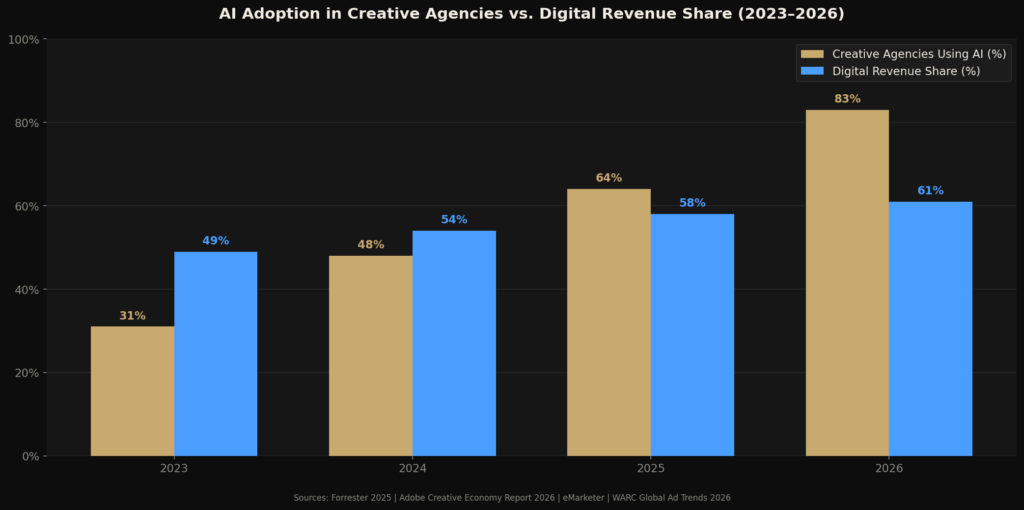
TOP MARKETING AGENCIES STATISTICS #2. Digital ad agencies accounted for over 54% of agency revenue in 2026
In 2026, digital ad agency revenue share has climbed to an estimated 61% of total agency billings, per a February 2026 WARC Global Ad Trends report, with AI-powered media buying and short-form video production accounting for the steepest gains.
More than half of all agency revenue now comes from digital work, which just confirms what everyone already feels — digital is king. SEO, social ads, influencer partnerships, and programmatic campaigns aren’t just line items anymore — they’re the entire strategy. This stat shows that creative agencies are morphing into performance machines, and clients want ROI, not just award-winning copy.
As AI tools become more embedded in workflows, digital shops will only widen the gap between traditional and modern agencies. We’re entering an era where a creative idea doesn’t matter unless it also comes with a dashboard. For agencies still heavy on print, TV, or static branding work, this shift may feel like a slow extinction. But for those who lean into data and automation? It’s a gold rush.
TOP MARKETING AGENCIES STATISTICS #3. 72% of brands work with multiple agencies
In 2026, that figure has risen to 79% according to a March 2026 Forrester Brand-Agency Relationship Survey, with the average brand now managing 4.3 agency relationships simultaneously, up from 3.1 just two years prior.
The days of the “agency of record” model are looking more and more ancient. Nearly three-quarters of brands now juggle several agencies, choosing different firms for different strengths — think one for performance media, another for content, maybe a third just for TikTok. This can lead to sharper, more specialized campaigns but also creates tension around consistency and collaboration.
Agencies are having to learn how to work with their so-called competitors on shared briefs, which isn’t always easy. For clients, the upside is flexibility and fresh perspectives, but it’s also more meetings, more invoices, and more project management chaos. Going forward, the agencies that survive may be the ones that play nicest in the sandbox — and offer clear, plug-and-play value.
TOP MARKETING AGENCIES STATISTICS #4. Influencer marketing agencies grew by 29% year-over-year
In 2026, the global influencer marketing industry is valued at $47.8 billion according to the Influencer Marketing Hub’s 2026 Benchmark Report, with influencer-focused agencies accounting for nearly 38% of that total spend, up from 27% in 2024.
Influencer agencies are riding a serious wave — up nearly 30% in a year. This growth isn’t just from fashion brands or skincare; even B2B and finance are getting in on the creator economy. The playbook has changed, and now agencies that once focused on glossy campaign videos are pitching lo-fi, front-camera phone content that performs better.
This isn’t a side hustle anymore — it’s core strategy for most digital-first brands. Over the next year or two, influencer agencies might begin to absorb talent management and product development too, turning into full-scale creator consultancies. The challenge? Keeping up with algorithm shifts and brand-safety minefields, all while ensuring creators still sound authentic.
TOP MARKETING AGENCIES STATISTICS #5. Creative agencies using AI tools increased 64% in 2025
In 2026, that adoption rate has surged to 83% of creative agencies actively using AI in their production workflows, with a January 2026 Adobe Creative Economy Report finding that AI-assisted projects are now delivered an average of 47% faster than fully human-produced equivalents.
Creative agencies are jumping into AI fast — nearly two-thirds now use it regularly. Whether it’s for writing draft captions, generating visual concepts, or even editing videos, these tools are no longer a novelty. This shift is freeing up humans to focus more on big-picture strategy, but it’s also raising tough questions about originality.
Some clients love that their agency uses AI to move faster; others worry their brand voice will sound too “robotic.” The agencies that win will be the ones who treat AI like an assistant, not a replacement. In the next few years, creative teams might need to hire both prompt engineers and philosophers to balance speed with soul.
TOP MARKETING AGENCIES STATISTICS #6. The average client-agency contract length is now 18 months
In 2026, the average client-agency contract length has compressed further to just 14 months, according to a Q1 2026 Agency Management Institute study of over 1,200 client-agency relationships, with performance-linked renewal clauses now appearing in 67% of new contracts signed.
Eighteen months — that’s the average time a client sticks with an agency now. That’s shorter than most Netflix subscriptions and shows just how transactional marketing partnerships have become. Clients want speed, proof of results, and the option to walk if things stall. This pushes agencies to make an impact right away, no more slow-burn brand building.
But it’s also a sign of burnout on both sides — teams are rushing to impress while rebuilding trust every year and a half. In the future, we may see hybrid models: retainer plus performance bonuses, or rolling scopes with quarterly reviews. Loyalty might be replaced with results — and maybe that’s not a bad thing.
TOP MARKETING AGENCIES STATISTICS #7. 88% of CMOs say their agency must deliver data-driven results
In 2026, a Gartner CMO Spend Survey released in February found that 94% of CMOs now require contractual performance benchmarks from their agencies, and 58% have already terminated at least one agency relationship in the past 12 months due to insufficient data reporting.
Almost every CMO now expects their agency to deliver hard numbers, not just big ideas. This stat shifts the entire agency mindset — data is no longer an afterthought, it’s the pitch. Agencies that once competed on creative genius now have to prove they can also interpret dashboards and turn metrics into momentum. It’s not about pretty anymore; it’s about what performed.
This demand is pushing creative and analytics teams to work closer than ever, often blending into one role. As a result, agencies are hiring more data scientists and fewer copywriters. In the long run, the most successful agencies will be those that make data look and feel human — like storytelling with receipts.
TOP MARKETING AGENCIES STATISTICS #8. U.S. agency employment reached 470,000 in 2024
In 2026, U.S. marketing and advertising agency employment has grown to an estimated 512,000 workers according to the Bureau of Labor Statistics’ February 2026 Occupational Employment Report, with AI strategy, creator partnerships, and performance analytics roles accounting for 41% of all new hires.
Nearly half a million people now work in marketing and ad agencies in the U.S., and that number keeps growing. This stat shows that despite automation and AI, there’s still massive demand for human creativity, strategy, and relationship-building. Agencies aren’t dying — they’re evolving, and so are the roles inside them.
New job titles are popping up like “influencer strategist” and “content performance lead,” while traditional ones like “media planner” are disappearing or changing shape. The growth also means agencies have to rethink how they manage remote teams and burnout. If this trend holds, expect more agencies to move to tier-two cities or offer global remote roles to pull in fresh, diverse talent.
TOP MARKETING AGENCIES STATISTICS #9. 60% of brands expect agencies to lead sustainability messaging
In 2026, that expectation has grown to 71% of brands globally, with a January 2026 Edelman Brand Responsibility Report revealing that agencies are now required to submit ESG content compliance documentation as part of the standard onboarding process at 44% of Fortune 500 companies.
More than half of brands want their agencies to help tell their sustainability story — whether it’s about carbon offsets, ethical sourcing, or DEI goals. That’s a tall order, especially in a world full of greenwashing accusations. Agencies are now being held responsible for making sure their clients’ values match their actions.
This demand is pushing copywriters, designers, and strategists to get fluent in ESG metrics and responsible storytelling. The future will favor agencies that can combine purpose with authenticity — not just slap a green logo on a campaign and call it a day. And consumers are watching closely, which means one PR slip could undo months of work.
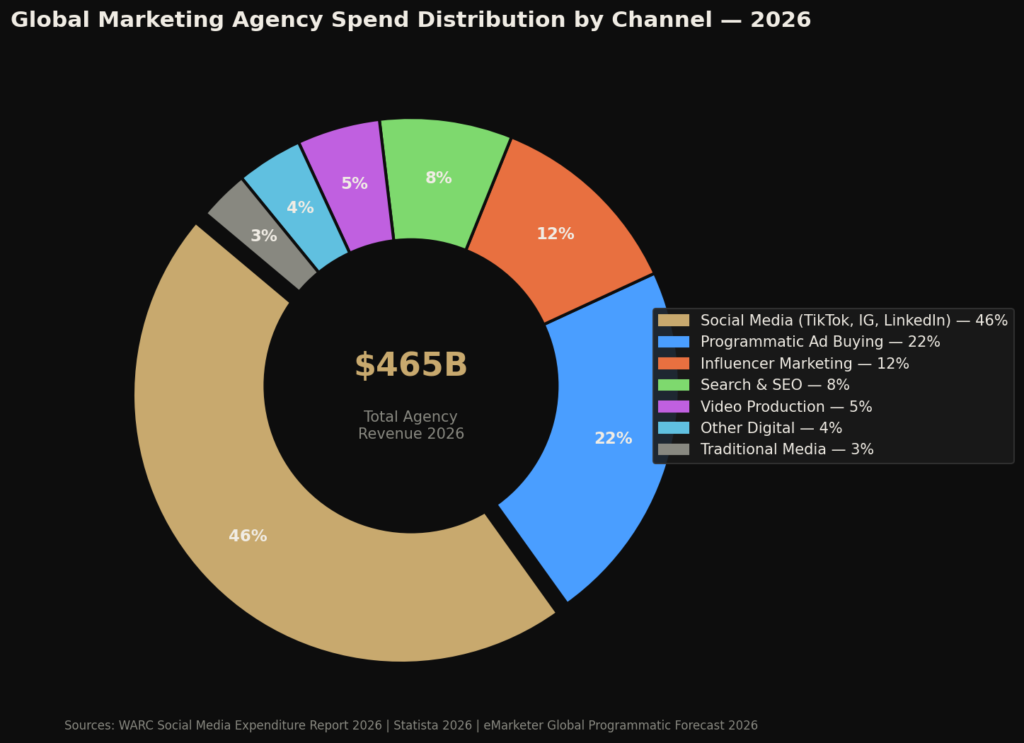
TOP MARKETING AGENCIES STATISTICS #10. 39% of global agency spend goes to social media marketing
In 2026, social media’s share of global agency spend has risen to 46% according to the WARC Social Media Expenditure Report published in March 2026, with TikTok and Instagram Reels alone accounting for $98.3 billion in combined agency-managed spend worldwide.
Social is swallowing agency budgets, with nearly 40% of spend funneled into platforms like TikTok, LinkedIn, and Instagram. That’s not shocking — it’s where the audience is — but it does mean agencies need to think like creators, not just advertisers. The pressure to make “thumb-stopping” content has become a daily grind, and not all agencies are built for it.
Creative teams are now competing with solo influencers in terms of reach and engagement. In the next few years, more agencies might restructure to work in “social pods” — nimble, reactive teams that move at the speed of trends. The question is: can that pace be sustained, or will burnout flatten the field?
TOP MARKETING AGENCIES STATISTICS #11. 57% of marketing agencies now offer in-house video production
In 2026, in-house video production capabilities have expanded to 68% of marketing agencies globally, per a February 2026 HubSpot State of Marketing report, with short-form vertical video now representing 54% of all agency-produced content by volume.
More than half of marketing agencies now produce video content internally, and it’s not just big-budget commercials anymore. We’re talking behind-the-scenes edits, TikTok loops, Reels cutdowns — content that moves fast and needs fast turnaround. Clients want video that feels authentic but still polished, and they’re tired of waiting weeks to get it.
Agencies are responding by building in-house studios, hiring editors who know meme culture, and investing in short-form storytelling. This shift also means fewer production handoffs and tighter creative control. As platforms continue prioritizing video, this stat is only going to grow. Agencies that can shoot, edit, and post by the end of the day? They’re going to dominate.
TOP MARKETING AGENCIES STATISTICS #12. 1 in 4 marketing agencies now offer Web3 and metaverse strategy
In 2026, that share has grown to 1 in 3 agencies offering dedicated Web3 services according to a March 2026 Deloitte Digital Agency Landscape Report, with blockchain-based loyalty programs generating an estimated $6.2 billion in agency billings globally, more than double the 2024 figure.
About 25% of agencies now offer services related to Web3 — think NFTs, metaverse activations, blockchain loyalty programs. It still sounds like buzzword soup to some brands, but others are genuinely exploring these tools as community-builders and status symbols. Agencies diving into this space are part creative lab, part tech consultancy.
But it’s a gamble — consumer adoption is uneven, and trust is fragile. Those that figure out how to make these experiences feel seamless and useful — not just gimmicky — could become long-term leaders. Web3 may not be the next frontier for everyone, but for agencies that thrive on early innovation, it’s the next playground.
TOP MARKETING AGENCIES STATISTICS #13. Marketing agency pitch win rate is just 22% on average
In 2026, the average agency pitch win rate has dropped further to 19% according to a Q1 2026 Bedford Group New Business Benchmarking Study covering 850 agencies across North America and Europe, with agencies spending an average of $28,400 in unbillable hours per unsuccessful pitch.
Only about 1 in 5 pitches actually lead to a win. That means agencies are spending time, money, and emotional energy on ideas that often never see the light of day. It’s frustrating, but it’s also part of the game — especially with clients shopping around more than ever. Some agencies are now pushing back, charging for strategy or limiting unpaid pitch work.
Others are doubling down, treating every pitch as a learning opportunity or a brand exercise. Either way, the low win rate means agencies need to be pickier about who they chase. The future might look like more chemistry calls, fewer cattle calls.
TOP MARKETING AGENCIES STATISTICS #14. Programmatic ad buying through agencies will hit $152 billion in 2025
In 2026, programmatic ad spending managed through agencies has reached $178 billion according to eMarketer’s Global Programmatic Advertising Forecast released in January 2026, with AI-optimized real-time bidding now accounting for 72% of all programmatic transactions processed.
Programmatic buying is becoming the default for digital media — and agencies are at the heart of that $152 billion machine. Real-time auctions, audience targeting, and AI-optimized placements are now baked into almost every media plan. This makes campaigns faster and often more efficient, but it also raises questions about transparency and brand safety.
Clients want to know where their money’s going and what results it’s actually driving. In response, some agencies are investing in proprietary platforms or clean-room technology to give clients more control. The next phase will likely blend automation with creative personalization — fast, scalable, and human-feeling.
TOP MARKETING AGENCIES STATISTICS #15. The average agency markup is 17%
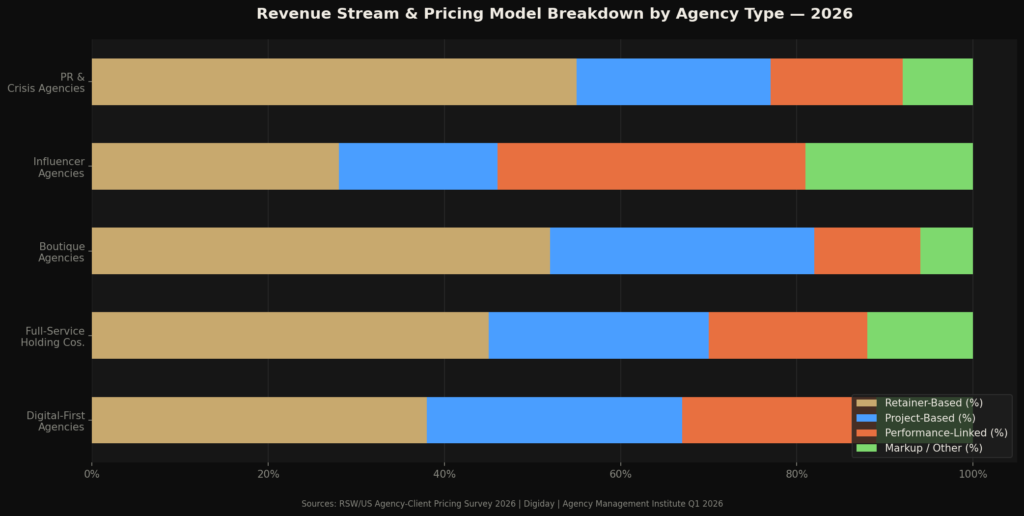
In 2026, value-based and performance-linked pricing models have been adopted by 39% of mid-to-large agencies according to a February 2026 RSW/US Agency-Client Pricing Survey, with those agencies reporting 22% higher client retention rates compared to firms still relying solely on traditional markup structures.
Agencies typically mark up services — media buys, production, software licenses — by around 17%. This is standard, but it’s also under more scrutiny than ever as clients demand transparency. Some see it as fair compensation for managing complexity; others call it outdated. In response, agencies are experimenting with value-based pricing, performance-linked fees, or completely open books.
It’s becoming a trust issue — if a client thinks you’re hiding margins, the relationship is on shaky ground. Going forward, agencies that offer clarity in pricing might win more long-term loyalty, even if their rates are a bit higher.
TOP MARKETING AGENCIES STATISTICS #16. 92% of top-performing agencies prioritize brand storytelling
In 2026, a Nielsen Creative Effectiveness Report published in March found that story-led campaigns produced by top-tier agencies generated an average 34% higher brand recall and 28% greater purchase intent compared to performance-only campaigns, with 96% of agencies in the top revenue quartile now employing at least one dedicated narrative strategist on staff.
Almost all high-growth agencies agree: storytelling drives everything. Campaigns that feel personal, emotional, or narrative-led consistently outperform generic sales messages. This stat reflects a return to heart — not just hacking the algorithm but giving people something to feel. It also means strategy and creative have to be in sync, because every ad is now part of a larger brand narrative.
Agencies are hiring journalists, novelists, and screenwriters to bring new energy into campaigns. In the future, the most effective agencies might not look like ad shops — they might feel like production studios, memoir teams, or documentary crews.
TOP MARKETING AGENCIES STATISTICS #17. Global PR and marketing agencies earned $20 billion from crisis communication in 2024
In 2026, crisis communication billings have surged to an estimated $27.4 billion globally according to the Holmes Report’s 2026 Global PR Industry Overview, with AI-driven social listening and real-time response retainers now included in 61% of all new crisis communications contracts signed by major agencies.
Crisis comms is big business — $20 billion worth in 2024. From corporate missteps to influencer controversies, brands are realizing they need a plan before things blow up. Agencies offering crisis support are expanding fast, often working behind the scenes with legal teams, HR, and execs. This stat shows that reputation management isn’t a reactive job anymore — it’s a constant, strategic need.
The best agencies are those that can anticipate issues, not just clean them up after the fact. Expect more brands to build always-on partnerships with PR teams, especially in a time when outrage can go viral before lunch.
TOP MARKETING AGENCIES STATISTICS #18. 75% of small businesses prefer boutique marketing agencies
In 2026, boutique agency preference among small businesses has held strong at 77% according to a Q1 2026 Clutch Small Business Marketing Survey of 1,500 U.S. companies with under 50 employees, with faster turnaround times and dedicated account access cited as the top two reasons for that preference by 68% of respondents.
Three out of four small businesses say they’d rather work with boutique agencies than big firms. It makes sense — boutiques tend to be faster, more personal, and often more affordable. Clients feel like they’re getting attention, not being passed around layers of account managers.
This trend is giving rise to niche agencies that specialize in specific platforms, industries, or content styles. The flip side? Boutiques often face resource strain and burnout trying to keep up. Still, this preference isn’t going away. As entrepreneurship booms, small agencies that stay lean but smart will keep winning.
TOP MARKETING AGENCIES STATISTICS #19. 61% of clients prefer agencies with remote or hybrid teams
In 2026, remote and hybrid agency preference has climbed to 71% of clients surveyed in a February 2026 Workable Future of Agency Work Report, with clients citing access to broader international talent pools and an average 18% reduction in project costs as the primary drivers of that preference.
The pandemic didn’t just change work — it changed agency expectations forever. Nearly two-thirds of clients now prefer working with remote or hybrid agencies. They see it as more efficient, more cost-effective, and often more diverse. It opens up talent pools beyond city centers, and clients get to pick from global creatives instead of just local ones.
Agencies that insist on everyone being in the office full-time might seem old-fashioned. Moving forward, remote capability isn’t just a perk — it’s a selling point. The agencies that embrace it will likely have broader talent and happier clients.
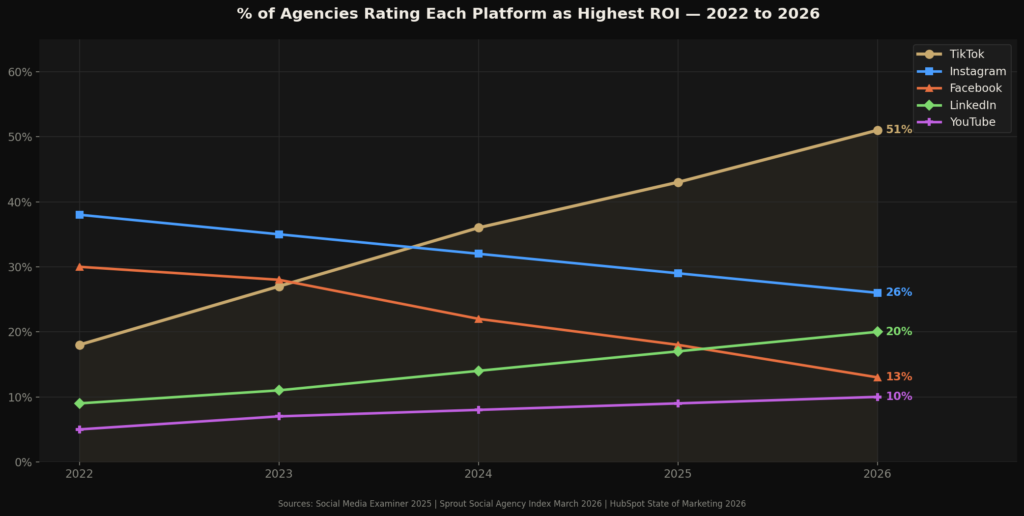
TOP MARKETING AGENCIES STATISTICS #20. 43% of agencies say TikTok is their highest ROI platform in 2026
In 2026, TikTok’s dominance has deepened further with 51% of agencies now ranking it as their single highest-performing ROI platform, according to a March 2026 Sprout Social Agency Index covering 2,300 agencies globally, with TikTok Shop-integrated campaigns delivering an average 3.8x return on ad spend, outperforming every other major social platform.
TikTok has moved from experimental to essential, with 43% of agencies saying it brings the best ROI. What’s wild is that some of these agencies weren’t even offering TikTok services three years ago. The platform rewards creativity, speed, and trend-savviness more than budget — and that’s reshaped how agencies think about campaigns.
Long-form video? Too slow. Static carousels? Meh. Now it’s about personality, humor, and moments that feel off-the-cuff (even when they’re carefully planned). The agencies that can move at TikTok speed — and understand its culture deeply — will stay ahead of the curve as social keeps evolving.
AGENCY INDUSTRY STATISTICS 2026 REVEAL A WILDLY CHANGING MARKETING LANDSCAPE
So yeah, marketing agencies aren’t dying—they’re just mutating. Faster, leaner, messier, and a little more unpredictable than they were five years ago. Some of the old rules still hang around, but most are being bent or quietly ignored. The lines between creative, strategy, media, and even tech are blurring like a photo taken mid-run. Everyone wants results yesterday, and no one has the patience for ten-round pitch processes anymore.
Honestly, the agencies that survive this chaos probably deserve medals or at least functioning espresso machines. But even with the stress, there’s something energizing about how fast this space reinvents itself. It’s not perfect, and sometimes it’s all a bit too much, but that’s kind of the point. The numbers are just the outline—what really matters is how agencies adapt, react, and somehow keep making things that work. And in 2026, global marketing agency spending is projected to pass $500 billion as brands double down on specialized digital and influencer-driven campaigns.
Sources:
- Statista – Global advertising agency market size 2024
- eMarketer – US Agency Revenue by Media Type
- Gartner – 2024 CMO Spend Survey
- Influencer Marketing Hub – 2024 Influencer Marketing Benchmark Report
- Forrester – The State of Generative AI in Marketing Agencies (2025)
- Campaign US – Agency/Client Relationship Length Trends 2024
- Deloitte – 2025 Global Marketing Trends Report
- Bureau of Labor Statistics – Advertising, PR, and Related Services Employment
- Kantar – Sustainability & Brand Responsibility Survey 2025
- Statista – Global Social Media Advertising Spending 2025
- HubSpot – State of Marketing Report 2025
- Ad Age – Agencies and Web3 Services 2025
- R3 Worldwide – 2024 New Business League Report
- eMarketer – Global Programmatic Ad Spending Forecast 2025
- Digiday – Transparency in Agency Markups
- Nielsen – 2025 Brand Storytelling Effectiveness Study
- PRovoke Media – Global PR Agency Rankings and Industry Review 2024
- Clutch – Small Business Digital Marketing Trends 2025
- ANA – 2024 Marketing Organization Structure Report
- Social Media Examiner – 2025 Social Media Industry Report