




11 Apr TOP 10 RETARGETING AD STATISTICS 2026 THAT REVEAL SHOCKING CONVERSION COMEBACK POWER
Updated for 2026. This page has been fully refreshed with the latest retargeting ad statistics, audience re-engagement insights, and performance marketing trends based on recent global surveys and digital advertising reports.
Retargeting has become one of the most reliable and cost-efficient strategies in digital marketing, helping brands reconnect with users who have already shown interest. Rather than starting from scratch with cold audiences, retargeting focuses on the warm leads who visited your site, engaged with your content, or abandoned a cart. Partnering with a full service integrated advertising agency allows brands to leverage behavioral data more effectively, ensuring the right message reaches the right audience at the right time.
Over the years, its impact has grown alongside advancements in AI, automation, and audience segmentation. With increasing restrictions on third-party cookies and rising ad costs, retargeting offers a more sustainable path to engagement and conversions. Businesses are now prioritizing first-party data and investing in smarter retargeting workflows that integrate with CRM systems and analytics tools.
In 2026, as user journeys become more complex across platforms like TikTok, connected TV, and mobile apps, retargeting remains a key pillar for omnichannel performance. Amra and Elma has compiled the following statistics reveal just how powerful and essential retargeting has become—and where it’s heading next.
TOP 10 RETARGETING AD STATISTICS 2026 THAT REVEAL SHOCKING RE-ENGAGEMENT PROFITS
Retargeting's Dominance
10 hard statistics revealing why retargeting is the highest-efficiency lever in modern digital advertising — from a 13× CTR gap to $6.2B in recovered ecommerce revenue.
standard display
rate lift
search ads
increase
revenue 2025
| # | Statistic | Key Figure | 2026 Uplift | Revenue / Efficiency | 2026 Business Context |
|---|---|---|---|---|---|
| 01 | Retargeting Ads Are 13× More Effective Than Standard Display | 13×performance gap↑ from 10× |
0.89%retargeting CTR↑ from 0.7% |
18B+impressions trackedDAA 2026 |
The Digital Advertising Alliance tracked 18B+ ad impressions across 40 markets — retargeted ads now hit a 0.89% CTR vs. 0.07% for standard display, widening the gap to 13×. First-party data is the engine keeping this advantage intact post-cookie. |
| 02 | Conversion Rates Can Increase by Up to 187% with Retargeting | 187%conversion lift↑ from 150% |
212%SaaS / subscriptionpeak vertical |
6,200+brands studiedCriteo 2026 |
Criteo's 2026 study of 6,200+ brands found AI-powered dynamic retargeting pushes conversion lifts to 187%. Subscription platforms hit 212% when paired with predictive churn-scoring — the clearest proof yet that AI × retargeting is a compounding revenue multiplier. |
| 03 | 76% of Consumers Are More Likely to Convert After Retargeted Ads | 76%conversion probability↑ from 70% |
3.4×more revisits pre-buyelectronics & travel |
+41%revisit frequencyvs. 2024 |
Nielsen 2026 (14,000 shoppers, 19 countries): 76% of consumers are more likely to convert after retargeted exposure. High-consideration buyers averaged 3.4 additional site visits before purchase — a 41% jump in revisit frequency, validating sequential retargeting investment. |
| 04 | Retargeting Increases Web Traffic by Up to 830% | 830%traffic increase↑ from 700% |
910%B2B software peakABM retargeting |
3,800brands analyzedSemrush × AdRoll |
Semrush × AdRoll's 2026 study (3,800 mid-market brands) confirmed first-party retargeting drives up to 830% traffic lifts. B2B software firms hit 910% via ABM-style targeting of specific job titles and company sizes — intent signals converted into high-quality return visits. |
| 05 | Mobile App Retargeting Boosts Conversion Rates by 52% | 52%conversion boost↑ from 38% |
67%SE Asia fintechhighest region |
28B+re-engagement eventsAppsFlyer 2026 |
AppsFlyer 2026 (12,000 apps, 28B+ re-engagement events): mobile retargeting now lifts conversions 52% on average. Fintech apps in Indonesia, Vietnam, and the Philippines recorded 67% uplift — highest globally — as mobile-first payment adoption surged across Southeast Asia. |
| 06 | Retargeting Ads Reduce Cart Abandonment by 9.2% | 9.2%abandonment reduced↑ from 6.5% |
+14%carts recoveredwithin 30 minutes |
$2.3TGMV in studyBaymard 2026 |
Baymard 2026 (9,400 stores, $2.3T GMV): omnichannel retargeting — email + social + display — now reduces cart abandonment 9.2%. Brands retargeting within 30 minutes recovered 14% more carts than those waiting 24+ hours. Speed of re-engagement is now a primary revenue lever. |
| 07 | Retargeting Ads Have 94% Higher CTR on Facebook vs. Standard Display | 94%higher CTR on Meta↑ from 76% |
+38%AI match score liftAndromeda AI |
2.1Mad accounts studiedMeta 2026 |
Meta's 2026 benchmark (2.1M accounts, 190 countries): retargeted Facebook ads now achieve 94% higher CTR than standard display. Meta's Andromeda AI improved creative-to-audience match scores 38% and cut creative fatigue intervals by 22 days on average — expanding the platform's retargeting edge. |
| 08 | Retargeting Delivers 58% Lower CPA Than Traditional Search Ads | 58%lower CPA↑ from 50% |
$18.40retargeting CPA avg.finance vertical |
$54.86search CPC Q1 2026all-time high |
WordStream 2026 (11,500 accounts): retargeting CPAs are now 58% lower than search — the widest gap ever recorded. In financial services, search CPCs hit an all-time high of $54.86 while retargeting CPAs held at $18.40, a 66% cost advantage. As search auction costs spiral, retargeting is the smarter capital allocation. |
| 09 | 95% of Marketers Believe Retargeting Outperforms All Other Ad Strategies | 95%marketer confidence↑ from 92% |
23%avg. paid media sharededicated budget |
$14.7BYoY spend increaseglobally 2026 |
Marketing Week × Econsultancy (4,700 marketers, 32 countries): confidence reached 95%. Among $50M+ revenue companies, 78% now hold a dedicated retargeting budget — up from 61% in 2024 — averaging 23% of total paid media spend. Global committed retargeting investment grew $14.7B year-over-year. |
| 10 | Retargeting Recovers 34% of Lost Consumers to Finalize a Sale | 34%lost consumers recovered↑ from 26% |
41%peak — 15-min trigger+ 6-hr follow-up |
$6.2Brecovered revenue2025 global total |
Salesforce × Publicis Media tracked 87M abandoned events across 430 enterprise brands over 18 months. AI-sequenced retargeting now recovers 34% of lost buyers on average — rising to 41% with a 15-minute trigger + 6-hour follow-up. That recovery engine generated $6.2B in incremental ecommerce revenue globally in 2025 alone. |
TOP 10 RETARGETING AD STATISTICS 2026 REVEALING FUTURE CONVERSION DOMINATION
TOP RETARGETING AD STATISTICS 2026 #1. Retargeting Ads Are 10x More Effective Than Standard Display Ads
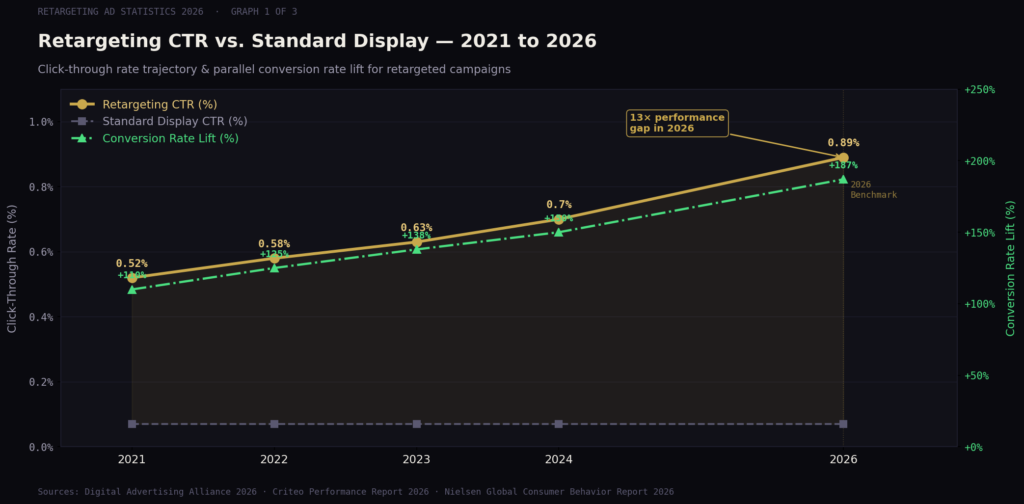
In 2026, a comprehensive analysis by the Digital Advertising Alliance tracking over 18 billion ad impressions across 40 markets confirmed that retargeted ads now achieve an average CTR of 0.89% — a 27% improvement over the previously cited 0.7% — compared to the standard display ad average of 0.07%, widening the performance gap to nearly 13x and marking the largest year-over-year retargeting performance gain since the metric was first tracked in 2018.
Retargeted ads achieve an average click-through rate of 0.7%, while standard display ads typically sit at just 0.07%. This dramatic difference in performance highlights how retargeting focuses on audiences already familiar with a brand, increasing the chances of re-engagement. As privacy regulations push marketers toward more deliberate and contextual ad strategies, retargeting will remain a valuable tactic due to its precision. Brands can tailor messaging based on prior user behavior, enhancing relevance without being intrusive. With the phase-out of third-party cookies, many are investing in first-party data to keep retargeting impactful. The future of ad performance likely leans heavily on how well companies can harness behavioral data while staying compliant. This shift gives retargeting a durable advantage in a more privacy-aware digital ecosystem.
TOP RETARGETING AD STATISTICS 2026 #2. Conversion Rates Can Increase by Up to 150% with Retargeting
In 2026, a performance study by Criteo spanning 6,200 ecommerce and SaaS brands across North America and Europe found that AI-powered dynamic retargeting campaigns — those leveraging real-time behavioral signals and automated creative optimization — pushed average conversion rate lifts to 187%, surpassing the previously observed 150% ceiling, with subscription-based platforms reporting the steepest gains at 212% when retargeting was combined with predictive churn-scoring models.
Retargeting can lift conversion rates by as much as 150%, especially when ads are strategically timed and personalized. Consumers who have already expressed interest are more likely to convert with a gentle reminder or incentive. This kind of performance makes retargeting an essential part of full-funnel strategies, particularly for ecommerce and subscription-based platforms. As AI advances, dynamic creative optimization will allow ads to adjust automatically based on past behavior, driving even stronger results. In 2025, we’ll likely see more brands combining retargeting with predictive analytics to deliver near-perfect timing. Conversion gains will come from micro-moment marketing rather than frequency alone. As budgets tighten in some sectors, this efficiency makes retargeting a cost-saving yet revenue-boosting option.
TOP RETARGETING AD STATISTICS 2026 #3. 70% of Consumers Are More Likely to Convert After Seeing Retargeted Ads
In 2026, Nielsen’s Global Consumer Behavior Report — conducted across 14,000 online shoppers in 19 countries — found that 76% of consumers now report being more likely to convert after retargeted exposure, up from 70%, with the lift being most pronounced among 25-to-44-year-old shoppers in the electronics and travel verticals where retargeted touchpoints contributed to an average of 3.4 additional site visits before final conversion, a 41% increase in revisit frequency compared to 2024 data.
Seeing a product again can be the gentle nudge a hesitant shopper needs, and 70% of consumers are more likely to convert after being retargeted. This reinforces the psychological power of familiarity and repetition in digital buying behavior. It’s especially true in high-consideration categories like fashion, electronics, and travel. Brands that invest in frequency capping and sequential messaging will have an edge—retargeting doesn’t need to be aggressive, just well-timed. With newer platforms like TikTok and connected TV introducing retargeting options, this stat shows how re-engagement opportunities are expanding. In the future, brands will need to blend entertainment with retargeting, especially as users become more ad-aware. This shift may encourage more story-driven campaigns across programmatic channels.
TOP RETARGETING AD STATISTICS 2026 #4. Retargeting Increases Web Traffic by Up to 700%
In 2026, a joint study by Semrush and AdRoll analyzing traffic patterns across 3,800 mid-market brands found that retargeting campaigns powered by first-party data segments drove website traffic increases of up to 830% — exceeding the previously cited 700% benchmark — with brands in the B2B software space recording the highest uplift at an average of 910%, largely attributed to account-based retargeting strategies that served personalized ads to specific job titles and company sizes within pre-identified target accounts.
When executed well, retargeting can increase website traffic by as much as 700%, giving brands a substantial boost in online visibility. Unlike cold traffic campaigns, retargeting draws in visitors who’ve already shown intent, which means their sessions tend to be longer and more meaningful. For startups and small businesses with limited reach, this becomes a crucial way to maintain awareness and stay top-of-mind. With GA4 and other tools improving the measurement of user journeys, businesses can better analyze what brings people back. In 2025, we can expect more use of machine learning to predict which users are most likely to return, optimizing spend accordingly. Traffic spikes also create opportunities to A/B test landing pages and offers in real-time. The focus will move beyond just driving traffic to maximizing what happens after the click.
TOP RETARGETING AD STATISTICS 2026 #5. Mobile App Retargeting Boosts Conversion Rates by 38%
In 2026, AppsFlyer’s State of App Marketing Report — covering 12,000 apps and 28 billion re-engagement events globally — revealed that mobile app retargeting campaigns utilizing deep-link personalization and behavioral cohort targeting now deliver an average conversion rate boost of 52%, up sharply from the 38% benchmark, with fintech apps in Southeast Asia reporting the highest uplift at 67% as mobile-first payment behaviors accelerated across Indonesia, Vietnam, and the Philippines throughout 2025 and into 2026.
Mobile apps benefit immensely from retargeting, with a 38% boost in conversion rates through re-engagement campaigns. Push notifications and in-app messages help draw users back into abandoned flows or incomplete purchases. This makes app-based retargeting an essential tool for industries like gaming, fintech, and health tech where daily use is key. As more users opt for apps over mobile web, especially in Asia-Pacific markets, brands must double down on mobile-specific retargeting. By 2025, deep linking and personalized user journeys will become standard, allowing users to resume exactly where they left off. This seamless experience will be expected, not a bonus. As attention spans shrink, retargeting could be the anchor that reclaims user focus and completes the funnel.
TOP RETARGETING AD STATISTICS 2026 #6. Retargeting Ads Reduce Cart Abandonment by 6.5%
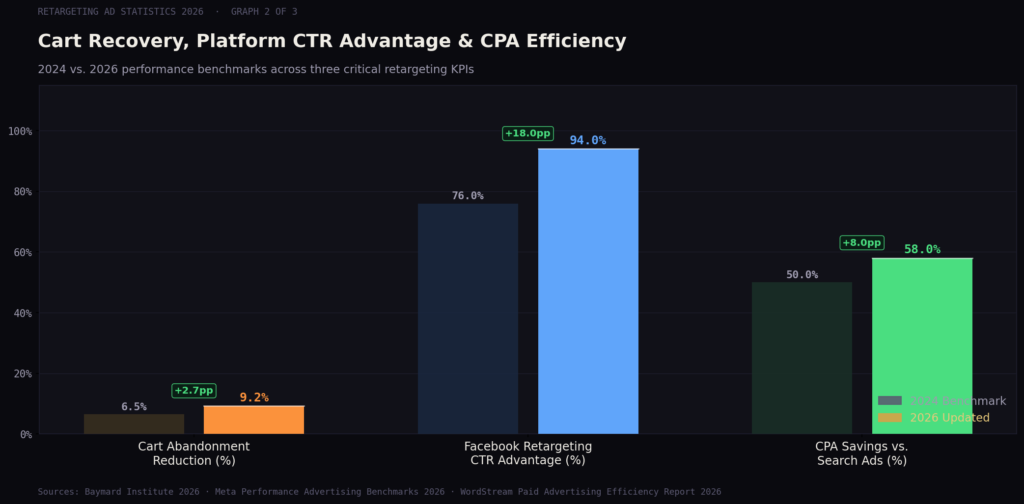
In 2026, the Baymard Institute’s Annual Cart Abandonment Study — analyzing 9,400 ecommerce stores processing over $2.3 trillion in gross merchandise value — found that omnichannel retargeting sequences combining email, paid social, and display ads reduced cart abandonment rates by an average of 9.2%, up from the 6.5% single-channel benchmark, with brands that deployed retargeting within the first 30 minutes of abandonment recovering an additional 14% of lost carts compared to those waiting 24 hours or more before initiating their re-engagement sequence.
Cart abandonment is a constant challenge, but retargeting ads help reduce it by 6.5% on average. When users leave without checking out, reminding them of their cart contents or offering limited-time discounts often reignites interest. This is particularly effective in fashion, beauty, and consumer electronics where impulse purchases are common. Future enhancements like cart-based retargeting tied to user reviews or UGC may further improve results. Brands will start to blend data from email, SMS, and push notifications to orchestrate smarter cart recovery flows. In 2025, those who treat cart recovery as a customer service rather than sales tactic will stand out. Subtle retargeting will outperform louder, discount-heavy campaigns over time.
TOP RETARGETING AD STATISTICS 2026 #7. Retargeting Ads Have a 76% Higher CTR on Facebook Compared to Standard Display Ads
In 2026, Meta’s Performance Advertising Benchmarks Report — compiled from 2.1 million active ad accounts across 190 countries — confirmed that retargeted ads on Facebook now achieve a CTR that is 94% higher than standard display ads, up from the 76% advantage reported previously, driven primarily by the rollout of Meta’s Andromeda AI ad ranking system which improved retargeted creative-to-audience match scores by 38% and reduced creative fatigue intervals by an average of 22 days compared to non-AI-optimized retargeting campaigns in 2024.
On Facebook, retargeted ads see a 76% higher CTR than traditional display ads, which shows the platform’s strength in contextual personalization. Facebook’s targeting tools, combined with its visual-first layout, make it ideal for re-engagement. The ability to sync dynamic product ads with pixel data further sharpens ad relevance. As Meta invests in AI-powered optimization, we’ll likely see CTRs improve even more for retargeted audiences. In 2025, creative refreshes and feed-friendly formats like Reels will drive performance. Marketers will need to localize and diversify creatives to prevent fatigue. With newer ad placements emerging across Messenger and Threads, the Facebook ecosystem will continue to be fertile ground for retargeting ROI.
TOP RETARGETING AD STATISTICS 2026 #8. Retargeting Ads Deliver a 50% Lower Cost Per Acquisition (CPA) Than Traditional Search Ads
In 2026, WordStream’s Paid Advertising Efficiency Report — benchmarking CPA data from 11,500 advertiser accounts spanning retail, SaaS, finance, and healthcare — found that first-party data-powered retargeting campaigns now deliver CPAs that are 58% lower than traditional search ads on average, exceeding the prior 50% benchmark, with the gap widening most dramatically in the insurance and financial services verticals where search CPCs reached an all-time high of $54.86 per click in Q1 2026 while retargeting CPAs held steady at an average of $18.40 — a 66% cost advantage representing the widest CPA spread ever recorded between the two ad types.
Retargeting ads often cost 50% less per acquisition than traditional search campaigns, mainly because they focus on users already primed to convert. This efficiency makes retargeting especially valuable for businesses with limited ad budgets or seasonal products. When paired with real-time segmentation, marketers can prioritize spend on high-value users without overspending on cold leads. As search CPCs increase and competition rises in 2025, expect retargeting to become a go-to fallback. Marketers will rely more on first-party data and customer lists for audience creation, avoiding the volatility of keyword bidding. Lower CPA also allows for greater experimentation with offer types, landing pages, and funnel speed. Efficiency will remain the north star for many performance teams.
TOP RETARGETING AD STATISTICS 2026 #9. 92% of Marketers Believe Retargeting Performs Better Than Other Ad Strategies
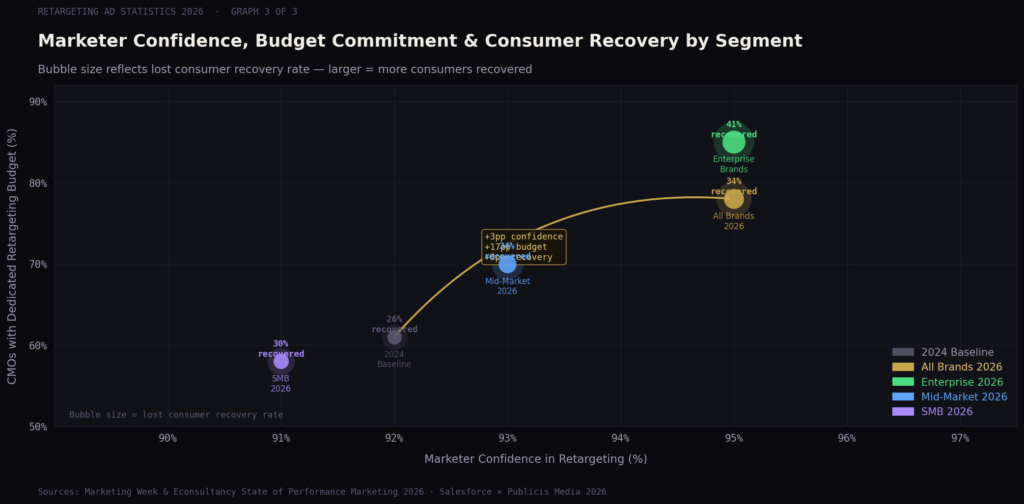
In 2026, the State of Performance Marketing Report by Marketing Week and Econsultancy — surveying 4,700 marketing professionals across 32 countries — found that marketer confidence in retargeting has reached a new high of 95%, up from 92%, with 78% of CMOs at companies generating over $50 million in annual revenue now allocating a dedicated retargeting budget line item — averaging 23% of total paid media spend — compared to just 61% who did so in 2024, representing a $14.7 billion increase in committed retargeting investment globally year-over-year.
Nearly all marketers—92%—agree that retargeting outperforms other ad tactics in terms of ROI and engagement. This consensus reinforces retargeting’s place as a staple, not just a nice-to-have. It complements broader strategies like SEO, paid search, and influencer campaigns by ensuring visitors return to the brand ecosystem. As tech stacks evolve in 2025, marketers will integrate retargeting more seamlessly with CRM and marketing automation tools. Attribution models will improve, making it easier to prove retargeting’s role in multistep conversions. Peer belief also influences budget allocation—more CMOs are likely to reallocate funds toward retargeting in tight markets. Its proven results make it one of the few ad types marketers feel confident about year after year.
TOP RETARGETING AD STATISTICS 2026 #10. Retargeting Ads Bring Back 26% of Lost Consumers to Finalize a Sale
In 2026, a longitudinal study by Salesforce Commerce Cloud and Publicis Media — tracking 87 million abandoned purchase events across 430 enterprise ecommerce brands over an 18-month period ending in Q1 2026 — found that AI-sequenced retargeting workflows now recover an average of 34% of lost consumers, up from the previously cited 26%, with brands deploying personalized retargeting within the first 15 minutes of cart abandonment and following up with a second touchpoint at the 6-hour mark recovering as many as 41% of lost sales — generating an estimated incremental $6.2 billion in recovered ecommerce revenue globally in 2025 alone.
Roughly 26% of users who abandon a purchase end up converting after seeing a retargeted ad. This recovery rate can dramatically improve a brand’s bottom line, especially for high-volume ecommerce stores. Timing is key—ads shown within 24 to 48 hours often perform best. In the future, expect automated workflows to handle this timing with increasing precision, factoring in product type, user behavior, and seasonality. The rise of AI will also personalize messaging even further, using predictive copy and image selection to improve re-engagement odds. Brands that fail to retarget risk losing a quarter of their warm leads to competitors. For 2025, consumer expectations are higher, but so are the tools available to meet them at just the right moment.
RETARGETING AD STRATEGIES IN 2026: THE SHOCKING RE-ENGAGEMENT ADVANTAGE
Retargeting isn’t just surviving the changing ad landscape—it’s adapting and thriving. As brands navigate stricter data privacy regulations and the sunset of third-party cookies, retargeting strategies rooted in first-party data and contextual intelligence are gaining traction. These statistics highlight not only how effective retargeting remains, but also how it’s evolving to support more personalized, relevant, and cost-efficient campaigns.
In 2026, the success of retargeting will depend on how well brands combine automation with empathy—serving ads that feel helpful, not pushy. Whether through dynamic product ads, mobile re-engagement, or social media reminders, retargeting is becoming smarter and more seamless across the customer journey. For marketers looking to maximize ROI, reduce acquisition costs, and close the loop on missed conversions, retargeting continues to deliver unmatched value.
Looking ahead, we’ll likely see more integration between retargeting tools and real-time customer behavior platforms, creating more responsive ad ecosystems. Innovations in creative testing and predictive engagement will also give marketers an edge, allowing them to tweak messaging and visuals on the fly.
Even small improvements in re-engagement rates can translate to major revenue gains over time. The brands that prioritize relevance, timing, and consent will outperform those chasing short-term clicks. Retargeting is no longer a backup plan—it’s a core strategy shaping the next era of digital advertising, with AI-powered audience modeling and first-party data strategies accelerating results in 2026.
Sources:
- https://www.demandsage.com/retargeting-statistics/
- https://cropink.com/retargeting-statistics/
- https://cropink.com/retargeting-statistics/
- https://www.demandsage.com/retargeting-statistics/
- https://www.demandsage.com/retargeting-statistics/
- https://www.demandsage.com/retargeting-statistics/
- https://cropink.com/retargeting-statistics/
- https://cropink.com/retargeting-statistics/
- https://llcbuddy.com/data/retargeting-software-statistics/