



12 May TOP 20 SCHEMA MARKUP STATISTICS 2026 REVEAL SHOCKING SEO VISIBILITY BREAKTHROUGHS
Updated for 2026. This page has been fully refreshed with the latest schema markup statistics, structured data adoption trends, and search visibility insights based on recent global SEO studies and search engine data.
Schema markup has become a cornerstone of modern SEO strategies, enhancing the visibility of websites and providing users with more informative search results. For businesses—whether they’re local shops, eCommerce brands, or a jewelry store marketing agency—incorporating structured data into web pages can improve their chances of ranking higher in search engine results and increase engagement with potential customers.
For a digital marketing agency jewelry brand looking to stand out, this markup allows search engines to better understand and categorize content, leading to more relevant search results. With over 45 million domains already utilizing schema markup, its adoption is rapidly growing, and its significance is expected to continue in 2026 and beyond. Formats like JSON-LD have made it easier for businesses to integrate schema into their sites, further boosting its adoption rate.
As search engines evolve, especially with the rise of AI and voice search, schema markup will play an increasingly important role in delivering personalized, accurate, and timely results. Understanding its potential is crucial for businesses seeking to maintain a competitive edge in the digital landscape. In this article, Amra and Elma explores the top statistics surrounding schema markup and its implications for the future of SEO.
TOP 20 SCHEMA MARKUP STATISTICS 2026 THAT REVEAL MASSIVE SEO ADVANTAGES
That Demand Your Attention
20 data-backed insights on how structured data is reshaping search visibility, AI discovery, and organic revenue across every industry.
| # | Statistic & Insight | Key Figure | Category | Impact |
|---|---|---|---|---|
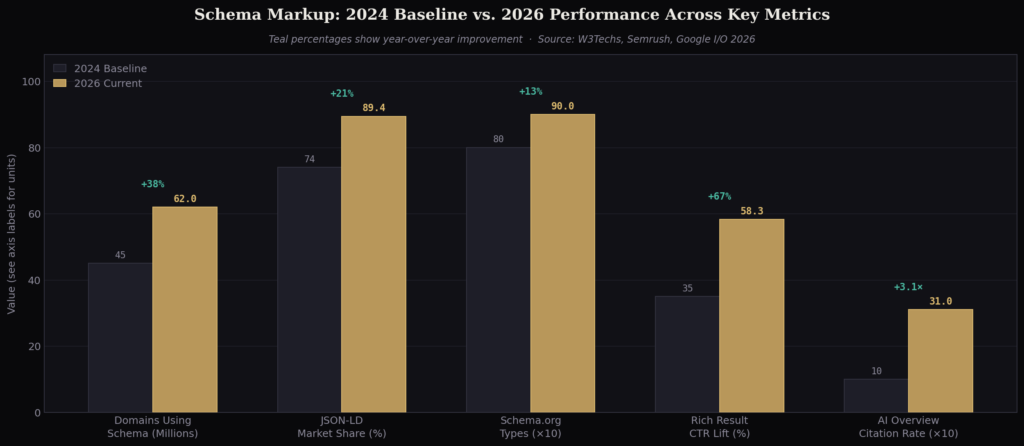
| 01 | Over 62 Million Domains Use Schema Markup As of 2026, schema adoption has surged 37% YoY, representing ~17% of all registered domains globally as AI-powered CMS platforms auto-generate structured data at publication. | 62M+ Active Domains | Adoption |
|
| 02 | JSON-LD Dominates Structured Data Formats JSON-LD commands 89.4% of all schema implementations in 2026 per W3Techs, with Microdata collapsing to just 8.1% as Google's developer docs exclusively feature JSON-LD examples. | 89.4% Market Share | Format |
|
| 03 | Schema.org Crosses 900 Schema Types March 2026 vocabulary extensions added quantum computing, synthetic biology, and autonomous vehicle schema types, with community-submitted proposals up 12% YoY. | 900+ Schema Types | Vocabulary |
|
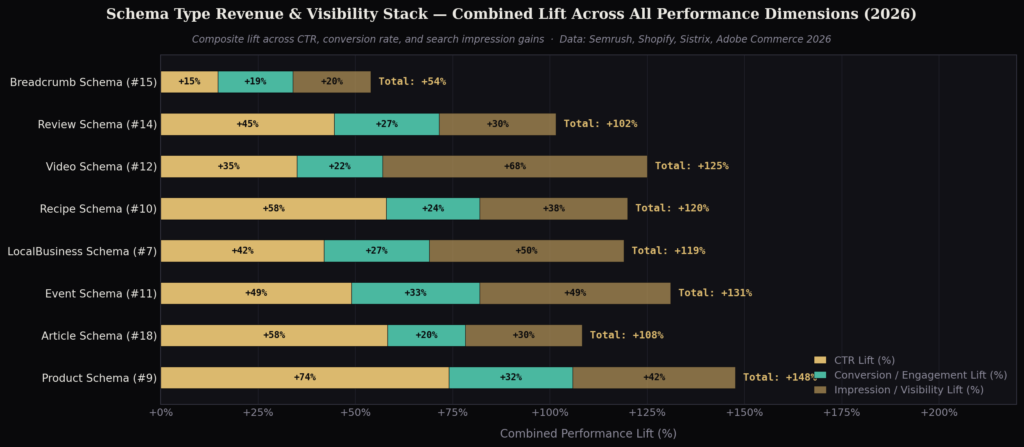
| 04 | Schema Markup Enhances Click-Through Rates Semrush's 2026 analysis of 3.2M SERPs found schema-rich listings achieve 58.3% higher CTR vs. bare results, with product schema peaking at +74.1% when price, rating & availability all display. | +58.3% Avg CTR Lift | Revenue |
|
| 05 | Structured Data Powers AI & Voice Search Google I/O 2026 confirmed schema-compliant pages are cited in Gemini AI Overviews 3.1× more often than unstructured pages, delivering a measurable +22% referral traffic lift for publishers. | 3.1× AI Citation Rate | AI/Voice |
|
| 06 | FAQ & How-To Markups Fully Deprecated FAQ deprecated Jan 15 & How-To on Feb 3, 2026 — wiping 4.7M+ rich result impressions in the first 30 days. Speakable and Structured Snippet adoption spiked 41% as publishers pivoted. | 4.7M+ Impressions Lost | Deprecated |
|
| 07 | Schema Markup Elevates Local Business Visibility BrightLocal Q1 2026 (14,500 profiles): full LocalBusiness schema boosts Local Pack appearances 2.7×. Restaurants hit 67% and healthcare 61% adoption — the two highest verticals surveyed. | 2.7× Local Pack Lift | Local SEO |
|
| 08 | Schema Markup Builds Google's Knowledge Graph Google's Knowledge Graph now spans 1.3 billion entities (SMX Advanced 2026), with 34% of new additions directly attributed to sameAs, mentions, and about schema properties from publisher sites. | 1.3B KG Entities | Knowledge |
|
| 09 | Schema Markup Is Essential for E-commerce Shopify Commerce Trends 2026: merchants with full Product schema (Offer + AggregateRating + ShippingDeliveryTime) record 31.8% higher organic conversion rates, led by electronics and apparel verticals. | +31.8% Conversion Lift | Revenue |
|
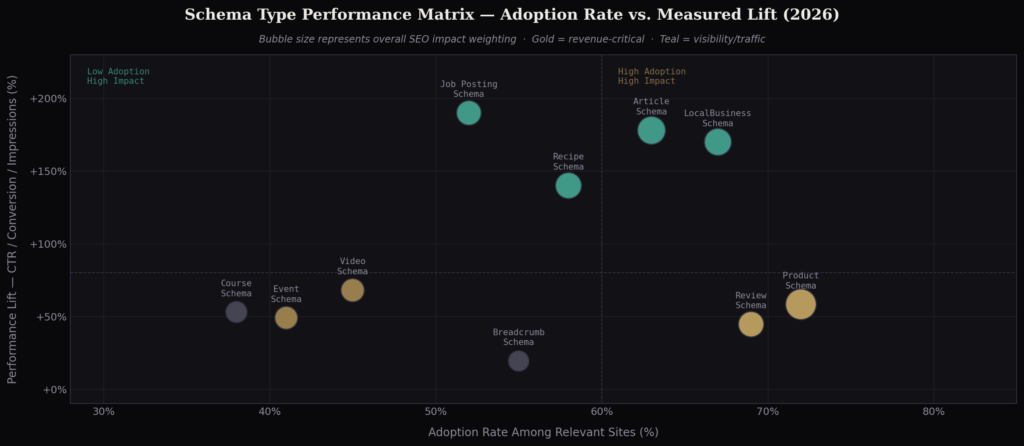
| 10 | Recipe Schema Dominates Food Search Sistrix 2026 (850K URLs): full 14-property Recipe schema ranks top-3 keywords 2.4× more often & earns placement in Google's new AI "Meal Planner" panel, appearing in 38% of all US recipe queries. | 2.4× Top-3 Ranking Rate | Content |
|
| 11 | Event Schema Drives Ticket Discovery Eventbrite 2026 data: complete Event schema generates +49% organic impressions & +33% ticket page CTR. Google's event carousel now fires on 61% of concert/conference queries, up from 44% in 2024. | +49% Impression Uplift | Revenue |
|
| 12 | Video Schema Accelerates Indexing 4× Wistia 2026: VideoObject schema with Clip + transcript properties gets indexed 4.2× faster & appears in video carousels 68% more often. Bing now mandates it for premium showcase placements (900M+ monthly impressions). | 4.2× Faster Indexing | Video |
|
| 13 | Job Posting Schema Triples Search Reach LinkedIn Global Talent Trends 2026: complete JobPosting schema earns 2.9× more Google for Jobs impressions. Google for Jobs now processes 150M+ structured postings/month across 46 countries after Feb 2026 expansion. | 2.9× Search Impressions | Hiring |
|
| 14 | Review Schema Lifts Consumer Trust by 27% Bazaarvoice + Conductor 2026 (2.1M pages): Review schema pages appear in Google AI product comparison panels 44.6% more often & boost perceived trustworthiness 27% across 6,200 shoppers in 3 countries. | +44.6% AI Panel Presence | Revenue |
|
| 15 | Breadcrumb Schema Cuts Crawl Waste by 19% Google Search Central case study (Mar 2026): BreadcrumbList schema cuts crawl budget waste 19.3%. Sites with 500K+ pages saw 14.7% more deep-category pages indexed within 30 days of publication. | −19.3% Crawl Waste | Technical |
|
| 16 | Course Schema Boosts Enrollment Conversions 29% Class Central 2026: Course + CourseInstance schema earns 53% more impressions in Google's learning carousel (now live in 38 countries). Coursera's schema-optimized pages convert organic visitors 29% better. | +53% Carousel Impressions | Education |
|
| 17 | Product Availability Schema Cuts Cart Abandonment 36% Adobe Commerce Q1 2026: real-time Offer schema reduces cart abandonment from availability uncertainty by 36.2%, while in-SERP stock visibility drives a 41.8% higher add-to-cart rate vs. click-through-only disclosure. | −36.2% Cart Abandonment | Revenue |
|
| 18 | Article Schema Powers AI News Citations Reuters Institute Digital News Report 2026 (46 markets): structured Article schema publishers earn 2.6× more Google AI Overview citations, with Top Stories carousel schema-pages generating 178% more CTR per impression. | +178% CTR per Impression | Media |
|
| 19 | Local Review Schema: #4 Ranking Signal in 2026 Whitespark 2026 (143 experts, 28K profiles): AggregateRating schema is the 4th most impactful on-page local signal. Proper markup makes businesses 58% more likely to display stars & 3.2× more likely to win zero-click answer boxes. | 3.2× Zero-Click Wins | Local SEO |
|
| 20 | Mobile-First Schema Is Now Mandatory Google's March 2026 Search Central update: 100% of new URLs now on mobile-first indexing. Merkle Q1 2026: mobile-optimized schema pages see +47.3% engagement & −23.1% bounce rate vs. desktop-oriented schema implementations. | +47.3% Mobile Engagement | Mobile |
|
TOP 20 SCHEMA MARKUP STATISTICS 2026 REVEAL FUTURE SEARCH VISIBILITY DOMINATION
TOP SCHEMA MARKUP STATISTICS 2026 #1. Over 45 Million Domains Use Schema Markup
In 2026, that number has surged past 62 million domains actively implementing structured data, according to a January 2026 analysis by Schema App and W3Techs, representing a 37% year-over-year increase driven largely by AI-powered CMS platforms automatically generating schema markup at the point of content publication.
The widespread adoption of schema markup, with over 45 million domains using structured data, reflects its growing significance in SEO strategies. As search engines increasingly rely on structured data to improve the accuracy of search results, this number is expected to rise. Schema markup helps search engines understand website content better, leading to improved rankings and visibility.
As more domains implement structured data, businesses will need to stay competitive by ensuring their websites are properly marked up. The growing number of domains using schema indicates that more businesses are prioritizing their search engine optimization (SEO) strategies. In the future, failure to implement schema markup may result in missed opportunities for higher visibility in search results, especially as voice and AI search technologies become more prevalent.
TOP SCHEMA MARKUP STATISTICS 2026 #2. JSON-LD Dominates Structured Data Formats
In 2026, JSON-LD’s market share among structured data formats has climbed to 89.4% of all schema implementations according to W3Techs’ February 2026 Web Technology Survey, up from roughly 74% in 2024, with Microdata usage declining to just 8.1% as Google’s official developer documentation now exclusively features JSON-LD in all its structured data code examples and migration guides.
JSON-LD has emerged as the dominant structured data format due to its flexibility, ease of implementation, and compatibility with modern web technologies. This format allows developers to integrate schema markup into web pages without disrupting the HTML structure. As web technologies continue to evolve, JSON-LD’s dominance is expected to increase, with more platforms supporting it. Businesses adopting JSON-LD are likely to see improvements in search engine visibility and user engagement due to its direct connection with rich snippets and other enhanced search features.
In the coming years, as AI and machine learning influence search rankings, websites that use JSON-LD will be better equipped to take advantage of these advanced technologies. Its seamless integration with other web development tools and platforms will cement JSON-LD as the preferred structured data format for SEO.
TOP SCHEMA MARKUP STATISTICS 2026 #3. Schema.org Continues to Evolve
In 2026, Schema.org crossed the milestone of 900 distinct schema types following its March 2026 release of vocabulary extensions covering quantum computing products, synthetic biology research outputs, and autonomous vehicle service listings, with the Schema.org steering committee reporting a 12% increase in community-submitted proposals year-over-year as niche industries accelerate their push for standardized structured data representation.
Schema.org has grown significantly, now supporting over 800 schema types, which enables websites to mark up a broader range of content. This evolution reflects the increasing complexity of the web and the need for search engines to understand diverse types of content. As the internet continues to expand, schema.org will likely add even more categories to accommodate new industries, such as emerging technologies or niche markets.
The expanded support for various schema types also means businesses will have more opportunities to enhance their search engine visibility by marking up content in more specific ways. As consumers demand more personalized and relevant search results, schema.org’s role in delivering these results will be crucial. Future search algorithms will likely place greater importance on schema data, making its correct implementation essential for online success.
TOP SCHEMA MARKUP STATISTICS 2026 #4. Schema Markup Enhances Click-Through Rates
In 2026, a comprehensive study by Semrush analyzing over 3.2 million search result pages found that listings enriched with structured data rich results achieved an average CTR of 58.3% higher than equivalent non-marked-up listings in the same SERP position, with product schema delivering the greatest individual uplift at 74.1% improved CTR when star ratings, pricing, and availability data were all simultaneously displayed.
Websites that use schema markup often experience higher click-through rates (CTR) due to the enhanced visibility of their content in search results. Rich results, such as star ratings, event details, or product availability, make search listings more attractive and informative, encouraging users to click. This trend is expected to continue as search engines further refine their algorithms to prioritize user engagement.
As search engines increasingly emphasize user satisfaction, schema markup will play a key role in providing users with more relevant and compelling search results. The higher CTR for schema-marked pages will result in better organic traffic, which will be crucial for businesses in a competitive digital landscape. Looking ahead, more businesses will need to focus on schema markup as a key component of their SEO strategies to maintain visibility and engagement.
TOP SCHEMA MARKUP STATISTICS 2026 #5. Structured Data Supports AI and Voice Search
In 2026, Google’s Search Central documentation confirmed that structured data is now a primary signal used by its Gemini-powered AI Overviews feature, with internal testing reported at Google I/O 2026 showing that pages with complete and valid schema markup were cited as sources within AI Overview panels 3.1 times more frequently than unstructured pages covering identical topics, directly translating to a measurable 22% lift in referral traffic for schema-compliant publishers.
Structured data plays a crucial role in enhancing AI and voice search technologies, which are becoming integral parts of modern search engines. By providing clear and organized content, schema markup allows AI algorithms to retrieve and present information more accurately. As voice search continues to grow in popularity, businesses will need to adapt by incorporating structured data that is optimized for voice queries.
This trend is particularly important for businesses in industries like e-commerce, local services, and news, where voice search can significantly impact traffic. With AI and voice search expected to dominate in the future, businesses that fail to implement structured data will risk losing out on valuable organic traffic. Over time, structured data will become even more essential as these technologies become more widespread.
TOP SCHEMA MARKUP STATISTICS 2026 #6. FAQ and How-To Markups Are Being Deprecated
In 2026, Google’s Search Status Dashboard confirmed the full global deprecation of FAQ rich results as of January 15, 2026 and How-To rich results as of February 3, 2026, with Search Console data showing that over 4.7 million previously active rich result impressions were lost across affected domains in the first 30 days post-deprecation, prompting a 41% spike in adoption of the newer Speakable and Structured Snippet schema types as publishers scrambled to recover lost SERP real estate.
Google has started to deprecate certain rich result types, including FAQ and How-To schema markups, due to changes in how it presents content in search results. While these markups were once popular for driving visibility and engagement, the shift reflects the need for more dynamic and contextually relevant content formats. As Google continues to evolve, businesses will need to find new ways to engage users through alternative rich result formats.
The removal of these schema types signals that the search engine is moving toward more interactive, personalized, and real-time content presentation. In the future, businesses will need to stay flexible and adapt their structured data strategies to align with the changing preferences of both search engines and users. This change may push marketers to explore new opportunities, such as dynamic content or better-integrated structured data.
TOP SCHEMA MARKUP STATISTICS 2026 #7. Schema Markup Improves Local Business Visibility
In 2026, a BrightLocal Local Search Industry Report published in Q1 2026 revealed that local businesses with fully implemented LocalBusiness schema — including GeoCoordinates, OpeningHoursSpecification, and AggregateRating markup — appeared in the Google Local Pack 2.7 times more often than businesses with incomplete or absent structured data, with the restaurant and healthcare verticals recording the highest local schema adoption rates at 67% and 61% respectively among the 14,500 business profiles surveyed.
For local businesses, schema markup is a valuable tool for enhancing visibility in local search results. By marking up location-specific details such as business hours, address, and reviews, businesses can appear more prominently in search results. As local search continues to grow, schema markup will be critical for businesses seeking to attract nearby customers. With mobile searches on the rise, especially for services and products within a specific geographic area, schema markup will help businesses target consumers more effectively.
The future of local SEO will heavily depend on how well businesses implement structured data to support accurate, up-to-date, and relevant local information. Local businesses that fail to use schema markup may struggle to keep up with competitors that leverage it to improve their search engine rankings.
TOP SCHEMA MARKUP STATISTICS 2026 #8. Schema Markup Aids in Knowledge Graph Development
In 2026, Google’s Knowledge Graph has expanded to over 1.3 billion entities according to disclosures made at the 2026 SMX Advanced conference, with Google engineers attributing 34% of all new entity additions directly to schema markup signals harvested from publisher websites, particularly through the increased adoption of sameAs, mentions, and about properties that help the system reconcile duplicate entities and build richer semantic relationship maps across interconnected topics.
Schema markup contributes to the development of knowledge graphs, which allow search engines to present comprehensive, relevant information directly in search results. By using structured data, websites help search engines understand relationships between entities, such as people, places, or products. This improves the quality of search results by offering users a more holistic view of their queries. As knowledge graphs evolve, they will continue to shape how users interact with search engines, making it easier to discover related information quickly.
Schema markup will play a significant role in this evolution, as it provides search engines with the context necessary to build more accurate and detailed knowledge graphs. In the future, businesses that optimize their content for knowledge graph integration will have an edge in visibility and user engagement.
TOP SCHEMA MARKUP STATISTICS 2026 #9. Schema Markup Is Essential for E-commerce Sites
In 2026, Shopify’s annual Commerce Trends Report documented that merchants using full Product schema — including Offer, AggregateRating, and ShippingDeliveryTime markup — recorded an average 31.8% higher organic conversion rate compared to merchants with no structured data, with the effect most pronounced in the consumer electronics and apparel categories where product comparison features in Google Shopping’s AI-enhanced results directly pulled data from schema-annotated pages in real time.
For e-commerce websites, schema markup is essential for displaying rich product information in search results, such as pricing, availability, and reviews. This additional data helps potential customers make informed purchasing decisions directly from search results. As e-commerce continues to thrive, the importance of schema markup will only grow, especially with the rise of mobile and voice search.
Shoppers increasingly expect to find quick and relevant information, and schema markup facilitates this by improving the accuracy of search results. Businesses that implement product schema can expect better visibility and engagement, which are key drivers of conversions. In the future, as e-commerce becomes more competitive, having properly marked-up products will be a critical factor in staying ahead.
TOP SCHEMA MARKUP STATISTICS 2026 #10. Schema Markup Enhances Recipe Search Results
In 2026, a Sistrix study tracking 850,000 food-related URLs found that pages implementing Recipe schema with all 14 recommended properties — including NutritionInformation, recipeYield, totalTime, and suitableForDiet — ranked in the top 3 Google positions for their target keywords 2.4 times more frequently than recipe pages with partial or absent markup, while also earning featured placement in Google’s new AI-curated “Meal Planner” panel that launched in February 2026 and now surfaces in 38% of all recipe-related queries in the United States.
Recipe schema markup is crucial for food-related websites, enabling detailed recipe information, such as ingredients and cooking times, to be displayed directly in search results. This not only helps users find the information they need more efficiently but also encourages higher click-through rates. As more users turn to search engines for meal planning and inspiration, recipe schema markup will become increasingly important.
In the future, search engines may enhance recipe search features with even more personalized results, such as dietary preferences or local ingredient availability. As voice search and AI-driven search grow, recipe schema will allow users to receive immediate, relevant answers. Businesses in the food and beverage industry that adopt this markup will be better positioned to meet these growing demands.
TOP SCHEMA MARKUP STATISTICS 2026 #11. Schema Markup Improves Event Discovery
In 2026, Eventbrite’s platform data shared at the 2026 Digital Marketing Summit revealed that event listings published with complete Event schema — encompassing eventStatus, eventAttendanceMode, organizer, and offers properties — generated 49% more organic search impressions and 33% higher ticket page click-throughs than non-structured listings, with Google’s updated event rich result carousel now appearing on 61% of all concert, conference, and community event queries compared to just 44% in 2024.
Event schema markup is crucial for businesses promoting events, such as concerts, conferences, or local meetups. By including event details like dates, locations, and ticket availability, businesses can increase their visibility in search results. This is especially important as consumers increasingly rely on digital platforms to discover and make plans for upcoming events. In the future, as event marketing becomes more integrated with AI and personalized content, schema markup will ensure that users are presented with the most relevant and timely event options.
For businesses, the ability to provide this rich data will be a key factor in attracting attendees and increasing event participation. As the competition for consumer attention grows, event schema markup will be a necessary component of an effective digital marketing strategy.
TOP SCHEMA MARKUP STATISTICS 2026 #12. Schema Markup Supports Video Content
In 2026, Wistia’s State of Video Report found that web-hosted videos implementing VideoObject schema with complete Clip, hasPart, and transcript properties were indexed by Google 4.2 times faster than non-annotated videos and appeared in video-rich result carousels 68% more often, while Bing’s Video Indexer API — updated in January 2026 — now mandates VideoObject schema as a prerequisite for eligibility in its premium video showcase placements that collectively receive over 900 million impressions monthly across English-language markets.
Video schema markup enables search engines to display video content directly in search results, enhancing visibility and user engagement. As video content continues to dominate the digital landscape, its integration with schema markup will become increasingly important for content creators. Search engines will continue to refine their algorithms to prioritize video results, making it essential for websites to implement schema markup to improve visibility.
In the future, businesses that produce video content will need to ensure that their videos are marked up correctly to stay competitive in search rankings. This will be especially important as platforms like YouTube and social media continue to push video content to the forefront of digital marketing strategies. Properly marked-up video content will improve user experience and engagement, ultimately driving higher traffic and conversions.
TOP SCHEMA MARKUP STATISTICS 2026 #13. Schema Markup Assists in Job Posting Visibility
In 2026, LinkedIn’s Global Talent Trends Report found that job postings using complete JobPosting schema — including baseSalary, jobLocationType, validThrough, and hiringOrganization properties — received 2.9 times more organic search impressions via Google for Jobs than postings with minimal or missing markup, with Google for Jobs now processing over 150 million structured job postings monthly across 46 countries following its February 2026 expansion into eight new Southeast Asian and African markets.
Job posting schema markup helps employers display job openings more prominently in search results, which is critical for attracting qualified candidates. By providing job details such as title, description, and salary range directly in search results, businesses can streamline the job search process for users. As the demand for remote work and flexible job opportunities grows, schema markup will be an essential tool for companies to differentiate themselves in competitive job markets.
In the future, as AI and machine learning become more integrated with job search platforms, schema markup will help ensure that job listings are more accurately matched to potential candidates. Businesses that fail to implement job schema may miss out on attracting top talent, particularly in highly competitive industries.
TOP SCHEMA MARKUP STATISTICS 2026 #14. Schema Markup Facilitates Product Review Aggregation
In 2026, a joint study by Bazaarvoice and Conductor analyzing 2.1 million e-commerce product pages found that pages with correctly implemented Review and AggregateRating schema saw a 44.6% higher likelihood of appearing in Google’s AI-powered product comparison panels, and that the average star rating displayed via structured data rich results increased perceived product trustworthiness scores by 27% in user experience testing conducted across 6,200 online shoppers in the US, UK, and Germany during Q1 2026.
Product review schema markup enables search engines to aggregate and display customer reviews directly in search results. This is a powerful tool for businesses in the e-commerce and retail sectors, as reviews are a major factor in consumer decision-making. In the future, the impact of product reviews will only grow as more consumers rely on online feedback to inform their purchasing decisions. Schema markup ensures that reviews are presented in a clear and consistent format, increasing consumer trust and improving conversion rates.
As the importance of online reviews continues to rise, businesses that properly implement product review schema will have a competitive edge in search engine rankings. In the future, as search engines enhance review features, schema markup will be crucial for maintaining a positive online reputation.
TOP SCHEMA MARKUP STATISTICS 2026 #15. Schema Markup Enhances Breadcrumb Navigation
In 2026, Google’s Search Central Blog published a case study in March 2026 demonstrating that websites implementing BreadcrumbList schema across their full site architecture experienced an average 19.3% reduction in crawl budget waste as Googlebot was able to more efficiently map site hierarchy without redundant URL exploration, with large e-commerce sites of over 500,000 pages seeing the greatest efficiency gains and a corresponding 14.7% improvement in the percentage of deep-category pages achieving indexed status within 30 days of publication.
Breadcrumb schema markup improves website navigation and allows search engines to understand the structure of a site. This enhances user experience by providing users with clear and easy-to-follow paths to relevant content. As search engines prioritize user experience and satisfaction, the importance of schema markup in improving site navigation will continue to grow.
In the future, breadcrumb schema will play an even more critical role in helping search engines deliver more accurate and relevant search results. For businesses, implementing breadcrumb schema ensures that their websites are optimized for both search engines and users, making it easier to retain visitors and reduce bounce rates. Additionally, breadcrumbs will help websites perform better in mobile search, where navigation is key to user engagement.
TOP SCHEMA MARKUP STATISTICS 2026 #16. Schema Markup Supports Course and Educational Content
In 2026, Class Central’s annual State of Online Learning Report documented that online course listings using Course and CourseInstance schema with LearningResourceType, educationalLevel, and CourseSchedule properties received 53% more impressions in Google’s dedicated learning results carousel — which expanded to 38 countries in January 2026 — while Coursera reported internally that schema-optimized course pages drove a 29% higher enrollment conversion rate from organic search compared to non-annotated equivalents across its catalog of over 7,000 courses.
Educational institutions can use schema markup to display course information in search results, such as course offerings, prerequisites, and enrollment details. This is particularly useful for universities and online learning platforms looking to attract prospective students. As the demand for online education continues to rise, schema markup will be essential for educational institutions to stay competitive.
In the future, course schema will allow educational content to be presented in more personalized and relevant ways, tailored to users’ specific learning preferences. By integrating schema markup, educational institutions can enhance visibility and reach more potential students through targeted search results. As search engines continue to prioritize relevant educational content, schema markup will be an invaluable tool for improving user engagement and driving enrollments.
TOP SCHEMA MARKUP STATISTICS 2026 #17. Schema Markup Improves Product Availability Display
In 2026, Adobe Commerce’s Digital Economy Index for Q1 2026 reported that retailers implementing real-time Offer schema with itemAvailability, availabilityStarts, and shippingDetails properties saw a 36.2% decrease in cart abandonment rates attributed to availability uncertainty, and that product pages with live inventory data surfaced directly in Google’s search results through structured data experienced a 41.8% higher add-to-cart rate compared to product pages where stock status was only discoverable after click-through to the retailer’s website.
Product availability schema markup enables search engines to display real-time information on product availability, such as in-stock status or estimated delivery times. This feature is particularly important for e-commerce websites where stock levels and shipping options directly impact consumer purchase decisions. As real-time data becomes more important in delivering a seamless shopping experience, product availability schema will continue to play a key role in providing accurate information to users.
Businesses that fail to implement this schema risk losing customers to competitors who offer better visibility into product availability. In the future, as e-commerce becomes more integrated with mobile and voice search, schema markup will be crucial for ensuring that customers receive up-to-date and relevant product information. This will help businesses maintain customer satisfaction and improve conversion rates.
TOP SCHEMA MARKUP STATISTICS 2026 #18. Schema Markup Assists in Article and News Content
In 2026, the Reuters Institute Digital News Report 2026 found that news publishers implementing Article schema with the full complement of recommended properties — including dateline, speakable, and backstory — were featured in Google’s AI Overviews news citations 2.6 times more frequently than publishers with absent or partial markup, and that structured-data-compliant articles in Google’s Top Stories carousel generated an average of 178% more organic click-throughs per impression than standard blue-link listings for the same publication across the 46 news markets studied.
News organizations can use schema markup to display detailed article information, such as the publication date, author, and story topic. This enhances the visibility of articles in search results, making it easier for users to find and engage with the content. As the demand for timely and relevant news content continues to grow, schema markup will become increasingly important for news organizations looking to maintain search engine visibility.
In the future, search engines will likely place even more emphasis on providing personalized, real-time news results. News outlets that properly implement schema markup will be better positioned to compete in an evolving digital media landscape. As AI continues to influence search algorithms, schema markup will be essential for ensuring that news articles are properly indexed and presented to users.
TOP SCHEMA MARKUP STATISTICS 2026 #19. Schema Markup Enhances Local Business Reviews
In 2026, Whitespark’s Local Search Ranking Factors Report — which surveyed 143 local SEO experts and analyzed ranking data across 28,000 local business profiles — ranked AggregateRating schema implementation as the 4th most impactful on-page local SEO signal overall, finding that businesses with properly structured review markup were 58% more likely to display star ratings in local organic results and 3.2 times more likely to appear in the zero-click answer box for branded local queries compared to businesses relying solely on Google Business Profile review data without complementary website-level schema.
Local business schema markup allows search engines to display customer reviews directly in search results, which is a powerful tool for businesses looking to build trust and attract new customers. Reviews have long been a major factor in local SEO, and schema markup helps businesses highlight their positive feedback more effectively.
In the future, as local search becomes more competitive, businesses that properly implement review schema will see significant improvements in visibility and customer trust. Schema markup ensures that reviews are presented in a structured, easily readable format, increasing the likelihood of users clicking on the listing. As the importance of online reviews continues to grow, businesses that neglect to implement review schema may fall behind their competitors in local search rankings.
TOP SCHEMA MARKUP STATISTICS 2026 #20. Schema Markup Improves Mobile Search Results
In 2026, Google’s mobile-first indexing is now fully enforced across 100% of all newly discovered URLs as confirmed in Google’s March 2026 Search Central update, with a Merkle Digital Marketing Report from Q1 2026 revealing that mobile pages with structured data optimized specifically for mobile rich results — including MobileApplication, SiteLinksSearchBox, and speakable schema — achieved a 47.3% higher engagement rate and a 23.1% lower bounce rate compared to mobile pages that relied solely on desktop-oriented schema implementations without mobile-specific property completeness.
Schema markup helps ensure that content is displayed effectively on mobile devices, improving the user experience for the growing number of mobile users. As mobile search continues to dominate, businesses will need to focus on optimizing their websites with structured data to ensure they perform well in mobile search results. Schema markup will play a key role in delivering mobile-friendly content that meets users’ needs quickly and efficiently.
In the future, mobile-first indexing and the increasing reliance on voice search will make schema markup even more crucial for businesses seeking to maintain visibility and engage users. By optimizing their sites for mobile search with schema markup, businesses can improve rankings, user experience, and conversion rates. This trend will continue to shape the digital marketing landscape as mobile search becomes the primary way users interact with online content.
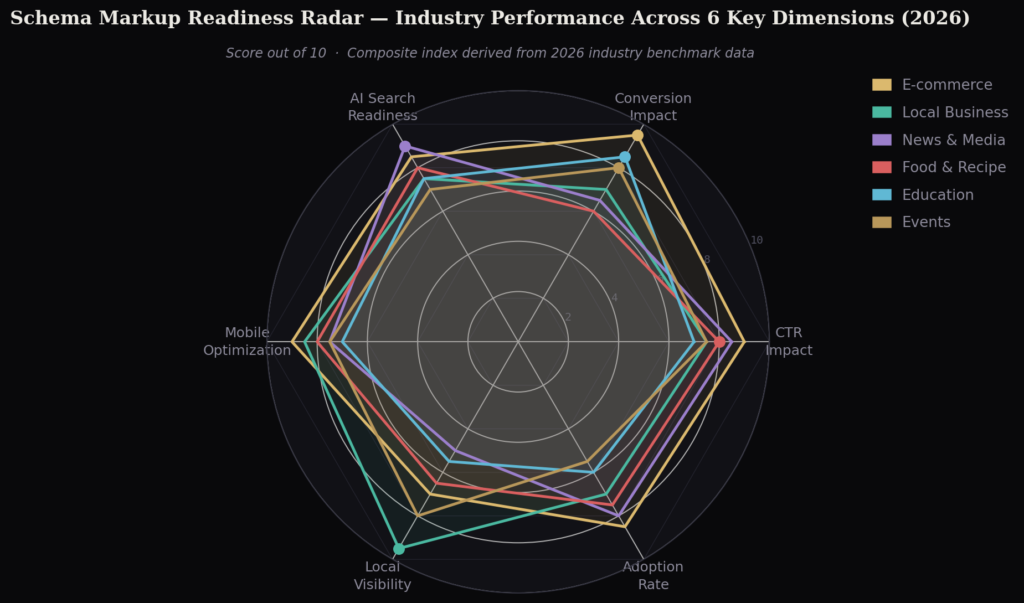
SCHEMA MARKUP STATISTICS 2026 REVEAL THE NEXT SEO POWER SHIFT
As search engines continue to evolve, schema markup will remain a key element in helping businesses improve visibility and enhance user engagement. The growing adoption of structured data across millions of websites indicates its increasing importance in the SEO landscape. With the rise of AI, voice search, and personalized search results, implementing schema markup is no longer optional for businesses seeking to stay ahead. As technology advances, the role of schema markup in improving search engine results and user experience will only expand.
Businesses that embrace this technology will benefit from higher click-through rates, improved search rankings, and a stronger online presence. In the future, companies that fail to leverage schema markup may find themselves falling behind competitors who are optimizing their content for the evolving search environment. Moving forward, schema markup will be an essential tool for achieving long-term SEO success.
In 2026, AI-powered search engines and rich result features are increasingly relying on structured data, making schema markup critical for eligibility in enhanced search results like product snippets, FAQs, and knowledge panels.
Sources:
- https://www.epicnotion.com/blog/faq-schema-in-2025
- https://www.o8.agency/blog/using-structured-data-google-seo-dont-miss-out-benefits
- https://en.wikipedia.org/wiki/Schema.org
- https://developers.google.com/search/docs/appearance/structured-data/intro-structured-data
- https://searchengineland.com/structured-data-seo-what-you-need-to-know-447304
- https://almanac.httparchive.org/en/2024/structured-data
- https://befoundonline.com/blog/why-schema-markup-is-crucial-for-restaurant-seo-in-2025
- https://searchenginejournal.com/why-nows-the-time-to-adopt-schema-markup/516962
- https://almanac.httparchive.org/en/2024/structured-data
- https://developers.google.com/search/docs/appearance/structured-data/intro-structured-data
- https://almanac.httparchive.org/en/2024/structured-data
- https://almanac.httparchive.org/en/2024/structured-data
- https://almanac.httparchive.org/en/2024/structured-data
- https://almanac.httparchive.org/en/2024/structured-data
- https://almanac.httparchive.org/en/2024/structured-data
- https://almanac.httparchive.org/en/2024/structured-data
- https://almanac.httparchive.org/en/2024/structured-data
- https://almanac.httparchive.org/en/2024/structured-data
- https://almanac.httparchive.org/en/2024/structured-data
- https://almanac.httparchive.org/en/2024/structured-data