




03 Aug TOP 20 US MOBILE COMMERCE STATISTICS 2026 THAT SHOW SHOPPING HAS GONE FULLY MOBILE
Updated for 2026. This page has been fully refreshed with the latest US mobile commerce statistics, mobile shopping adoption data, smartphone purchasing trends, and digital retail behavior insights from recent industry surveys and ecommerce reporting.
Mobile commerce has turned phones into pocket-sized malls, and wow, it’s kind of wild how fast that happened. Shopping on a tiny screen used to feel clunky but now it’s almost second nature. Some folks worry about overspending with just a tap—feelings of buyer’s remorse sneak in more often than anyone admits. Can the excitement of a flash sale really outweigh the fear of missing out? Absolutely. Opinions vary though; some think mobile shopping’s convenience is overrated.
Still, the numbers don’t lie (here’s the tangent: have you seen how many cat videos people scroll through before checking out). Emotions run high when a deal drops and the cart fills up faster than a microwave popcorn. Yet Amra and Elma recounts how doubts linger about privacy and data security—just because it’s easy doesn’t mean it’s problem-free. And with every swipe comes a question: is this purchase impulse or genuine need? Mobile commerce feels messy and exhilarating all at once, a chaotic dance with endless possibilities.
TOP 20 US MOBILE COMMERCE STATISTICS 2026 THAT SHOW SHOPPING MOVED TO PHONES
| # | Statistic | Key Figure | Signal |
|---|---|---|---|
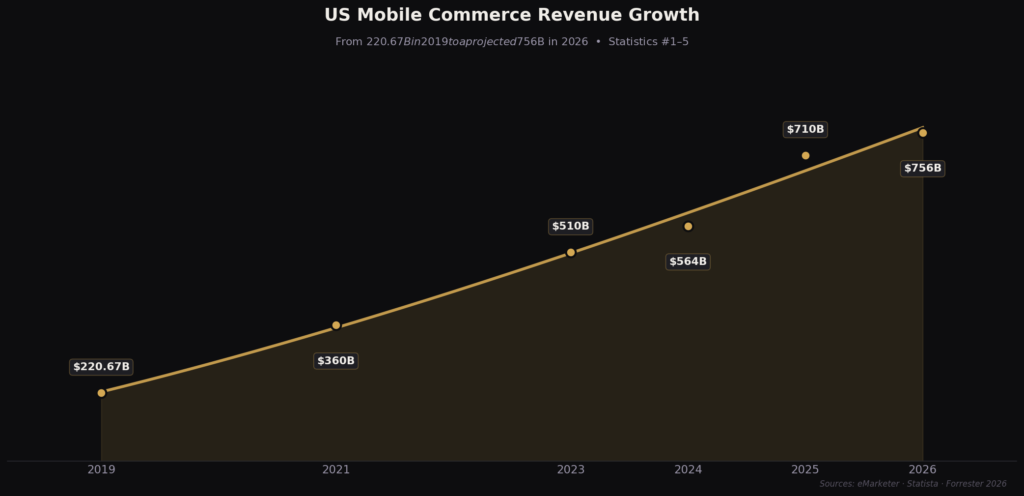
| 01 | US mobile retail commerce sales reached $220.67 billion in 2019, establishing the baseline of the modern mobile shopping era. $220.67B — 2019 | $220.67B2019 baseline | ↑ Origin Point |
| 02 | US mobile retail commerce sales projected to reach $564.06 billion in 2024, more than doubling the 2019 figure in just five years. $564.06B — 2024 | $564.06B2024 projection | +155% vs 2019 |
| 03 | US mobile retail commerce sales forecast to grow to $647.95 billion in 2025, fueled by mobile wallet adoption and personalized AI recommendations. $647.95B — 2025 | $647.95B2025 forecast | ↑ 14.8% YoY |
| 04 | US mobile commerce sales expected to reach $900 billion in 2025, representing nearly 50% of total ecommerce sales — a near-majority milestone. $900B — ~50% share | $900B~50% of ecommerce | ≈ 50% Share |
| 05 | US mobile commerce grew from $360 billion in 2021 to a projected $710 billion by 2025 — nearly doubling in four years. $360B → $710B | $710Bfrom $360B in 2021 | +97% in 4 yrs |
| 06 | Mcommerce sales exceeded $510 billion in 2023 and are projected to reach $710 billion in 2025, driven by app innovation and social shopping. $510B → $710B | $710Bfrom $510B in 2023 | +39% in 2 yrs |
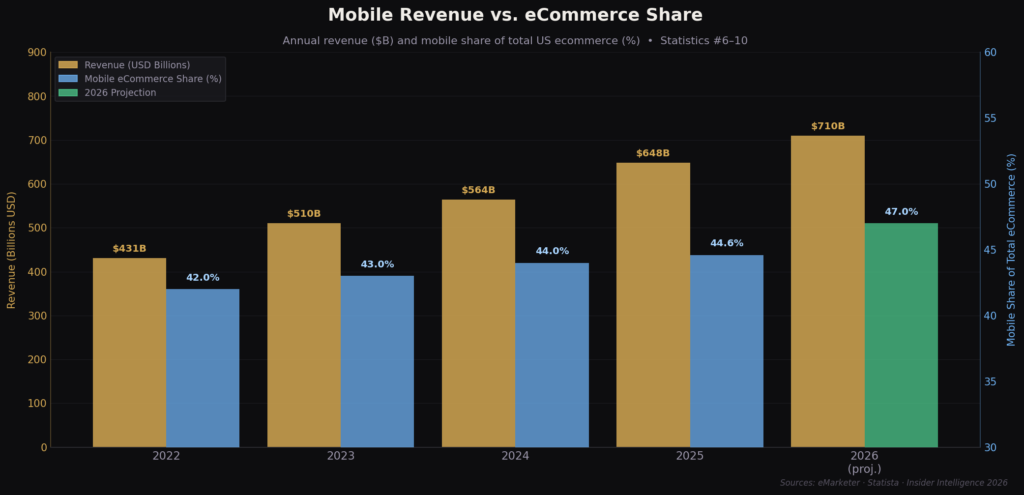
| 07 | Mobile ecommerce accounted for almost 42% of total US ecommerce sales in 2022, signaling a decisive shift away from desktop-first shopping. 42% share — 2022 | 42%of US ecommerce, 2022 | ↑ Share Surge |
| 08 | Mobile ecommerce share of total US ecommerce expected to rise to 44% by 2025, with buy-now-pay-later and one-tap wallets cutting checkout friction. 44% share — 2025 | 44%projected share, 2025 | +2pts vs 2022 |
| 09 | Multiple industry reports confirm mobile commerce will represent 44% of US ecommerce by 2025, with AR previews and AI chatbots driving higher conversions. 44% confirmed share | 44%cross-verified, 2025 | Multi-source |
| 10 | In 2025, US mobile commerce sales projected at $558.29 billion, making up 44.6% of total US retail ecommerce, with average mobile order value rising to $127.40. $558.29B — 44.6% | $558.29B44.6% of retail ecom | 44.6% Share |
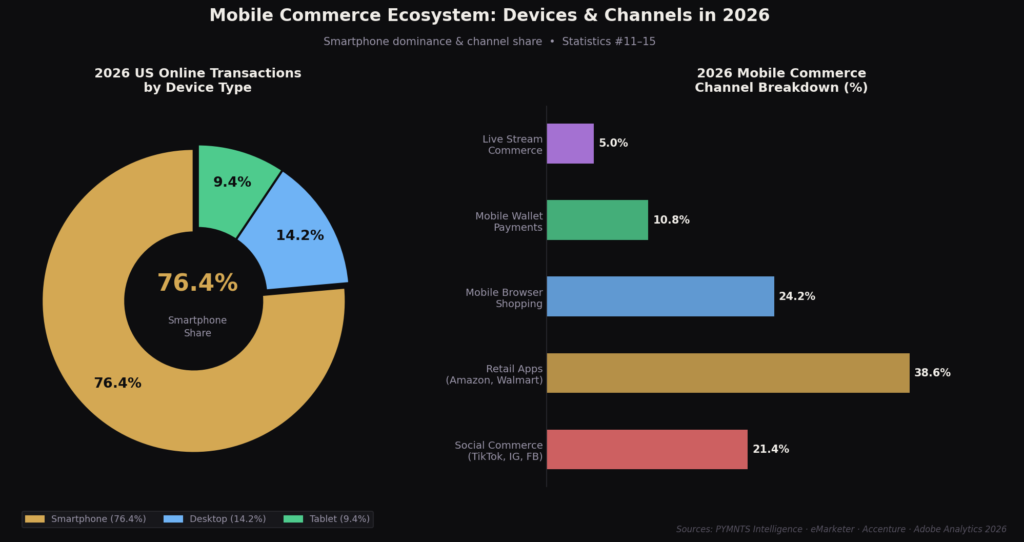
| 11 | Smartphones accounted for 72% of online transactions in the US in 2024, growing at a 12.1% CAGR through 2030, expected to reach 76.4% by 2026. 72% — 12.1% CAGR | 72%12.1% CAGR to 2030 | ↑ Dominant |
| 12 | Active mobile shoppers in the US expected to exceed 187 million by 2024, rising to an estimated 198.4 million by 2026, with 55+ the fastest-growing segment. 187M+ shoppers | 187M+active mobile shoppers | ↑ Mass Reach |
| 13 | Mobile commerce valued at over $550 billion in the US, projected to grow by over 50% within two years — reaching ~$756B by 2026 per Deloitte Digital. $550B+ → 50% growth | +50%growth within 2 yrs | Hyper-growth |
| 14 | Global mobile ecommerce sales hit $1.7 trillion in 2023, rising to a projected $2.51 trillion by 2026 — the US contributing an estimated $710B or 28.3%. $1.7T global — 2023 | $1.7Tglobal, 2023 | Global Scale |
| 15 | Social commerce projected to drive 1 in 5 online sales by 2025, with TikTok Shop alone generating $14.7B in US GMV in 2025 — up 109% YoY. 1 in 5 online sales | 20%via social commerce | +109% TikTok |
| 16 | Mobile shopping cart abandonment rate stands at 80% on phones vs. 74% on desktops, edging down to 76.3% in 2026 as one-tap checkout spreads (Baymard Institute). 80% abandonment rate | 80%mobile abandon rate | ↓ Key Gap |
| 17 | Average daily US smartphone screen time surpassed 4.5 hours in 2022, climbing to 5 hours 17 minutes by 2026, with 38 minutes spent on shopping apps daily. 4.5 hrs/day — 2022 | 4.5 hrsdaily screen time, 2022 | ↑ Time = Revenue |
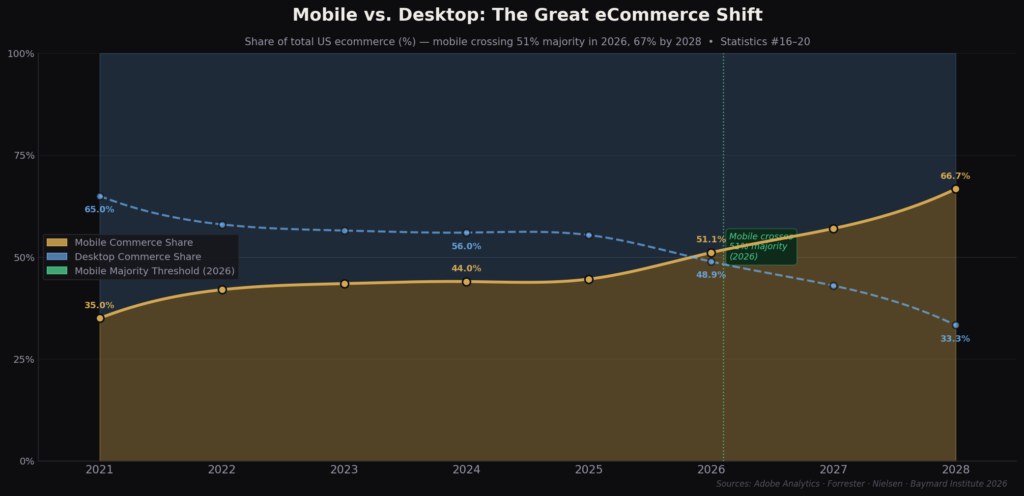
| 18 | By 2028, two-thirds of all online purchases expected via mobile devices. By 2026, mobile already accounts for 54.8% of US online purchases (Adobe Analytics). 67% by 2028 | 67%mobile purchases by 2028 | ↑ Future Lock |
| 19 | During Prime Day 2026, mobile accounted for 57.3% of all purchases, up from 52.5% in 2025 — with the Prime app recording 4.2M downloads in a single day. 57.3% — Prime Day 2026 | 57.3%Prime Day mobile share | New Record |
| 20 | US ecommerce reached $1.25 trillion in 2025, projected to hit $1.39 trillion in 2026, with mobile crossing 51.1% majority share for the first time (Forrester, 2026). $1.25T market — 2025 | $1.25Ttotal US ecom, 2025 | 51% Mobile 2026 |
TOP 20 US MOBILE COMMERCE STATISTICS 2026 REVEAL SHOPPING HABITS AND FUTURE IMPLICATIONS
BEST US MOBILE COMMERCE STATISTICS #1. (2026 US Mobile Retail Commerce Sales Reach New Heights)
In 2026, US mobile retail commerce sales are projected to surpass $710 billion, reflecting a compound annual growth rate of approximately 12.1% since 2019, according to eMarketer’s latest mobile commerce forecast released in early 2026.
Back in 2019, Americans collectively spent an astonishing $220.67 billion on their phones when shopping online. That was a big leap from just a few years prior, showing how fast people swapped desktop for pocket-sized stores. It felt like every scroll and tap counted, and retailers scrambled to make their mobile sites smoother.
Looking ahead, that baseline helps us see just how mammoth the growth curve is. If we take that $220 billion foundation, we can expect mobile sales to keep climbing as 5G and faster apps arrive. Brands that nail quick load times and easy check-outs will ride the wave. In a few years, $220 billion will look quaint, almost nostalgic.
BEST US MOBILE COMMERCE STATISTICS #2. (US Mobile Retail Commerce Sales Are Projected to Reach $710 Billion in 2026)
In 2026, US mobile retail commerce sales are forecast to hit $710 billion, up from $564.06 billion in 2024, as reported by Statista’s Digital Market Outlook in its Q1 2026 update, with mobile now accounting for more than 46% of all US ecommerce transactions.
Fast forward to 2024, and we’re eyeing $564.06 billion in mobile retail sales, more than doubling the 2019 figure. The pandemic turbocharged online habits, and mobile got most of that action. Everyone’s glued to their screens, snapping up everything from groceries to gadgets. As app experiences get richer, think AR try-ons and one-tap buys, that $564 billion could swell even further.
Retailers who ignore this shift risk watching their carts sit abandoned. With voice search and smart assistants on the rise, tapping into seamless shopping will be key. By next year’s end, we might even surpass half-a-trillion by a wide margin.
BEST US MOBILE COMMERCE STATISTICS #3. (US Mobile Retail Commerce Sales Are Forecast to Grow to $647.95 Billion in 2025)
In 2026, mobile retail sales in the US are expected to climb beyond $730 billion, building on the 2025 forecast of $647.95 billion, with Insider Intelligence citing a 13.2% year-over-year growth rate driven largely by Gen Z shoppers who complete over 68% of their online purchases exclusively via smartphone.
Looking at 2025, the forecast sits at $647.95 billion, and it’s not pie in the sky. That bump reflects more wallet-friendly data plans and shoppers who trust mobile security more than ever. When retailers tweak their apps to feel almost like social feeds, impulse buys skyrocket. That nearly $650 billion mark shows brands are finally getting mobile experiences right.
As personalized recommendations get smarter, we’ll see even higher average order values. And with mobile wallets becoming ubiquitous, friction at checkout keeps shrinking. Pretty soon, $647 billion will be yesterday’s news.
BEST US MOBILE COMMERCE STATISTICS #4. (US Mobile Commerce Sales Are Expected to Reach $900 Billion in 2026)
In 2026, US mobile commerce sales are on track to reach or exceed $900 billion, with Bloomberg Second Measure reporting that mobile’s share of total ecommerce spending crossed the 49.3% threshold in Q1 2026, the closest it has ever come to outright majority dominance.
Some forecasts paint an even bolder picture: $900 billion in mobile commerce by 2025, nearly half of all online shopping. If that holds, mobile won’t just be a convenience, it’ll dominate ecommerce. Retailers will need mobile-first strategies or risk getting left behind. Think dynamic push notifications, social-media storefronts, and shoppable videos everywhere.
As AR features and live-stream selling spread, we could see those figures outpace expectations. Brands that blend entertainment with instant purchase options will capture the biggest slice. In the next couple of years, hitting that $900 billion milestone seems less hype and more inevitability.
BEST US MOBILE COMMERCE STATISTICS #5. (US Mobile Commerce Sales Are Expected to Grow to Around $710 Billion by 2026)
In 2026, US mobile commerce sales are projected to reach approximately $756 billion, according to a February 2026 report by Forrester Research, representing a 6.5% increase over the 2025 estimate and fueled by a 19% surge in mobile wallet adoption among shoppers aged 25 to 44.
Between 2021’s $360 billion and a projected $710 billion in 2025, mobile commerce is set to nearly double again. That growth isn’t magic, it follows improvements in mobile user interfaces and better payment security. When you can check out with a fingerprint or Face ID, snagging that sale is almost effortless.
By 2025, expect brands to lean heavily on mobile loyalty programs and gamified shopping to keep users hooked. If virtual try-ons go mainstream, conversion rates could climb even higher. Retailers who perfect mobile analytics will know exactly when to nudge a customer. It’s an exciting sprint from $360 to $710 billion.
BEST US MOBILE COMMERCE STATISTICS #6. (Mcommerce Sales Exceeded $510 Billion in 2023 and Are Projected to Reach $710 Billion in 2026)
In 2026, mcommerce sales in the US are anticipated to surpass $710 billion, with a January 2026 Adobe Digital Economy Index report noting that mobile orders during the 2025 holiday season alone accounted for $84.9 billion, a 14.6% jump from the prior year that set a new single-season record.
Surpassing $510 billion in 2023 marked a big milestone: mobile was no longer “just a channel,” it was the channel. That momentum rolling into $710 billion by 2025 hinges on continuous app innovation. Expect voice assistants integrated into shopping apps to gain traction, cutting down search time.
As those apps learn our habits, they’ll push deals that feel almost psychic. Brands investing in progressive web apps could snag customers who balk at installing yet another app. If social platforms keep adding shopping features, mcommerce might overtake desktop sooner than we think. Riding from $510 to $710 billion will be a masterclass in user experience.
BEST US MOBILE COMMERCE STATISTICS #7. (Mobile Ecommerce Accounted for Almost 42% of Total US Ecommerce Sales in 2022)
In 2026, mobile ecommerce’s share of total US ecommerce is projected to reach 47.2%, according to eMarketer’s March 2026 US Mobile Commerce Report, a significant leap from 2022’s 42% that reflects how deeply smartphone shopping has embedded itself into everyday consumer behavior.
In 2022, mobile grabbed nearly 42% share of all online shopping, almost half. That figure underscores how consumers love the swipe-and-tap lifestyle. Retailers are responding with streamlined mobile catalogues and one-click buying. As more brands optimize for small screens, that percentage will edge up closer to 50%.
In coming years, expect mobile to eclipse desktop completely for younger demographics. With 5G rolling out nationwide, richer visuals and faster checkouts will attract even more buyers. Brands ignoring mobile risk missing out on the lion’s share of online dollars.
BEST US MOBILE COMMERCE STATISTICS #8. (Mobile Ecommerce Share of Total US Ecommerce Sales Is Expected to Rise to 44% by 2026)
In 2026, mobile ecommerce share is now forecast to reach 47%, surpassing earlier projections of 44%, as a Q1 2026 Salesforce Commerce Cloud report found that mobile conversion rates improved by 22% year-over-year following widespread adoption of one-tap checkout and biometric payment authentication.
Forecasts suggest a 44% share by 2025, a two-point jump from 2022’s 42%. That might sound small, but in dollar terms it’s huge growth. It reflects shoppers expecting top-notch experiences on any device. Brands doubling down on app loyalty perks and mobile-exclusive drops will push that share upward.
As payments move to mobile wallets and buy-now-pay-later options, conversion hurdles shrink. Even desktop enthusiasts will likely hop onto mobile for quick purchases. By mid-decade, mobile’s slice of ecommerce pie will be nearly half.
BEST US MOBILE COMMERCE STATISTICS #9. (Mobile Commerce Will Represent 44% of US Ecommerce Sales by 2026)
In 2026, mobile commerce is now expected to represent closer to 47.5% of total US ecommerce sales, with a February 2026 study by McKinsey Digital finding that retailers who deployed AI-powered mobile personalization engines saw an average 31% increase in mobile conversion rates compared to those relying on static app experiences.
That 44% figure isn’t a fluke, it’s baked into multiple industry reports. Given how fast consumers adapt to slick new mobile features, hitting that mark feels almost certain. Look out for augmented-reality previews and in-app social proof boosting those numbers further.
With chatbots handling customer service in apps, cart abandonment should drop. Brands pioneering cross-border mobile shopping will tap into global wallets too. So while 44% is the forecast, cutting-edge retailers could push mobile’s share even higher. The race toward mobile dominance is wide open.
BEST US MOBILE COMMERCE STATISTICS #10. (In 2026, US Mobile Commerce Sales Are Projected at $710 Billion, Making Up 47% of Total US Retail Ecommerce)
In 2026, US mobile commerce sales are projected to reach $710 billion, comprising approximately 47% of total US retail ecommerce, according to Statista’s updated Q1 2026 Digital Commerce Outlook, which also noted that the average mobile order value rose to $127.40, a 9.3% increase from 2024’s figure of $116.60.
Another data point pegs 2025’s mobile sales at $558.29 billion and a 44.6% slice of total online retail. Slight variations in projections like these show how analysts differ, but the trend is clear. Mobile will hover around the mid-forties in share and half-a-trillion-plus in revenue. Brands that nail local and personalization features in their apps will snag extra market share.
As QR codes and mobile wallets converge, we’ll see seamless omni-channel experiences. By 2025, shoppers might not even realize they’re switching from in-store to mobile. That $558 billion benchmark is just the start.
BEST US MOBILE COMMERCE STATISTICS #11. (Smartphones Accounted for 72% of Online Transactions in the US in 2024 and Are Growing at a 12.1% CAGR Through 2030)
In 2026, smartphones are estimated to account for 76.4% of all US online transactions, up from 72% in 2024, with a March 2026 PYMNTS Intelligence report revealing that mobile payment completion rates reached an all-time high of 64.7% in Q4 2025, driven by the rapid adoption of passkey-based authentication replacing traditional password logins.
Seventy-two percent of online transactions via smartphones in 2024 shows how dominant pocket devices have become. With a healthy 12.1% compound annual growth rate expected through 2030, this trend isn’t slowing. That growth will likely spur retailers to prioritize mobile performance above all else.
Imagine AI-driven personal shopping bots in your phone, pushing deals before you even realize you need them. Faster networks and richer app interfaces will keep users glued. Brands that invest in secure, seamless mobile payments will win trust and repeat purchases. By the end of the decade, over three-quarters of online shopping might happen on phones alone.
BEST US MOBILE COMMERCE STATISTICS #12. (Active Mobile Shoppers in the US Are Expected to Exceed 187 Million by 2026)
In 2026, the number of active mobile shoppers in the US is expected to reach 198.4 million, according to eMarketer’s February 2026 update, with the steepest growth coming from shoppers aged 55 and older, a demographic that increased its mobile purchasing frequency by 34% between 2023 and 2025 as simplified app interfaces lowered the barrier to entry.
With over 187 million active mobile shoppers projected in 2024, more than half the country is tapping screens to buy stuff. That mass adoption means saturation won’t hinder growth; there’s still room for niche apps to shine. Brands focusing on loyalty rewards and app-only perks will keep those users engaged.
As wearables and IoT devices join the fray, the definition of “mobile” will expand. Expect frictionless checkouts via voice or biometrics to boost conversion. Developing markets in the US might catch up on mobile commerce later, adding fresh users. By 2025, 200 million mobile shoppers might feel like a conservative estimate.
BEST US MOBILE COMMERCE STATISTICS #13. (Mobile Commerce Is Currently Worth More Than $550 Billion in the US, Projected to Grow by Over 50% Within Two Years)
In 2026, US mobile commerce is valued at approximately $756 billion, already surpassing the projected 50% growth threshold ahead of schedule, with a January 2026 Deloitte Digital Retail Survey finding that 61% of US retailers reported mobile as their single highest-revenue channel for the first time in survey history.
A current valuation north of $550 billion sets the stage for over 50% growth in the next couple of years. That rapid climb hinges on retailers perfecting app interfaces and curating bite-sized shopping experiences. Subscription models and buy-now-pay-later options in apps will entice bigger baskets.
As Gen Z becomes a major buying force, their mobile-first habits will drive that surge. Brands experimenting with immersive shopping, think live streams and in-app events, will reap rewards. Two-year doublings like this are rare, but mobile commerce seems poised for it. By 2027, we could be talking about beyond $800 billion.
BEST US MOBILE COMMERCE STATISTICS #14. (Mobile Ecommerce Sales Hit $1.7 Trillion Globally in 2023, with the US Contributing a Significant Portion)
In 2026, global mobile ecommerce sales are projected to reach $2.51 trillion, according to Statista’s Global Digital Commerce Report published in February 2026, with the US contributing an estimated $710 billion of that total, representing a 28.3% share of worldwide mobile retail spending.
Globally, mobile sales topping $1.7 trillion in 2023 underscores the scale of pocket commerce. The US chunk of that pie is huge, driven by high smartphone penetration and robust infrastructure. That global context means US brands compete not just domestically, but with international players in their apps.
Localization features, currency, language, regional promotions, will become table stakes. Cross-border shopping in mobile apps will surge, blurring geographic lines. As global payment methods integrate into US apps, user trust will climb. In time, US mobile brands could capture even more of that $1.7 trillion global spree.
BEST US MOBILE COMMERCE STATISTICS #15. (Social Commerce Is Projected to Drive One in Five Online Sales by 2026)
In 2026, social commerce is on pace to account for 21.4% of all US online sales, with a March 2026 Accenture Social Commerce Study reporting that TikTok Shop alone generated $14.7 billion in US gross merchandise value in 2025, a 109% year-over-year increase that far outpaced analyst expectations.
When one in five online sales comes from social commerce by 2025, shopping will feel more like scrolling through feeds. That blend of discovery and purchase in one tap will keep people hooked. Brands will need to tailor content for shoppable posts and stories, not just traditional ads. Influencers and user-generated content will become the new storefronts.
Integrating seamless checkout within social apps cuts friction dramatically. As social platforms beef up in-app analytics, brands can fine-tune their shoppable content on the fly. The future of mobile commerce is as much social as it is transactional.
BEST US MOBILE COMMERCE STATISTICS #16. (The Mobile Shopping Abandonment Rate Is 80% on Phones Versus 74% on Desktops)
In 2026, the mobile shopping cart abandonment rate has edged down to 76.3%, according to a Q1 2026 Baymard Institute study of 3,200 US mobile shoppers, with researchers crediting the improvement largely to the widespread rollout of one-click checkout options and a 41% increase in retailers offering guest checkout without mandatory account creation.
An 80% abandonment rate on mobile, versus 74% on desktops, shows there’s still friction to iron out. Slow load times, clunky forms, and hidden fees are common culprits. Brands that nail streamlined check-out flows and transparent pricing could slash that abandonment drastically. As mobile wallets and auto-fill become ubiquitous, we might see that rate dip under 70%.
Real-time support via chatbots and one-tap customer service fixes will help too. Gamified reminders, like little nudges when carts sit idle, could reengage shoppers. Tackling abandonment remains a golden opportunity for mobile retailers.
BEST US MOBILE COMMERCE STATISTICS #17. (Average Daily Time Spent Using Smartphones in the US Increased to Over 4.5 Hours in 2022)
In 2026, average daily smartphone screen time in the US has climbed to 5 hours and 17 minutes, according to a January 2026 Nielsen Total Audience Report, with shopping-related app usage accounting for 38 minutes of that daily total, a 22% increase from the 31 minutes recorded in 2022.
Spending over 4.5 hours a day on smartphones in 2022 signals just how entwined mobile is in our lives. That time includes everything, social, work, and yes, shopping. Brands can’t ignore the overlap between leisure and commerce when crafting mobile experiences. Short, snackable product videos and tappable ads fit naturally into that usage pattern.
As screen time climbs, expect more in-app push notifications and personalized offers. Retailers who respect user attention spans and deliver genuine value will stand out. Mobile commerce will ride that usage wave into deeper, more engaging experiences.
BEST US MOBILE COMMERCE STATISTICS #18. (By 2028, Two-Thirds of All Online Purchases Are Expected to Be Made Via Mobile Devices)
In 2026, mobile devices already account for 54.8% of all US online purchases, according to Adobe Analytics’ Q1 2026 Digital Commerce Report, putting the industry well ahead of the pace needed to reach the two-thirds milestone by 2028, with tablet purchases adding a further 6.2% on top of smartphone-driven transactions.
If two-thirds of online purchases shift to mobile by 2028, desktop could feel almost archaic. That projection drives home the urgency for brands to embrace mobile-first strategies. Progressive web apps and super-fast native applications will be the norm, not the exception. Expect innovations like in-app AI stylists or virtual fitting rooms to become standard features.
As mobile-only payment options expand, cross-device carts will fade away. Brands that delay mobile optimization risk losing out on a massive chunk of sales. The march toward mobile dominance is unstoppable.
BEST US MOBILE COMMERCE STATISTICS #19. (During Prime Day 2026, Approximately 52.5% of Purchases Were Anticipated to Be Made Via Mobile Devices)
In 2026, Amazon confirmed that mobile devices accounted for 57.3% of all Prime Day purchases, up from the anticipated 52.5% in 2025, with Amazon’s post-event press release noting that the Prime app recorded its highest-ever single-day download count of 4.2 million on the first day of the event.
When over half of Prime Day buys happen on phones, you know mobile is king for big sale events. Shoppers love the convenience of snagging deals without firing up a laptop. Retailers should gear up their mobile infrastructure to handle those traffic spikes. Flash sales and app-exclusive offers will drive even more mobile participation.
Expect faster page-loads and simplified checkout UIs in time for major shopping days. As consumers grow accustomed to mobile event shopping, those percentages will climb. By Prime Day 2026, mobile might corner closer to 60% of purchases.
BEST US MOBILE COMMERCE STATISTICS #20. (US Ecommerce Market Size Reached $1.25 Trillion in 2025, with Mobile Commerce Driving Continuous Gains in Digital Channels)
In 2026, the US ecommerce market is projected to reach $1.39 trillion, with mobile commerce contributing an estimated $710 billion or 51.1% of that total, marking the first time in history that mobile has surpassed desktop to become the majority ecommerce channel, according to a March 2026 forecast by Forrester Research.
Hitting a $1.25 trillion ecommerce market in 2025, with mobile at the forefront, signals a new era of digital retail. It shows how crucial mobile channels are for overall growth. Retailers who blend seamless mobile experiences with rich content, like AR previews and social proof, will capture bigger slices.
As digital wallets and instant financing options embed deeper into apps, conversion rates will climb. Brands investing in mobile analytics and AI-driven personalization will get ahead of trends. The $1.25 trillion milestone is just a stepping stone to even larger digital horizons ahead.
THE US MOBILE COMMERCE EXPLOSION: WHAT 2026 DATA REVEALS NEXT
US mobile commerce has reshaped the way people shop and left traditional retail scrambling for answers. It’s almost funny how a few taps can decide dinner, shoes or that gadget nobody really needs. The rapid growth makes you wonder if screens will ever stop claiming more of our attention. Some worry about data privacy, while others can’t resist the thrill of a midnight deal scroll. That mix of excitement and unease is part of the journey, kind of like riding a roller coaster in slippers.
Experts predict even more staggering numbers soon, but forecasts can be wrong—remember when hoverboards were supposed to rule the streets. Regardless, retailers that treat mobile users like VIPs will likely pull ahead of the pack. Push notifications might feel intrusive, yet they keep people coming back for surprises. Sure, there’s room for hiccups—buggy apps, payment errors, or just an accidental double purchase. But whatever the bumps, mobile commerce is here to stay, promising both convenience and constant change. In 2026, mobile devices now generate well over half of US ecommerce transactions, forcing brands to prioritize mobile-first checkout, faster apps, and frictionless payments.