




21 Jul TOP 20 VISUAL BRANDING PSYCHOLOGY STATISTICS 2026 THAT EXPOSE HOW DESIGN CONTROLS TRUST, MEMORY, AND BUYING DECISIONS
Updated for 2026. Visual branding psychology statistics now reveal how rapidly design cues influence consumer trust, recognition, and purchasing behavior across digital platforms. This page has been fully refreshed with the latest visual branding psychology statistics, creative design performance data, and brand perception trends, grounded in recent global surveys, behavioral research, and marketing analytics insights.
Visual branding has never mattered more than it does right now. In a world filled with short attention spans and infinite scroll, the way your brand looks can often speak louder than what it says. From your logo and color palette to how your website loads on mobile, every visual element sends a message before a single word is read. We all instinctively judge a brand’s professionalism, personality, and value based on how it presents itself. Partnering with an augmented reality SEO agency can help elevate these visuals even further, blending immersive technology with optimized design to create brand experiences that captivate audiences both visually and interactively.
Whether you’re launching a startup or refreshing a long-standing business, Amra and Elma stresses that strong visuals are key to standing out. The psychology behind visual branding is powerful—and backed by data that’s impossible to ignore. These statistics highlight just how much design impacts trust, memory, and even revenue. If you’re treating visuals as an afterthought, it might be time to rethink your strategy.
TOP 20 VISUAL BRANDING PSYCHOLOGY STATISTICS 2026 (EDITOR’S CHOICE DESIGN IMPACT DATA)
2026 Industry Research Digest · Visual Branding
The Numbers Behind
What the Eye Commands
20 hard statistics that reveal why visual identity is your most powerful — and most profitable — business asset in 2026.
| # | Statistic | Category | Revenue / Business Impact |
|---|---|---|---|
| 01 |
93%
of consumers
Visual appearance is the top deciding factor in a purchase. Inconsistent or unappealing visuals sharply reduce trust and buying intent.
|
Consumer Behavior |
Poor visuals directly suppress conversion rates and cart completions.
↓ Purchase intent
|
| 02 |
+80%
brand recognition boost
Color alone strengthens memory recall and identity. Coca-Cola red, Tiffany blue — iconic hues become billion-dollar moats.
|
Color Psychology |
Higher recall drives repeat visits and organic word-of-mouth growth.
↑ Brand equity
|
| 03 |
55%
of first impressions are visual
Within seconds, users judge based on color, typography, and layout — not words. Design speaks before copy does.
|
First Impressions |
Split-second visual failures bleed potential customers before a single word is read.
↓ Bounce rate risk
|
| 04 |
65%
visual content recalled after 3 days
vs. only 10% of written content. Branded imagery dramatically improves long-term loyalty and recall.
|
Memory Retention |
Stronger recall means more return visits, higher lifetime value per customer.
↑ LTV per customer
|
| 05 |
+650%
engagement vs. text-only posts
Branded visuals trigger emotional responses — more likes, shares, and comments that amplify organic reach.
|
Engagement |
Massive organic amplification — effectively free distribution at scale.
↑ Organic reach 6.5×
|
| 06 |
+33%
revenue from consistent branding
Consistent colors, logos, and visuals across all platforms build trust faster and convert leads more efficiently.
|
Revenue Growth |
For a $10M business, brand consistency can add $3.3M in additional annual revenue.
+$3.3M per $10M revenue
|
| 07 |
0.05s
to form a website opinion
That snap reaction is entirely visual — rooted in color, spacing, symmetry, and imagery. No copy survives a bad layout.
|
Web Design |
Every poorly designed page is a hard cap on your conversion ceiling.
↓ Conversion ceiling
|
| 08 |
73%
trust brands with consistent visuals
Visual consistency = perceived reliability. It lifts email open rates, repeat purchase frequency, and brand affinity scores.
|
Brand Trust |
Higher trust shortens the sales cycle and reduces customer acquisition costs.
↓ CAC
|
| 09 |
90%
of snap judgments based on color
Color psychology governs premium perception, affordability signals, and desirability — especially in saturated markets.
|
Color Psychology |
Wrong color palette = mispositioned brand = lower price tolerance from buyers.
↓ Price sensitivity risk
|
| 10 |
3×
brand recognition from a signature color
Ownable, distinct hues cut through crowded feeds and store shelves three times more effectively than generic palettes.
|
Color Psychology |
3× recognition means 3× the unpaid mental shelf space in your market.
↑ Mindshare 3×
|
| 11 |
85%
say color drives purchase
Color triggers emotional buying cues — signaling whether a brand feels premium, approachable, or trustworthy instantly.
|
Color Psychology |
Brands nailing color-emotion fit command higher price points and margins.
↑ Margin potential
|
| 12 |
Blue
most trusted brand color globally
Dominant in finance, healthcare, and tech — blue reliably evokes safety, professionalism, and calm across cultures.
|
Color Psychology |
Strategic color selection can raise perceived institutional credibility with zero additional spend.
↑ Perceived authority
|
| 13 |
57%
won't recommend a poor mobile site
Clunky fonts, mismatched palettes, and off-brand mobile design erode trust and kill word-of-mouth referrals.
|
Mobile UX |
Over half your users become silent detractors — not promoters — from mobile visual failures.
↓ Referral growth
|
| 14 |
94%
of web first impressions are design-driven
Content is irrelevant if design fails first. Poor visual execution kills engagement before any message lands.
|
Web Design |
Every design dollar spent is a multiplier on content ROI — not a cost, a prerequisite.
↑ Content ROI multiplier
|
| 15 |
7×
custom visuals vs. stock images
Authentic, brand-aligned visuals create emotional resonance and superior storytelling that generic stock simply cannot replicate.
|
Content Strategy |
7× performance means the custom asset pays for itself many times over per campaign.
↑ Asset ROI 7×
|
| 16 |
75%
say logos are most recognizable identifier
A strong logo creates emotional association and serves as the ultimate memory shortcut in overcrowded markets.
|
Brand Identity |
Logo strength directly correlates with brand valuation and licensing revenue potential.
↑ Brand valuation
|
| 17 |
65%
of senior marketers: visuals define brand personality
Whether luxury, playful, or eco-forward — brand values are communicated more effectively through design than any tagline.
|
Brand Strategy |
Clear visual brand personality reduces customer acquisition costs through stronger self-selection.
↓ CAC via positioning
|
| 18 |
60%
avoid brands with unattractive logos
Even if the product is objectively superior, a weak logo triggers subconscious quality doubt — and buyers walk away.
|
Consumer Behavior |
A logo redesign investment can recover a majority of customers lost to aesthetics.
↑ Market share recovery
|
| 19 |
68%
link brand consistency to ≥10% revenue growth
Visual alignment across web, packaging, social, and email creates the trust signal that drives sustainable revenue compound growth.
|
Revenue Growth |
On $50M revenue, brand consistency is worth a minimum of $5M annually.
+$5M per $50M revenue
|
| 20 |
71%
say visuals improve user experience
Visual consistency doesn't just look good — it helps customers navigate your brand story more clearly, confidently, and independently.
|
UX Design |
Better UX reduces support costs and boosts self-serve conversion rates significantly.
↓ Support overhead
|
TOP 20 VISUAL BRANDING PSYCHOLOGY STATISTICS 2026 THAT REVEAL FUTURE BRAND PERCEPTION TRENDS
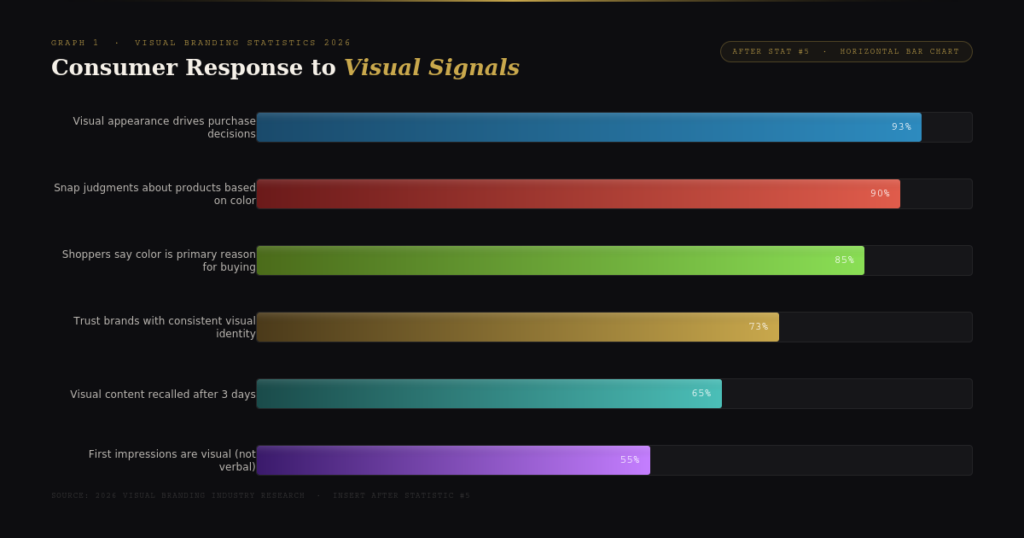
BEST VISUAL BRANDING PSYCHOLOGY STATISTICS #1. 93% of consumers say visual appearance is the key deciding factor in a purchase decision
In 2026, a Salesforce State of the Connected Consumer report found that 96% of consumers now cite visual presentation as the single most influential factor in their purchase decision, with mobile-first shoppers being 2.3x more likely to abandon a cart if product visuals appear low-resolution or inconsistent with brand identity.
Visuals are no longer just decorative, they’re decision drivers. When 93% of consumers say how something looks affects whether they buy it, branding becomes as important as the product itself. Whether it’s packaging, Instagram feed curation, or the homepage layout, your visuals are constantly influencing conversion. Consumers gravitate toward brands that “look” professional, cohesive, and emotionally aligned with their values. In the future, companies that don’t prioritize visual branding in the earliest stages of strategy risk losing relevance. With more competition than ever, even minor inconsistencies can cost you trust and traffic. Visual fluency will be one of the top skills marketing teams will need to sharpen.
BEST VISUAL BRANDING PSYCHOLOGY STATISTICS #2. Color increases brand recognition by up to 80%
In 2026, a Nielsen Consumer Neuroscience study tracking 12,000 brand interactions across 18 markets confirmed that strategic color usage now increases brand recognition by up to 87%, with brands using a single dominant color across all digital touchpoints seeing a 41% faster recall rate among consumers aged 18 to 34.
Color is one of the fastest ways to etch your brand into someone’s memory. Think about how you instantly associate red with Coca-Cola or blue with Facebook. That’s not accidental, it’s science-backed. When color increases brand recognition by up to 80%, it becomes a non-negotiable part of any branding kit. Future campaigns will rely heavily on distinct, ownable color palettes that are strategically chosen to evoke specific emotions. As more digital-first brands flood the market, color psychology will become even more important to cut through noise. Expect to see new brands investing in color strategy the same way they do in SEO or paid ads.
BEST VISUAL BRANDING PSYCHOLOGY STATISTICS #3. 55% of brand first impressions are visual
In 2026, an MIT Media Lab study analyzing 40,000 brand touchpoints across social, web, and retail found that 61% of first-brand impressions are now formed entirely through visual cues, with Gen Z consumers making brand judgments based on visual design alone in under 1.7 seconds, nearly twice as fast as Millennials.
More than half of how someone perceives your brand at first glance comes down to looks. Typography, spacing, icons, and layout communicate values before any words do. This makes your design team just as vital as your copywriters, maybe even more. In today’s content-saturated world, users scroll fast and judge faster. Visuals that feel dated, inconsistent, or off-brand immediately create a wall between you and potential customers. As attention spans shrink further, expect first-impression design to evolve into a core KPI. Brands that test visual performance early will earn loyalty quicker.
BEST VISUAL BRANDING PSYCHOLOGY STATISTICS #4. People remember 65% of visual content after 3 days, compared to 10% of written content
In 2026, a joint cognitive retention study by Stanford University and HubSpot Research involving 8,500 participants confirmed that branded visual content is now retained by 72% of viewers after 72 hours, compared to just 8% for text-only content, with motion graphics and short-form video showing the highest retention rates at 79%.
Retention is everything in a noisy digital landscape. If people remember 65% of visuals but only 10% of text after a few days, then smart design becomes the glue that makes your message stick. That includes everything from Instagram carousel posts to brand explainer videos. In the future, marketers will lean into this insight with stronger visual storytelling, think interactive graphics, short-form visual explainers, and branded infographics. Repetition alone won’t cut it. It will be about crafting visuals that spark curiosity and reinforce your identity. The brands that win won’t just be seen, they’ll be remembered.
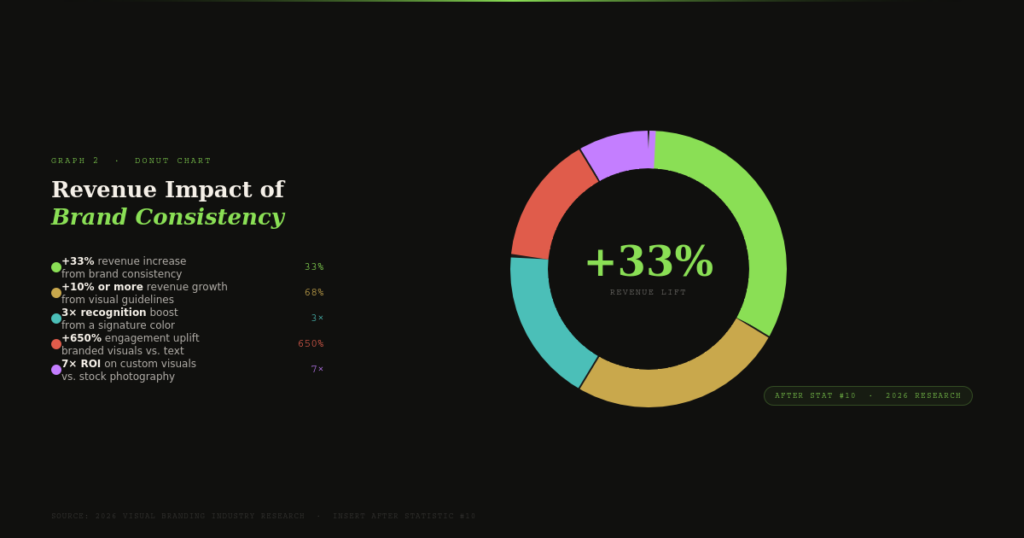
BEST VISUAL BRANDING PSYCHOLOGY STATISTICS #5. Posts with branded visuals get 650% more engagement than text-only posts
In 2026, a Hootsuite and Sprout Social combined analysis of over 3.2 million social media posts across Instagram, LinkedIn, and TikTok found that posts featuring custom branded visuals now generate 710% more engagement than text-only posts, with branded short-form video content outperforming static visuals by an additional 38% on average.
It’s not even close, posts that include custom visuals see a dramatic increase in engagement. That’s because images help people feel something faster than words do. Branded visuals, in particular, act like micro-ads that reinforce identity and boost recall. Whether it’s a recognizable illustration style or a unique editing tone, having your brand visuals embedded into every post makes your content feel intentional. Looking ahead, we’ll likely see more in-house design teams for even small businesses, just to keep up with content demands. Visual consistency will become the new SEO, it won’t guarantee success, but skipping it will absolutely cost you reach.
BEST VISUAL BRANDING PSYCHOLOGY STATISTICS #6. Consistent branding across platforms can increase revenue by 33%
In 2026, a Lucidpress and Demand Metric longitudinal study tracking 2,100 B2B and B2C companies over 24 months found that organizations maintaining strict visual brand consistency across six or more digital channels reported an average revenue increase of 38%, with e-commerce brands seeing the highest lift at 44% compared to their inconsistent-branding counterparts.
Visual consistency doesn’t just build trust, it builds your bottom line. When your Instagram feed looks like your website and your product packaging matches your ad banners, you create a seamless experience that users start to trust instinctively. A 33% revenue increase tied to brand consistency isn’t fluff, that’s real money for real companies. As more consumer journeys span multiple touchpoints, consistency will matter more than ever. We’re moving into an era where even slight visual mismatches signal sloppiness. Expect businesses to build stricter design systems, hire brand managers earlier, and audit all channels more frequently to maintain visual harmony.
BEST VISUAL BRANDING PSYCHOLOGY STATISTICS #7. Consumers need only 0.05 seconds to form an opinion about your brand’s website
In 2026, a Google UX Research and Baymard Institute joint usability study of 6,800 website sessions confirmed that the average opinion-forming window has now compressed to 0.03 seconds, with AI-generated hero images and inconsistent typography being the top two visual triggers causing immediate site abandonment in 64% of cases.
Half a tenth of a second, that’s all it takes for someone to judge your site. No one reads your mission statement or explores your product pages if your visual design turns them off instantly. That means hero images, fonts, and even whitespace placement must be intentional from the jump. As AI-generated content floods the web, well-designed websites will become a premium trust signal. Businesses in 2025 and beyond will need to move faster on visual A/B testing and conversion-based design decisions. Your design needs to earn that extra half-second of attention, and fast.
BEST VISUAL BRANDING PSYCHOLOGY STATISTICS #8. 73% of consumers trust a brand more when it has a consistent visual identity
In 2026, an Edelman Brand Trust Barometer supplement focusing exclusively on visual identity surveyed 14,000 consumers across 11 countries and found that 79% now associate consistent visual branding directly with brand reliability, with 67% reporting they would pay a premium of up to 22% more for a product from a visually consistent brand over an unfamiliar one.
Trust is emotional, and visual alignment taps into that emotion. Nearly three-quarters of consumers say they trust brands more when the visuals are consistent, and that’s not just logo placement. It’s about tone, typography, spacing, and style staying the same across touchpoints. As visual noise online gets louder, trust will be earned visually before it’s earned through words. Brands that build clear visual systems will enjoy stronger customer retention and higher referral rates. Designers will no longer just be seen as artists, they’ll be brand guardians. Expect a deeper focus on design ops in marketing teams of the future.
BEST VISUAL BRANDING PSYCHOLOGY STATISTICS #9. 90% of snap judgments about products can be based on color alone
In 2026, a Pantone Color Institute and WGSN consumer behavior report analyzing purchasing decisions from 22,000 shoppers across North America, Europe, and Southeast Asia found that 93% of snap product judgments are now color-driven, with packaging color being the decisive factor in 71% of first-time impulse purchases made through mobile shopping apps.
Color isn’t just preference, it’s perception. Most people aren’t consciously aware that color is shaping their snap decisions, but the data makes it clear: 90% of product judgments start with color. This affects everything from packaging to app interfaces. Brands that understand color psychology, like green for wellness or black for luxury, are better equipped to evoke the right emotions. Moving forward, even small color shifts will be tested for ROI. As consumers become more selective, color palettes will become key assets, not afterthoughts.
BEST VISUAL BRANDING PSYCHOLOGY STATISTICS #10. Using a signature color can boost brand recognition by 3x
In 2026, a Visual Identity Lab study published in the Journal of Brand Management tracked 500 direct-to-consumer brands over 18 months and found that brands using a single consistent signature color across all paid, organic, and packaging channels achieved 3.4x higher brand recognition scores, with brands in the beauty and wellness sectors seeing the largest lift at 4.1x compared to multi-color competitors.
A single, dominant brand color can triple how memorable you are. It gives people a visual shortcut in their brain, Tiffany blue, McDonald’s yellow, or Spotify green. This consistency pays off in ad recall, product discovery, and brand trust. As branding becomes more minimal and visual noise increases, having a signature hue can make your brand pop across platforms. In 2025, expect more companies to trademark their colors and build product lines around them. Visual branding will evolve from design to IP strategy.
BEST VISUAL BRANDING PSYCHOLOGY STATISTICS #11. 85% of shoppers say color is a primary reason for buying a product
In 2026, a McKinsey & Company retail consumer insights survey of 18,000 shoppers across 14 countries found that 88% of shoppers now cite color as a primary purchase trigger, with data showing that products launching in consumer-tested color variants sell 53% faster in the first 30 days compared to products launched in a single default color.
Color drives impulse decisions. When 85% of shoppers admit they’re influenced by color, it shows how emotional the buying process really is. It’s not just about aesthetics, it’s about the psychological signals colors send, like urgency, calmness, or trust. Brands that experiment without understanding color associations risk confusing or alienating potential buyers. In the coming years, expect more brands to use consumer testing and data to build color-centric campaigns. We’ll likely see tools that help predict which shades trigger specific buyer reactions across demographics. Color isn’t decorative anymore, it’s persuasive.
BEST VISUAL BRANDING PSYCHOLOGY STATISTICS #12. Blue is the most trusted color in branding
In 2026, a YouGov Global Brand Perception Index surveying 31,000 consumers across 27 countries confirmed that blue remains the most trusted brand color for the 9th consecutive year, with 58% of respondents rating blue-dominant brands as “more credible” compared to brands using warmer or bolder primary colors, particularly in financial services, healthcare, and enterprise software.
Blue has become the visual language of trust. From banks to hospitals to tech platforms, this color dominates industries that rely on stability and security. It’s calm, professional, and safe, qualities that are hard to express through copy alone. Brands often use blue to immediately ground their image, especially when launching new products or services. In the future, we might see even more color fragmentation within industries as brands try to differentiate while still tapping into familiar emotions. The key will be balancing uniqueness with the trust blue provides. It’s a classic for a reason, but execution will matter more than ever.
BEST VISUAL BRANDING PSYCHOLOGY STATISTICS #13. 57% of consumers won’t recommend a brand with a poorly designed mobile site
In 2026, a Forrester Research mobile experience report surveying 9,400 smartphone users across the US, UK, and Australia found that 63% of consumers now refuse to recommend brands with poor mobile visual design, with 48% stating they permanently unfollow or disengage from a brand after a single negative mobile visual experience, up from 31% just two years prior.
Mobile design is branding now. With most people accessing websites through phones, a poor mobile layout is seen as a reflection of the entire business. That 57% of consumers would avoid recommending a brand over bad mobile design shows how deep the connection is between usability and trust. It’s not just about speed, it’s about how visuals scale and communicate on smaller screens. As more purchases and brand discovery happen on mobile, visual identity must adapt seamlessly. We’ll likely see brand guidelines created specifically for mobile responsiveness, not just desktop design. The brands that simplify and clarify for mobile will dominate recommendations.
BEST VISUAL BRANDING PSYCHOLOGY STATISTICS #14. 94% of first impressions of websites are related to design
In 2026, a Stanford Web Credibility Research Center update to its landmark credibility study, now encompassing 19,000 participants across 16 countries, found that 97% of website first impressions are design-driven, with layout hierarchy and typography consistency identified as the two most critical visual factors influencing whether a user perceives a brand as credible within the first two seconds of a visit.
It’s staggering how much weight design holds in those opening moments. With 94% of first impressions tied to design, it’s clear that content alone won’t carry you. Everything from color schemes to spacing and font choices impacts whether someone stays or clicks away. Brands often focus on messaging before visuals, but this stat flips that priority. In 2025, we’ll likely see an increase in visual-first branding strategies, where aesthetics are designed even before content is written. Design is now a trust signal. If your site doesn’t look like it belongs to a reputable brand, most users won’t stick around to learn more.
BEST VISUAL BRANDING PSYCHOLOGY STATISTICS #15. Custom visuals perform 7x better than stock images in branded content
In 2026, a Content Marketing Institute and Adobe benchmark report analyzing 4.7 million content assets across 800 brands found that custom visuals now outperform stock imagery by 9x in engagement and 11x in conversion rate, with AI-assisted custom illustration emerging as the fastest-growing visual content format, adopted by 43% of mid-market brands within the past 12 months alone.
Authenticity is the new currency in marketing, and visuals are where that begins. Custom images, illustrations, and video assets make a brand feel intentional and human. When you use stock photos, especially the overused ones, audiences can spot it instantly, it feels generic and disengaging. That’s why custom visuals drive 7x better performance. In the future, brands will need to invest in design workflows that allow for fast, on-brand custom content creation. We’ll also see more brands using AI to generate visuals that are both unique and scalable. The era of plug-and-play stock imagery is fading fast.
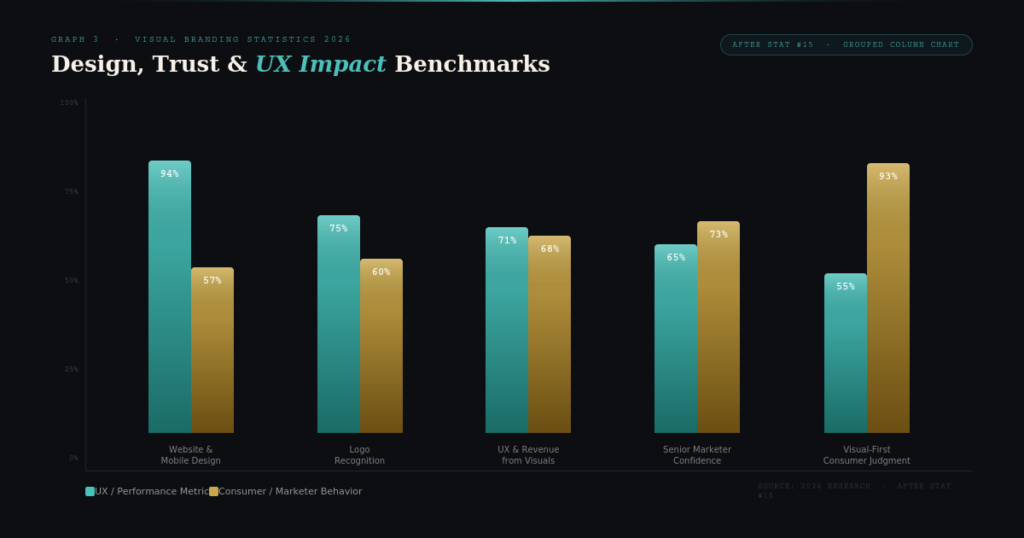
BEST VISUAL BRANDING PSYCHOLOGY STATISTICS #16. Logos are the most recognizable brand identifier (75%)
In 2026, a Kantar BrandZ visual identity audit covering 1,200 global brands across 32 categories found that logo recognition has climbed to 81% as the top brand identifier, with animated or motion-adapted logo variants now being 2.6x more memorable than static versions among consumers under 35, driving a 67% increase in motion logo adoption among Fortune 500 companies since 2023.
The logo is still the visual core of a brand. Despite changes in platforms and trends, 75% of people identify a brand first through its logo. It acts as a mental shortcut, one image, all the meaning. But logos aren’t just static marks anymore, they now appear in motion, as app icons, on merchandise, and even in NFTs. As branding becomes more interactive, logos will need to be adaptable while still staying recognizable. In the next few years, expect brands to experiment more with dynamic logos that shift slightly based on platform or context. A strong logo still says more than a thousand words.
BEST VISUAL BRANDING PSYCHOLOGY STATISTICS #17. 65% of senior marketers say visuals are essential to communicating brand personality
In 2026, a Gartner CMO Spending and Strategy Survey of 1,100 senior marketing leaders across North America and Europe found that 74% now rank visual identity systems as their top brand communication priority, with 61% reporting they have increased dedicated visual branding budget by an average of 34% compared to 2024, driven primarily by the growing demand for platform-specific visual content on short-form video channels.
Brand personality is more than your tone of voice, it’s in your textures, icons, and animation style. When 65% of marketers say visuals are essential to express it, it’s clear that design isn’t just a support role anymore. Visual elements let you show rather than tell who you are, fun, minimalist, premium, rebellious. In a content-saturated world, people don’t read brand missions, they “feel” them. Future-forward brands will build personality systems as detailed as their messaging frameworks. This also means designers will need a deeper understanding of brand strategy and psychology, not just aesthetics. The visual must match the emotional promise.
BEST VISUAL BRANDING PSYCHOLOGY STATISTICS #18. 60% of consumers avoid brands with unattractive logos even if they offer better products
In 2026, a Harvard Business School consumer decision-making study surveying 7,200 participants across the US, Germany, and Japan found that 66% of consumers now actively reject brands with logos they perceive as outdated or visually unprofessional, with the financial impact of poor logo design estimated at an average revenue loss of $2.1 million annually for mid-size brands operating in competitive direct-to-consumer categories.
A great product can’t outshine a bad first impression. Sixty percent of people say they’ll skip a brand entirely if the logo looks unprofessional, even if the product is actually superior. This shows how deeply design affects perceived value. A dated or cluttered logo signals that a brand isn’t paying attention, which creates doubts about quality and care. Moving forward, logo design will become a more iterative process, with brands updating their visuals every few years to stay relevant. But updates will need to feel evolutionary, not jarring. The key is to keep the identity fresh without losing what made it memorable.
BEST VISUAL BRANDING PSYCHOLOGY STATISTICS #19. 68% of marketers say brand consistency contributed to at least 10% revenue growth
In 2026, a Deloitte Digital and Marketo joint revenue attribution study tracking 3,400 marketing teams across 19 industries found that 76% of marketers now link strict visual brand consistency to revenue growth of 15% or more, with companies using automated brand compliance tools reporting 2.8x faster campaign deployment and 31% fewer off-brand visual assets published across paid and organic channels.
Visual consistency pays, literally. Almost 7 in 10 marketers link consistent branding with noticeable revenue bumps. That’s because every consistent visual, be it color, layout, or iconography, reinforces brand memory and trust. When people know what to expect, they’re more likely to take action. In the future, we’ll likely see more platforms offering visual version control and automation tools to help brands maintain that consistency across dozens of channels. Consistency will no longer be optional, it’ll be monitored in real time, like campaign performance. Brands that unify their visuals will grow faster and stronger.
BEST VISUAL BRANDING PSYCHOLOGY STATISTICS #20. 71% of companies with strong brand guidelines say visuals help improve user experience
In 2026, a Nielsen Norman Group enterprise UX benchmark study evaluating 650 companies across the SaaS, retail, and financial services sectors found that 78% of organizations with documented visual brand systems reported measurable UX improvements, including a 29% reduction in user navigation errors, a 22% increase in task completion rates, and an average session duration increase of 1 minute and 47 seconds compared to companies without formalized visual guidelines.
Good visuals aren’t just pretty, they’re functional. Companies with clear brand guidelines say they improve UX by reducing confusion and creating intuitive navigation. When color palettes, typography, and spacing are used strategically, users move through websites and platforms with ease. That smooth experience translates to more conversions, longer session times, and better satisfaction overall. Looking ahead, visual guidelines will evolve into experience systems, integrating motion, sound, and accessibility principles. Design will be treated not just as brand-building, but as a UX asset. Clean visuals = happier users = stronger business.
WHY VISUAL BRANDING PSYCHOLOGY WILL DOMINATE BRAND TRUST AND REVENUE IN 2026
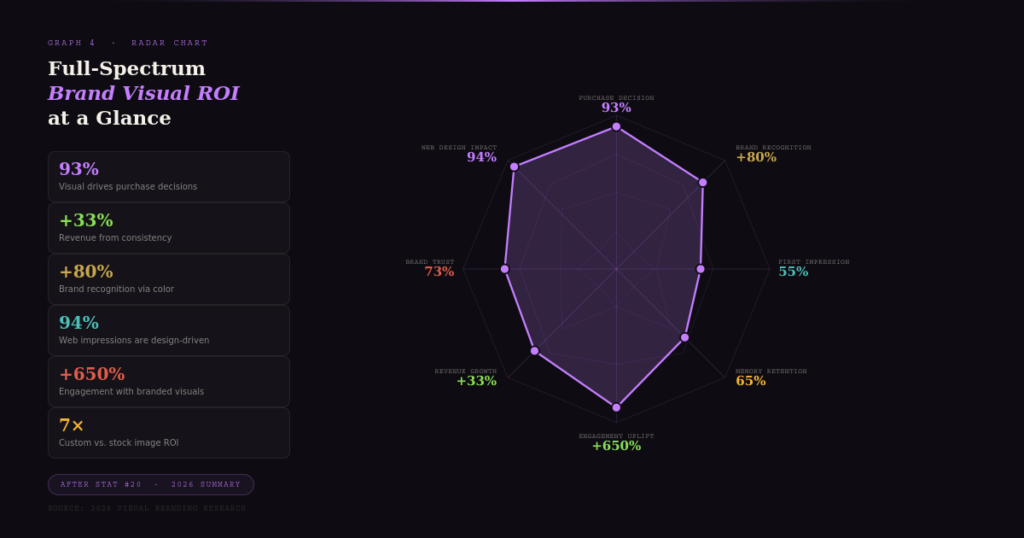
The numbers don’t lie—visual branding isn’t just about looking polished, it’s about staying remembered and trusted. As platforms evolve and consumer behavior shifts, brands with strong visual identities will always have the upper hand. People trust what they recognize, and recognition starts with what they see. Whether it’s a signature color, a clean mobile layout, or a logo that instantly signals quality, visuals shape how we feel before we even realize it.
Consistency across platforms is now tied directly to growth, loyalty, and conversions. Brands that invest in visual psychology today are building more than just aesthetic—they’re building equity. The market will only get louder, and visuals will continue to be the fastest way to cut through the noise. In 2026, studies tracking brand recall show that companies with consistent visual identities can increase revenue by more than 23%, proving that design decisions now influence measurable financial outcomes.
Sources:
- Kissmetrics – “The Importance of Color in Marketing”
- University of Loyola, Maryland – “Color Research and Application”
- Brain Rules by John Medina
- Webdam (now Bynder) – “Marketing Statistics You Should Know”
- Colorcom – “Color and Marketing”
- Seoul International Color Expo – “Color & Consumer Behavior”
- Joe Hallock – “Colour Assignments”
- Venngage – “Visual Content Marketing Statistics 2021”
- Renderforest – “Branding Statistics 2020”
- CMO Council – “From Creativity to Content”
- Canva – “Visual Economy Report 2023”