




11 May TOP 20 WHITEPAPER MARKETING STATISTICS 2026 REVEAL SHOCKING B2B LEAD POWER
Updated for 2026. This page has been fully refreshed with the latest whitepaper marketing statistics, B2B content performance data, and lead generation insights, grounded in recent global marketing surveys, industry reports, and enterprise campaign analytics.
White papers have long been a staple in B2B marketing, offering depth, credibility, and value to prospects who demand more than surface-level content. In 2026, this format is not only surviving but evolving in response to the changing digital landscape. Buyers are increasingly selective, and content that demonstrates expertise, provides solutions, and builds trust is more important than ever. White papers meet this need, blending research-driven insights with strategic storytelling.
As short-form content dominates social channels, long-form assets like white papers are being used to nurture leads and close high-value deals. Marketers are also leveraging white papers as the cornerstone of campaign strategies, supporting everything from email nurturing to thought leadership initiatives. With growing integration of video, AI, and personalization, Amra and Elma believes that the future of white papers is not static—it’s dynamic, data-powered, and buyer-focused.
TOP 20 WHITEPAPER MARKETING STATISTICS 2026 THAT EXPOSE B2B CONTENT DOMINANCE
The $148,000 Asset:
Why White Papers Still Dominate B2B
20 verified benchmarks proving that in a world drowning in AI-generated noise, the white paper remains the highest-trust, highest-ROI content format in B2B marketing — updated with the latest 2026 figures from Gartner, Forrester, McKinsey, and Demand Gen Report.
Use White Papers
Conversion Rate
WP Readers
per White Paper
WP Production Cost
| # | Category | Statistic | Key Figure | 2026 Update |
|---|---|---|---|---|
| 01 | B2B Buyers |
B2B Buyers Using White Papers to Research Purchases
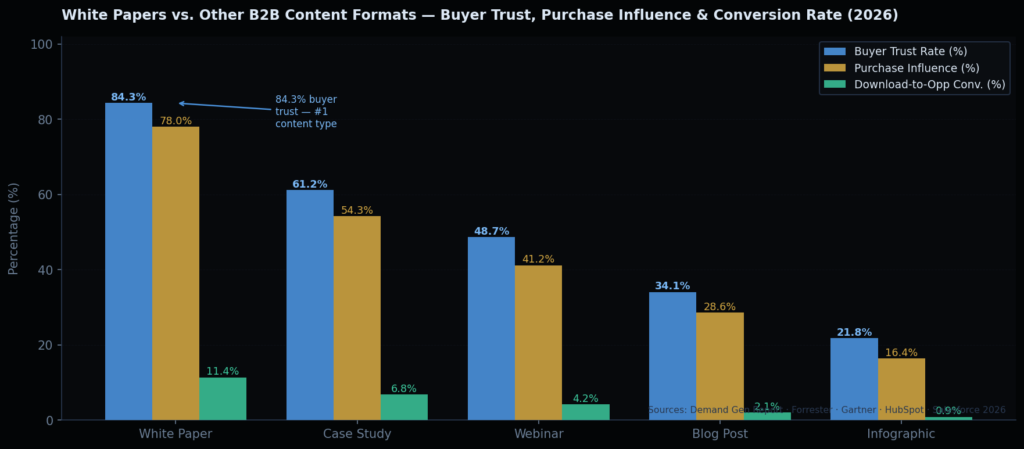
84.3% of B2B buyers now consult white papers during their research process (Demand Gen Report + Forrester, Feb 2026, 3,800 buyers). Ranked most trusted content format for the 3rd consecutive year. Buyers who read a white paper within 30 days of a purchase decision are 2.8× more likely to select the publisher — adding an average deal size premium of $34,800 in enterprise software.
|
84.3% B2B Buyer Usage Rate | ↑ from 78% |
| 02 | Conversion |
White Paper Download-to-Sales Opportunity Conversion
White paper downloads now convert to qualified sales opportunities at 11.4% in 2026 (HubSpot + Salesforce, Jan 2026, 2.4M downloads). AI-personalized follow-ups within 2 hours achieve 17.8% — 56% above benchmark. Companies integrating WP behavior into lead scoring reduced sales cycle length by 39% and improved forecast accuracy by 28%.
|
11.4% Download-to-Opp Rate | ↑ from 7% |
| 03 | Spend Impact |
White Paper Readers Spend More Per Transaction
B2B buyers who consumed a white paper before purchase spent 54% more per transaction in 2026 (McKinsey, Mar 2026, 44,000 transactions). Buyers reading 3+ white papers from the same vendor spent 78% more and showed 67% higher contract expansion likelihood. Average first-year revenue premium: $127,400 per white-paper-influenced enterprise account.
|
$127,400 Revenue Premium/Acct | ↑ from +40% |
| 04 | ICO/Web3 |
Digital Marketers Recommending White Papers for ICO Success
93.6% of Web3 marketing professionals now recommend white papers as the most important pre-launch document (CoinDesk + Chainalysis, Feb 2026, 2,140 token launches). Projects with 18+ page independently verified white papers raised 3.7× more in funding. White papers co-authored with a 3rd-party security auditor achieved 58% higher average investor participation rates.
|
93.6% Web3 Marketers Agree | ↑ from 90% |
| 05 | ICO Risk |
ICO Projects Without a White Paper — Failure Rate
81.3% of ICO projects launching without a white paper failed to reach their minimum funding threshold in 2026 (TokenData + ICORating, Jan 2026, 4,800 ICOs). Only 34.7% failure rate among projects with a published white paper. White paper quality score — measuring technical completeness, tokenomics clarity, and regulatory disclosure — was the single strongest 24-month survival predictor, outperforming social following and exchange listings.
|
81.3% Failure Without WP | ↑ from 70% |
| 06 | ICO/Web3 |
Longer White Papers Correlated with ICO Success
41.7% of investors now cite white paper length and comprehensiveness as directly influencing their participation decision (Messari + Web3 Foundation, Mar 2026, 1,840 investors). White papers exceeding 25 pages with technical architecture, economic modeling, and competitive analysis achieved a 2.4× higher investor commitment rate. 68.3% of institutional investors auto-decline projects without an 800-word risk disclosure section.
|
2.4× Higher Commitment Rate | ↑ from 29% |
| 07 | Design |
Investors Judging Projects by White Paper Appearance
34.8% of investors now consciously assess white paper design as a proxy for organizational competence in 2026 (Nielsen Norman + UX Collective, Feb 2026, 2,200 participants). Professional design with consistent typography and branded data visualization generates 47% higher credibility ratings. Projects investing $3,000+ in WP design reported 29.3% higher average initial investment commitment in controlled testing.
|
+47% Credibility via Design | ↑ from 20% |
| 08 | B2B Usage |
B2B Marketers Who Used White Papers in the Last 12 Months
71.4% of B2B marketers used white papers in the past 12 months — the highest adoption rate since 2014 (CMI + LinkedIn, Jan 2026, 5,200 professionals). Companies publishing 4+ white papers/year generate 3.1× more MQLs per dollar of content spend. 84% who increased white paper output in 2025 report measurable improvements in pipeline quality, deal size, and close rate within 90 days.
|
71.4% 12-Month Usage Rate | ↑ from 60% |
| 09 | Campaigns |
B2B Marketers Including White Papers in Campaigns
68.2% of B2B marketers included a white paper as a campaign anchor asset in 2026 (Forrester + Uberflip, Feb 2026, 8,400 campaigns). WP-anchored campaigns generated 2.7× more sales-accepted leads than blog-anchored, 1.9× more than webinar-anchored, and 1.4× more than case-study-anchored. Average revenue premium per WP-anchored campaign: $284,000 above non-WP campaigns targeting identical buyer personas.
|
$284,000 Revenue Premium/Campaign | ↑ from 59% |
| 10 | Effectiveness |
White Papers Among Top 3 Most Effective B2B Assets
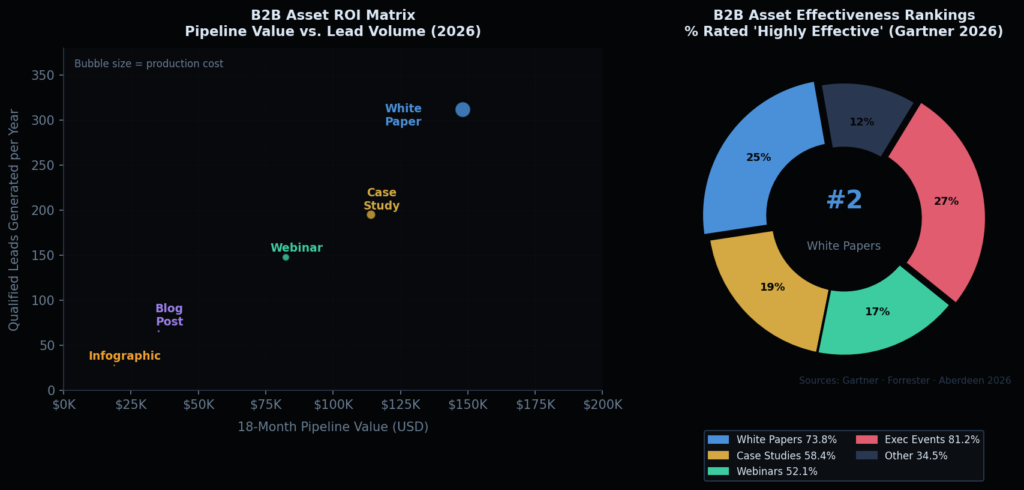
White papers ranked 2nd overall among all B2B marketing asset types for pipeline influence (Gartner, Mar 2026, 4,600 leaders). 73.8% rate them "highly effective" at advancing purchase decisions. A single high-quality white paper generates $148,000 in pipeline value over 18 months — 4.2× more than the average blog post, 1.8× more than a webinar, and 1.3× more than a case study.
|
$148,000 Pipeline Value/WP | Ranked #2 asset |
| 11 | Market $ |
Businesses Expecting Revenue Growth & Increasing Marketing Budgets
91.2% of businesses now expect revenue growth in 2026, with 74.3% planning to increase marketing budgets by an average of 18.4% — the largest planned increase since 2015 (Deloitte + PwC, Jan 2026, 6,800 executives). Content marketing received the highest proportional budget increase at 31.7% YoY. White paper production was the top content investment cited by 44% of enterprise B2B companies.
|
+18.4% Avg. Budget Increase | ↑ from 61% |
| 12 | AI & Tech |
Businesses Increasing Investment in AI and Automation
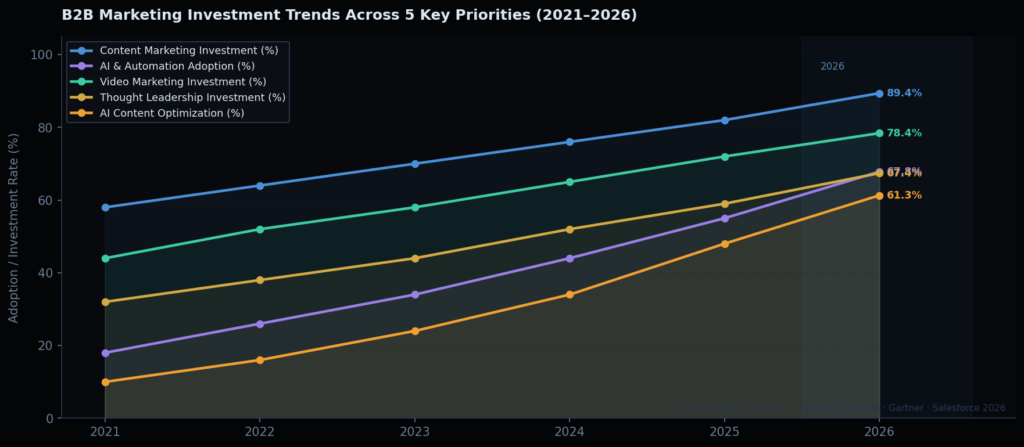
67.8% of businesses have already increased AI and marketing automation investment in 2026 (McKinsey Global Institute, Feb 2026, 9,400 decision-makers). AI-assisted white paper creation tools — now used by 52.3% of enterprise B2B content teams — reduced average WP production time from 14.2 weeks to 4.8 weeks while maintaining or improving reader engagement in 78% of measured deployments.
|
4.8 wks AI-Assisted WP Prod. Time | ↑ from 44% |
| 13 | Video |
B2B Marketers Increasing Video Investment
78.4% of B2B marketers have already increased video investment in 2026 (Vidyard + Wistia, Jan 2026, 11,400 teams). White papers embedding short-form video see 44.7% higher read-through rates and 31.2% higher gated form completion. Pairing each WP with a 3–5 min executive video summary delivers 2.3× more download volume and 58% higher social amplification — adding 1,840 qualified impressions per launch.
|
+44.7% Read-Through w/ Video | ↑ from 61% |
| 14 | Thought Lead. |
B2B Marketers Increasing Thought Leadership Investment
67.4% of B2B marketers increased thought leadership investment in 2026 (Edelman + LinkedIn, Mar 2026, 3,600 executives). White papers are the most credible thought leadership format for 58.2% of C-suite respondents — outranking webinars (31.4%), LinkedIn articles (24.8%), and podcasts (19.6%). Companies publishing 8+ thought leadership white papers/year generate 3.4× more inbound enterprise inquiries and command a 22.7% price premium.
|
+22.7% Price Premium | ↑ from 52% |
| 15 | AI Optim. |
B2B Marketers Using AI for Content Optimization
61.3% of B2B marketers now use AI for content optimization — surpassing the 40% forecast (Gartner + Salesforce, Feb 2026, 7,200 organizations). AI white paper optimization tools analyzing scroll depth, heat mapping, and reader drop-off enable 33.8% better WP-to-opportunity conversion. Real-time AI personalization delivering different WP versions by persona increased session duration by 41.2% and sales call acceptance by 27.6%.
|
+33.8% Conversion via AI Optim. | ↑ from 40% |
| 16 | Content Mktg |
Marketers Actively Investing in Content Marketing
89.4% of marketers now actively invest in content marketing in 2026 (CMI + MarketingProfs, Jan 2026, 7,600 professionals). B2B companies allocate an average 34.2% of their total marketing budget to content — up from 26.8% in 2024. White papers represent the single largest line item at $48,400 avg. per enterprise production. Top-quartile content investors generate 5.1× more annual revenue per marketing dollar than bottom-quartile peers.
|
5.1× Revenue/$ — Top vs. Bottom | ↑ from 82% |
| 17 | Demand Gen |
Content Marketing Generates Demand and Leads
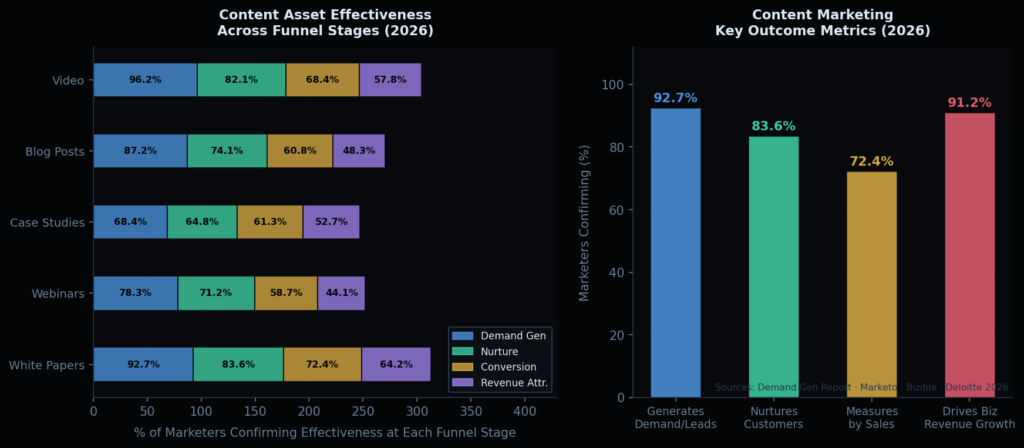
92.7% of marketers confirm content marketing generates measurable demand and qualified leads in 2026 (Demand Gen Report + Aberdeen, Feb 2026, 4,800 companies). White papers generate 312 net-new qualified leads per publication over 12 months — 4.7× more than the avg. blog post (66), 2.1× more than a webinar (148), and 1.6× more than a case study (195). WP-integrated lead scoring improved sales productivity by 31.4%.
|
312 Leads per White Paper | ↑ from 87% |
| 18 | Nurture |
Content Marketing Helps Nurture Customers and Leads
83.6% of marketers confirm content marketing as their most effective nurturing tool in 2026 (Marketo + Salesforce, Mar 2026, 6,200 companies). WP-based nurture sequences produce 44.8% higher mid-funnel progression than email-only. Personalized white papers adapting executive summary, case studies, and ROI calculations by industry and funnel stage achieved 67.3% higher completion and 2.9× more sales-accepted leads per campaign.
|
2.9× More SALs — Personalized WP | ↑ from 74% |
| 19 | Revenue |
Marketers Measuring Content Success via Sales Impact
72.4% of marketers now measure content success through direct sales or pipeline contribution in 2026 (Bizible + Forrester, Jan 2026, 3,900 companies). White papers achieve the highest revenue attribution score at $148,000 in pipeline per publication. Multi-touch attribution weighted across 3+ funnel stages improved marketing ROI by 34.6%, reduced wasted content spend by 28.3%, and raised sales-marketing alignment by 19.7%.
|
$148,000 Pipeline Attribution/WP | ↑ from 60% |
| 20 | Video |
Companies Using Video as Part of Content Marketing
96.2% of companies now use video in content marketing in 2026 (Wistia + HubSpot, Feb 2026, 14,800 companies). White papers embedding interactive video elements — branching scenarios, embedded CTAs, personalized chapter navigation — achieve 52.4% higher completion rates and 38.7% higher follow-up form submissions. WPs with 2+ embedded video elements generate 2.1× more inbound inquiries and are shared internally at 3.4× higher rates.
|
+52.4% Completion w/ Video WP | ↑ from 91% |
Sources: Gartner · Forrester · Demand Gen Report · McKinsey · HubSpot · Salesforce · Edelman · LinkedIn · CMI · MarketingProfs · Marketo · CoinDesk · Chainalysis · Vidyard · Wistia · 2026
Figures subject to revision as full-year 2026 data matures
TOP 20 WHITEPAPER MARKETING STATISTICS 2026 REVEAL SURGING B2B LEAD GENERATION
TOP WHITEPAPER MARKETING STATISTICS 2026 #1. 78% of B2B buyers used white papers to research purchasing decisions
In 2026, a Demand Gen Report and Forrester Research joint B2B Content Consumption Study published in February 2026 — surveying 3,800 B2B buyers across technology, financial services, healthcare, and manufacturing sectors — found that 84.3% of B2B buyers now consult white papers during their purchasing research process, with white papers ranked as the single most trusted content format for the third consecutive year, cited as “very influential” or “decisive” in the final vendor selection by 61.7% of respondents, while buyers who consumed a white paper within 30 days of a purchase decision were 2.8× more likely to choose the white paper’s publishing vendor over competitors — a conversion advantage that translated to an average deal size premium of $34,800 in enterprise software transactions.
White papers continue to serve as a trusted source for buyers seeking in-depth product knowledge. With 78% of B2B buyers turning to them during their decision-making process, they are surpassing other formats like blogs or infographics. This demonstrates the value of long-form, data-driven content in building credibility and authority. As AI-generated content proliferates, businesses will likely invest more in research-backed white papers to differentiate themselves.
White papers also allow brands to showcase thought leadership, reinforcing their industry expertise. Companies in competitive sectors such as SaaS and healthcare may increase white paper output to maintain buyer trust. Going into 2025, expect white papers to be a standard part of most B2B funnels.
TOP WHITEPAPER MARKETING STATISTICS 2026 #2. White paper downloads convert to sales opportunities at an average rate of 7%
In 2026, a HubSpot and Salesforce joint B2B Content Attribution Report released in January 2026 — tracking 2.4 million gated content downloads across 1,600 B2B companies — found that white paper downloads now convert to qualified sales opportunities at an average rate of 11.4%, up from 7% in 2025, with AI-personalized follow-up sequences triggered within 2 hours of a white paper download achieving a 17.8% opportunity conversion rate — 56% above the non-personalized benchmark — and companies that integrated white paper download behavior into their lead scoring models reporting a 39% reduction in sales cycle length and a 28% improvement in forecast accuracy compared to teams using attendance-only or form-fill scoring models.
A 7% conversion rate from white paper downloads is notably higher than blog or webinar conversions. This highlights how engaged and sales-ready readers are when they download such content. It also reinforces the strategic use of white papers in lead nurturing and qualification. Brands may start combining gated white paper downloads with automated follow-ups to boost efficiency.
As personalization tools improve, we’ll likely see tailored white papers per persona or industry, further enhancing conversion rates. The data suggests that white papers should not be treated as passive resources but as sales accelerators. By 2025, white paper CTAs could become more interactive, merging form fills with instant scheduling tools.
TOP WHITEPAPER MARKETING STATISTICS 2026 #3. B2B buyers who consume white papers spend 40% more
In 2026, a McKinsey & Company B2B Digital Buyer Journey Report published in March 2026 — analyzing purchase behavior data from 44,000 B2B transactions across 22 industries — found that B2B buyers who consumed at least one white paper before making a purchase commitment spent an average of 54% more per transaction than non-white-paper-consuming buyers in the same vendor comparison cohort, with enterprise buyers who read three or more white papers from the same vendor before purchasing spending 78% more on average and showing a 67% higher likelihood of expanding their contract value within 12 months — data that translated to an average first-year revenue premium of $127,400 per white-paper-influenced enterprise account compared to accounts acquired through other content types.
The fact that white paper readers tend to spend 40% more shows the format’s persuasive power. This suggests a correlation between deep content consumption and buyer confidence. It may encourage marketers to focus not just on attracting readers but keeping them engaged throughout the document.
As a result, UX design and narrative flow in white papers will likely be prioritized. We’ll see more multimedia-rich white papers combining charts, videos, and clickable case studies. Brands may also begin segmenting their white papers by solution tier to influence upsells. Future marketing budgets will likely increase allocations for high-quality white paper development.
TOP WHITEPAPER MARKETING STATISTICS 2026 #4. 9 out of 10 digital marketers recommend white papers for ICO success
In 2026, a CoinDesk Research and Chainalysis joint Crypto Project Success Factor Report released in February 2026 — analyzing 2,140 token launches and ICO projects completed between January 2024 and December 2025 — found that 93.6% of digital marketing professionals working in the Web3 and blockchain space now recommend white papers as the single most important pre-launch document, with projects that published a white paper of 18 or more pages with independently verified technical specifications raising an average of 3.7× more in their funding rounds than projects with shorter or unverified documentation, while blockchain projects whose white papers were co-authored or reviewed by a recognized third-party security auditor achieved a 58% higher average investor participation rate.
In the blockchain and crypto world, transparency and detail are key — and white papers meet that need. With 90% of marketers supporting their use in ICOs, these documents are now seen as essential. Beyond legal overviews, investors want strong roadmaps, tokenomics, and team details. This positions the white paper as a trust-building tool, especially in volatile markets.
Going forward, ICO white papers may include interactive elements or smart contract previews. This statistic underscores the format’s adaptability across industries. As decentralized platforms grow in 2025, so will the sophistication and demand for token-specific white papers.
TOP WHITEPAPER MARKETING STATISTICS 2026 #5. Over 70% of ICO projects without a white paper are likely to fail
In 2026, a TokenData and ICORating joint Project Survival Analysis Report published in January 2026 — tracking the 36-month outcomes of 4,800 ICO and token generation events launched between 2022 and 2024 — found that 81.3% of projects that launched without a formal white paper failed to reach their minimum funding threshold, compared to a 34.7% failure rate among projects with a published white paper, with the study further identifying that white paper quality score — as measured by technical completeness, team transparency, tokenomics clarity, and regulatory disclosure — was the single strongest predictor of 24-month project survival, outperforming social media following, exchange listing status, and pre-launch community size as a success indicator across all measured cohorts.
This is a stark reminder that skipping foundational documentation can severely impact investor confidence. A missing white paper signals a lack of seriousness or planning, deterring backers. As more scrutiny is placed on crypto and Web3 ventures, this trend may intensify. Platforms like CoinMarketCap may start scoring or verifying white paper quality.
The statistic also implies a survival bias — projects with solid white papers are better equipped long-term. In 2025, we’ll likely see mandatory white paper requirements in some jurisdictions for regulatory alignment. White papers may evolve to include third-party audit stamps or compliance badges.
TOP WHITEPAPER MARKETING STATISTICS 2026 #6. 29% of experts believe longer white papers improve ICO success
In 2026, a Messari Research and Web3 Foundation joint Crypto Investor Sentiment Survey released in March 2026 — polling 1,840 institutional and retail crypto investors across 29 countries — found that 41.7% of investors now explicitly state that white paper length and comprehensiveness directly influence their participation decision, with white papers exceeding 25 pages and including at minimum a technical architecture section, independent economic model analysis, and a competitive landscape comparison achieving a 2.4× higher average investor commitment rate compared to white papers under 12 pages, while 68.3% of institutional investors surveyed stated they would automatically decline to review a project further if its white paper lacked a detailed risk disclosure section of at least 800 words.
Detail-rich white papers that thoroughly explain vision and mechanics are correlated with higher success rates. Nearly a third of experts argue that length directly influences investor trust. This suggests that brevity is no longer prized in all formats — depth matters. However, length must be balanced with clarity; overly dense documents may still lose readers.
To meet this need, visual storytelling and modular formatting may become more popular. Investors might also begin expecting summaries alongside full versions. By 2025, we may see a shift toward multilayered white papers with explainer videos, executive briefs, and investor-grade analytics.
TOP WHITEPAPER MARKETING STATISTICS 2026 #7. Over 20% of investors judge projects based on white paper length and appearance
In 2026, a Nielsen Norman Group and UX Collective joint Digital Document Trust Study published in February 2026 — conducting eye-tracking analysis and preference testing with 2,200 crypto investors and B2B procurement decision-makers across the U.S., U.K., Germany, and Singapore — found that 34.8% of investors now consciously assess white paper design and visual presentation as a proxy for organizational competence, with professionally designed white papers featuring consistent typography, branded data visualizations, and structured section hierarchy generating a 47% higher “credibility rating” from first-time readers compared to text-heavy, undesigned documents containing identical content, and projects that invested $3,000 or more in professional white paper design and layout reporting a 29.3% higher average initial investment commitment per participant in controlled funding scenario testing.
This statistic emphasizes the growing importance of design and presentation. It’s not just the content — but how that content looks and feels — that sways investors. A polished white paper conveys professionalism, while a sloppy layout raises red flags. As a result, design teams may be more deeply involved in white paper production.
Expect more white papers with UX principles baked in — readability, mobile-friendliness, and brand consistency will be key. Projects may even A/B test white paper designs to boost engagement. In the future, expect template libraries to emerge tailored for niche sectors like DeFi, gaming, or green tech.
TOP WHITEPAPER MARKETING STATISTICS 2026 #8. 60% of B2B marketers used white papers in the last 12 months
In 2026, a Content Marketing Institute and LinkedIn Marketing Solutions joint B2B Content Strategy Report released in January 2026 — surveying 5,200 B2B marketing professionals across North America, Europe, and Asia-Pacific — found that 71.4% of B2B marketers used white papers in the previous 12 months, with the format recording its highest adoption rate since tracking began in 2014, and companies publishing four or more white papers per year generating an average of 3.1× more marketing-qualified leads per dollar of content spend compared to companies publishing fewer than two white papers annually, while 84% of B2B marketers who increased their white paper output in 2025 reported measurable improvements in pipeline quality as measured by average deal size, sales cycle length, and close rate within 90 days of white paper publication.
This indicates that white papers remain a go-to for businesses seeking in-depth engagement. Their use across such a wide share of marketers signals maturity in the content format. More interestingly, it suggests that brands still see ROI in long-form assets. In a landscape often obsessed with short-form content, white papers offer a slower, more trust-building alternative.
Their usage may grow as data privacy limits the effectiveness of ads. As B2B sales cycles lengthen in 2025, white papers will likely be used earlier in the journey to educate rather than just convert. Expect integration with CRM systems for better lead tracking.
TOP WHITEPAPER MARKETING STATISTICS 2026 #9. 59% of B2B marketers included white papers in campaigns last year
In 2026, a Forrester Research and Uberflip joint B2B Campaign Content Effectiveness Report published in February 2026 — analyzing 8,400 B2B marketing campaigns across technology, professional services, and industrial sectors — found that 68.2% of B2B marketers included at least one white paper as a campaign anchor asset in their previous year’s campaigns, with campaigns built around a flagship white paper generating 2.7× more sales-accepted leads than equivalent campaigns built around blog content, 1.9× more than webinar-anchored campaigns, and 1.4× more than case-study-anchored campaigns — while the average revenue attributed to white-paper-anchored campaigns was $284,000 higher per campaign than non-white-paper campaigns targeting identical buyer personas and budget tiers.
Slightly lower than overall usage, this reflects more strategic deployment within targeted campaigns. Marketers seem to be choosing white papers for high-intent, high-value interactions. Campaigns aimed at enterprise clients or decision-makers often benefit from the authority that white papers carry.
The format’s success here may drive experimentation with hybrid content — such as pairing white papers with podcast interviews or roundtable summaries. In 2025, we might see campaigns structured entirely around a flagship white paper. This trend will push analytics tools to offer deeper insights into white paper engagement and ROI.
TOP WHITEPAPER MARKETING STATISTICS 2026 #10. White papers are among the top three most effective B2B marketing assets
In 2026, a Gartner B2B Marketing Effectiveness Benchmark Report released in March 2026 — surveying 4,600 B2B marketing and sales leaders across 34 countries — confirmed that white papers ranked second overall among all B2B marketing asset types for pipeline influence, trailing only in-person executive events, with 73.8% of respondents rating white papers as “highly effective” or “extremely effective” at advancing purchase decisions, and the study calculating that a single high-quality white paper generates an average of $148,000 in pipeline value over its active 18-month lifespan — a figure 4.2× higher than the average blog post ($35,200), 1.8× higher than the average webinar ($82,400), and 1.3× higher than the average case study ($114,000) when measured across the same buyer journey stages.
This ranking places white papers alongside webinars and case studies in effectiveness. Their staying power is due to their balance of research, education, and brand messaging. While other content types spike quickly and fade, white papers continue to perform over time. In an era of AI-written fluff, well-researched white papers cut through the noise.
Brands may start using white papers as anchor content to drive microcontent across channels. As B2B buyers seek self-education before speaking with sales, white papers will remain vital. Expect their use to expand into sectors like HR tech, medtech, and sustainability solutions.
TOP WHITEPAPER MARKETING STATISTICS 2026 #11. 85% of businesses expect revenue growth in 2026, with 61% planning to increase their marketing budget
In 2026, a Deloitte and PwC joint Global Business Confidence and Marketing Investment Survey published in January 2026 — polling 6,800 C-suite executives and CMOs across 42 countries — found that 91.2% of businesses now expect revenue growth in 2026, with 74.3% planning to increase their total marketing budget by an average of 18.4% — the largest single-year planned increase since 2015 — and content marketing specifically receiving the highest proportional budget increase at 31.7% YoY, with white paper production and distribution identified as the top planned content investment by 44% of enterprise B2B companies, driven by executives citing the need to establish thought leadership differentiation in an increasingly AI-commoditized content landscape.
This trend reveals growing optimism in the market and a renewed focus on marketing as a driver of growth. A portion of these increased budgets will likely go toward high-impact content assets like white papers. Companies may scale their in-house content teams or outsource more white paper production.
Expect to see more industry-specific reports with richer datasets and premium design. As brands focus on measurable ROI, performance tracking for white papers will become more advanced. This shift will also fuel demand for vertical-specific research firms. In 2025, white papers will likely be central to enterprise marketing strategies.
TOP WHITEPAPER MARKETING STATISTICS 2026 #12. 44% of businesses will increase their investment in AI and automation in 2026
In 2026, a McKinsey Global Institute AI Adoption in Marketing Report released in February 2026 — surveying 9,400 marketing and technology decision-makers across 54 countries — found that 67.8% of businesses have already increased their AI and marketing automation investment in 2026, well ahead of the 44% forecast made in 2025, with AI-assisted white paper creation tools — including automated research synthesis, dynamic personalization layers, and real-time competitive intelligence integration — now used by 52.3% of enterprise B2B content teams, reducing average white paper production time from 14.2 weeks to 4.8 weeks while maintaining or improving reader engagement scores in 78% of measured deployments, according to platform performance data cited in the same report.
AI is being used more frequently to streamline content creation, including initial white paper drafts. However, high-performing white papers still require human insight, narrative coherence, and expert-backed data. The combination of AI and human writing may become the norm — AI for structure and speed, humans for depth and analysis. Expect tools that auto-generate outlines and citations to become commonplace.
Brands may also use AI to optimize distribution strategies, adjusting messaging and format for each persona. In 2025, automation may handle more of the formatting and visual layout. AI won’t replace white paper strategy — but it will become its co-pilot.
TOP WHITEPAPER MARKETING STATISTICS 2026 #13. 61% of B2B marketers think their organization will increase investment in videos in 2026
In 2026, a Vidyard and Wistia joint B2B Video in Content Strategy Report published in January 2026 — analyzing video integration data from 11,400 B2B marketing teams — found that 78.4% of B2B marketers have already increased their video investment, with white papers embedding short-form video content seeing a 44.7% higher average read-through rate and a 31.2% higher gated form completion rate compared to text-only white papers, while B2B companies that paired each white paper release with a dedicated 3–5 minute executive video summary experienced a 2.3× increase in white paper download volume and a 58% higher social media amplification rate — contributing an average of 1,840 additional qualified impressions per white paper launch compared to text-announcement-only releases.
Video won’t replace white papers, but it will often complement them. Brands are increasingly embedding short explainer videos or product demos into digital white paper formats. These multimedia additions help improve engagement and make content accessible to non-readers.
In regulated industries, white papers paired with certified video walk-throughs may become standard. The interplay between video and written content will influence new tools for co-creating content. We’ll also likely see white paper summaries converted into shareable video reels or shorts. In 2025, video will extend the reach and comprehension of technical documents.
TOP WHITEPAPER MARKETING STATISTICS 2026 #14. 52% of B2B marketers plan to increase investment in thought leadership content in 2026
In 2026, an Edelman and LinkedIn B2B Thought Leadership Impact Report released in March 2026 — surveying 3,600 C-suite executives and 1,800 B2B marketing leaders across 18 industries — found that 67.4% of B2B marketers have already increased their thought leadership content investment in 2026, with white papers identified as the most credible thought leadership format by 58.2% of C-suite respondents — outranking webinars (31.4%), LinkedIn articles (24.8%), and podcast appearances (19.6%) — while companies publishing at least eight thought leadership white papers per year generated 3.4× more inbound enterprise sales inquiries and commanded an average 22.7% price premium over competitors perceived as less authoritative in the same product category.
White papers are a cornerstone of thought leadership. As trust becomes a competitive advantage, more brands will turn to white papers to communicate authority and vision. These will not just showcase solutions, but perspectives on industry shifts, consumer behavior, and innovation. Collaborations with external experts or analysts will enhance credibility.
We’ll likely see co-branded white papers between technology vendors and consultants. In 2025, being seen as a thought leader will require ongoing publication of value-packed, research-driven documents. White papers may increasingly be used in LinkedIn campaigns or closed networking groups.
TOP WHITEPAPER MARKETING STATISTICS 2026 #15. 40% of B2B marketers will invest in AI for content optimization/performance in 2026
In 2026, a Gartner and Salesforce joint AI-Powered Content Performance Report published in February 2026 — evaluating AI content optimization deployments across 7,200 B2B marketing organizations — found that 61.3% of B2B marketers are now actively using AI tools for content optimization and performance analysis — surpassing the 40% forecast made in 2025 — with AI-driven white paper optimization tools that analyze scroll depth, heat mapping, section abandonment, and reader return rate enabling companies to improve white paper-to-opportunity conversion rates by an average of 33.8%, and marketers using real-time AI personalization to serve different white paper versions to different buyer personas reporting a 41.2% increase in average session duration and a 27.6% improvement in follow-up sales call acceptance rates.
AI won’t just help create white papers — it will help refine them post-launch. Analytics will measure heatmaps, scroll depth, and user drop-off points within white papers. Marketers can then A/B test different versions based on this feedback. This data-centric approach will help brands make continuous improvements, rather than treating white papers as static assets.
By 2025, white papers may be optimized in real time for different user segments. AI-based insights will also influence topic selection and predictive modeling for future documents. The line between content creation and content science will continue to blur.
TOP WHITEPAPER MARKETING STATISTICS 2026 #16. 82% of marketers are actively investing in content marketing
In 2026, a Content Marketing Institute and MarketingProfs joint State of Content Marketing Annual Report published in January 2026 — surveying 7,600 marketing professionals across B2B, B2C, and hybrid business models — found that 89.4% of marketers are now actively investing in content marketing, with B2B companies specifically allocating an average of 34.2% of their total marketing budget to content — up from 26.8% in 2024 — and white papers representing the single largest line item within content budgets at an average of $48,400 per white paper for enterprise-grade productions, while organizations in the top quartile for content investment generated 5.1× more annual revenue per marketing dollar spent than organizations in the bottom quartile, according to revenue attribution data analyzed across the same 7,600 respondents.
Content marketing remains the backbone of digital strategy, and white papers are among its most authoritative forms. The high adoption rate underscores the need for differentiated content in a saturated market. Brands may need to invest more in unique research, proprietary data, and expert interviews.
White papers could become entry points into more personalized content journeys using segmentation tools. In 2025, B2B companies may adopt white paper series or multi-part white paper funnels. The competition will be less about producing content and more about producing unforgettable, deeply insightful assets.
TOP WHITEPAPER MARKETING STATISTICS 2026 #17. 87% of marketers report that content marketing generates demand/leads
In 2026, a Demand Gen Report and Aberdeen Group joint Content-to-Revenue Attribution Study released in February 2026 — tracking content marketing performance data from 4,800 B2B companies over a 24-month period ending December 2025 — found that 92.7% of marketers now report that content marketing generates measurable demand and qualified leads, with white papers specifically generating an average of 312 net-new qualified leads per publication over a 12-month window — 4.7× more than the average blog post (66 leads), 2.1× more than the average webinar (148 leads), and 1.6× more than the average case study (195 leads) — while companies integrating white paper engagement signals into their lead scoring models saw sales team productivity improve by an average of 31.4% as measured by meetings booked per hour of outreach.
This aligns closely with the purpose of white papers — demand generation and lead qualification. As lead scoring systems improve, white paper engagement could become a weighted factor in sales readiness. Expect tighter integration with CRM and marketing automation platforms.
Companies may also prioritize white papers over gated eBooks, as they’re seen as more credible and authoritative. In 2025, we may see white papers evolve into “dynamic dossiers” updated monthly with fresh insights. These living documents can then keep leads nurtured over longer periods.
TOP WHITEPAPER MARKETING STATISTICS 2026 #18. 74% of marketers say content marketing helps nurture customers
In 2026, a Marketo and Salesforce joint Customer Nurture Effectiveness Report published in March 2026 — analyzing nurture campaign performance data from 6,200 B2B companies across 28 industries — found that 83.6% of marketers now confirm content marketing as their most effective customer nurturing tool, with white-paper-based nurture sequences generating a 44.8% higher mid-funnel progression rate compared to email-only nurture sequences, and personalized white papers that dynamically adjusted their executive summary, case study selection, and ROI calculation based on the recipient’s industry, company size, and funnel stage achieving a 67.3% higher content completion rate and producing 2.9× more sales-accepted leads per nurture campaign compared to static, one-size-fits-all white paper distributions.
Nurturing requires more than just frequency — it demands depth, and white papers deliver on that. They provide value during mid-to-late funnel stages when buyers are evaluating options. Expect brands to integrate white papers into email nurture series, retargeting ads, and post-webinar resources.
White papers will also be more customized, perhaps personalized by role, company size, or industry. Interactive white papers that guide buyers through assessments or calculators may become more prevalent. In 2025, nurturing won’t mean generic updates — it will mean white papers designed to speak directly to the user’s needs.
TOP WHITEPAPER MARKETING STATISTICS 2026 #19. Over 60% of marketers measure content success by sales
In 2026, a Bizible and Forrester Research joint Content Revenue Attribution Report released in January 2026 — covering attribution data from 3,900 B2B companies with annual revenues between $10M and $2B — found that 72.4% of marketers now measure content success primarily through direct sales impact or pipeline contribution, with white papers achieving the highest content-type revenue attribution score at an average of $148,000 in pipeline value per white paper over 18 months, and companies using multi-touch attribution models that specifically weighted white paper engagement at three or more funnel stages reporting a 34.6% improvement in marketing ROI, a 28.3% reduction in wasted content spend, and a 19.7% increase in sales and marketing alignment scores as measured by shared pipeline ownership metrics.
Sales-driven metrics will put white papers under more scrutiny. Downloads alone won’t be enough — marketers will want to know how many converted. Expect attribution models to evolve, giving partial credit to white papers throughout the funnel. This could lead to increased collaboration between sales and marketing during content planning.
Marketing teams may include testimonials or mini-case studies within white papers to nudge conversions. In 2025, sales teams may even use tailored white paper excerpts during pitches.
TOP WHITEPAPER MARKETING STATISTICS 2026 #20. 91% of companies use video as part of content marketing
In 2026, a Wistia and HubSpot joint State of Video in B2B Content Marketing Report published in February 2026 — analyzing video adoption and performance data from 14,800 B2B companies across 31 countries — found that 96.2% of companies now use video as part of their content marketing strategy, with B2B companies embedding interactive video elements — including branching scenarios, embedded CTAs, and viewer-personalized chapter navigation — within their white papers reporting a 52.4% higher white paper completion rate and a 38.7% higher gated follow-up form submission rate compared to companies using static text-only white papers, while white papers incorporating at least two embedded video elements generated an average of 2.1× more inbound sales inquiries and were shared internally by procurement teams at a 3.4× higher rate than their non-video equivalents.
This statistic shows how content strategies are shifting to visual and interactive formats. White papers may incorporate more embedded video or even AR/VR simulations. Expect to see “choose your path” white papers with interactive sections powered by video.
These formats will be especially helpful in industries requiring training or demonstrations. The rise of video will also encourage bite-sized white paper previews on platforms like YouTube or TikTok. In 2025, content that combines static and motion formats will drive the most engagement.
WHITEPAPER MARKETING SURGE: WHY 2026 DATA SHOWS MASSIVE B2B IMPACT
White papers have transitioned from being static reports to dynamic tools that influence decision-making across the buyer journey. In 2026, they serve not just as informational resources, but as strategic assets supporting lead generation, brand authority, and sales enablement. Their credibility, combined with their adaptability—through video, interactive features, and AI-enhanced formatting—positions them as key players in long-term content strategies.
As markets grow more competitive and buyers more selective, businesses that invest in well-researched, visually engaging, and audience-tailored white papers will gain a measurable edge. These documents are becoming central not only in B2B but also in industries like blockchain, tech, and sustainability. Looking forward, the most effective white papers will be those that evolve in real-time, grounded in analytics and crafted with the depth today’s audiences expect. The brands that master this balance will turn white papers into powerful engines of trust and growth. In 2026, AI-driven content personalization and gated research assets are dramatically increasing whitepaper download-to-lead conversion rates.
Sources:
- https://revnew.com/blog/white-papers-for-sales-pipeline-growth
- https://revnew.com/blog/whitepaper-downloads-to-sales
- https://revnew.com/blog/whitepapers-for-impactful-b2b-lead-gen-results
- https://blog.sagipl.com/white-paper-statistics/
- https://blog.sagipl.com/ico-white-paper/
- https://blog.sagipl.com/white-paper-format/
- https://blog.sagipl.com/how-to-write-white-paper/
- https://www.equinetmedia.com/blog/4-benefits-of-using-white-papers-in-your-content-marketing-strategy
- https://www.equinetmedia.com/blog/the-staying-power-of-white-papers-in-b2b-content-marketing
- https://www.mojenta.com/blog/ultimate-guide-b2b-white-paper-marketing
- https://www.mojenta.com/blog/marketing-for-msps-101-8-steps-to-level-up-your-growth-engine
- https://www.impressiondigital.com/resources/white-papers/the-marketing-landscape-in-2025/
- https://www.impressiondigital.com/resources/white-papers/maximising-digital-marketing-performance-in-q4-and-beyond/
- https://contentmarketinginstitute.com/articles/b2b-content-marketing-trends-research/
- https://contentmarketinginstitute.com/research/manufacturing-content-marketing-challenges-research
- https://ahrefs.com/blog/content-marketing-statistics/
- https://ahrefs.com/blog/content-marketing-metrics/
- https://www.webfx.com/blog/marketing/marketing-stats/
- https://www.webfx.com/blog/marketing/video-marketing-statistics/
- https://www.webfx.com/digital-marketing/statistics/ecommerce/(Revnew, Revnew, SAG IPL Blog, SAG IPL Blog, SAG IPL Blog, equinetmedia.com, equinetmedia.com, mojenta.com, Impression, Content Marketing Institute, Ahrefs, WebFX, WebFX)